
肺炎球菌疫苗的上市后安全性监测:一项使用美国疫苗不良事件报告系统(VAERS)数据库的真实世界药物警戒研究。
Post-marketing safety surveillance of pneumococcal vaccines: a real-world pharmacovigilance study using the U.S. vaccine adverse event reporting system (VAERS) database.
作者信息
Zheng Xinkuo, Liu Meishen, Ding Aili, Zhang Shihong, Wu Ling, Kong Fanli, Sun Weijia, Peng Yuchen, Xi Yalin
机构信息
Department of Pharmacy, Central Hospital of Dalian University of Technology, Dalian, China.
Department of Pharmacy, The Second Affiliated Hospital of Dalian Medical University, Dalian, China.
出版信息
Front Cell Infect Microbiol. 2025 Aug 26;15:1635180. doi: 10.3389/fcimb.2025.1635180. eCollection 2025.
BACKGROUND
Pneumococcal vaccines have been utilized in the United States for decades with extensive clinical safety records. However, comprehensive post-marketing pharmacovigilance evaluations for all available types remain lacking. This study aimed to assess adverse events following immunization (AEFI) using the VAERS database and analyze potential associations between adverse events (AEs) and vaccine administration based on VAERS data.
METHODS
We retrieved all AEs associated with pneumococcal vaccines recorded in the VAERS database from 1990 through March 2025. Descriptive analyses were conducted to summarize the demographics, clinical characteristics, and vaccination profiles of reported cases. Disproportionality analysis was performed to detect potential safety signals between AEs and vaccine administration.
RESULTS
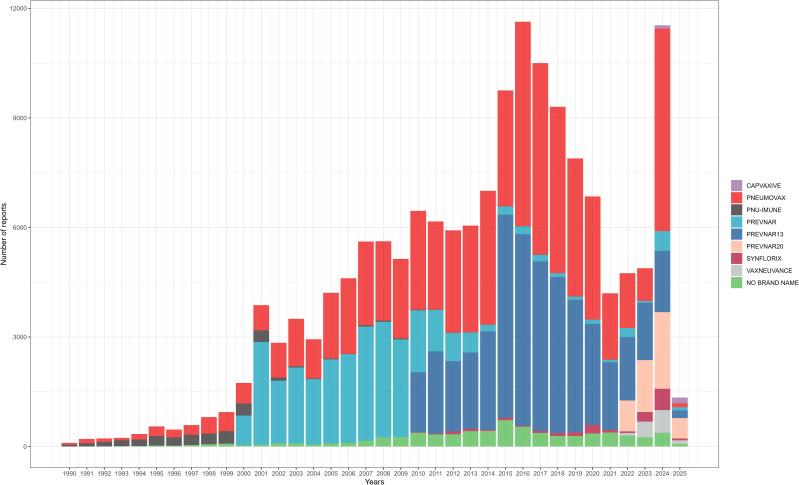
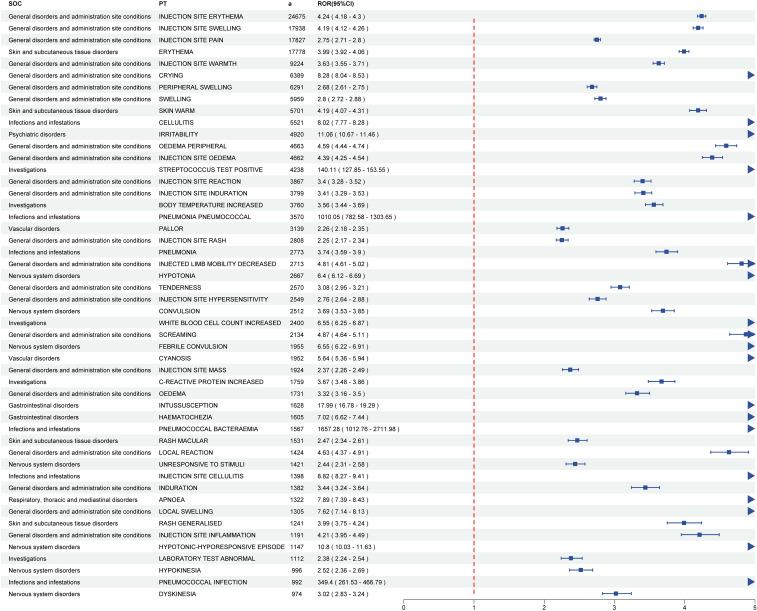
The VAERS database documented 157,244 individuals receiving pneumococcal vaccines, with 158,778 doses administered, capturing 632,481 AE reports following vaccination during the study period. Females showed higher AE reporting rates (54.29%) compared to males (36.88%), with the majority of cases (38.20%) occurring in individuals aged < 18 years. Complete recovery (44.20%) and hospitalization (14.94%) were the most common outcomes. Most AEs (77.11%) occurred within 0-30 days post-vaccination (median onset: 0 day). Pneumococcal polysaccharide vaccine (PPSV, 48.92%) and 13-valent pneumococcal conjugate vaccine (PCV13, 27.57%) constituted the predominant vaccine types. Disproportionality analysis identified 929 positive AE signals across 24 system organ classes (SOCs), with injection site erythema [reporting odds ratio (ROR) = 4.24], injection site swelling (ROR = 4.19), and injection site pain (ROR = 2.75) being the most frequent. Designated Medical Event (DME) screening revealed erythema multiforme (n = 398) and product contamination microbial (ROR = 11.25) as key safety signals. General disorders (ROR = 1.73) and skin conditions (ROR = 1.69) were the predominant SOC categories.
CONCLUSIONS
This post-marketing surveillance has revealed predominantly non-serious AEs, with most adverse events clustered within 30 days post-vaccination. These observations reinforce the established safety profile of pneumococcal vaccines while emphasizing temporal risk patterns to guide post-vaccination monitoring protocols and risk-benefit evaluations.
背景
肺炎球菌疫苗在美国已使用数十年,拥有广泛的临床安全记录。然而,对于所有可用类型的全面上市后药物警戒评估仍然缺乏。本研究旨在使用疫苗不良事件报告系统(VAERS)数据库评估免疫接种后的不良事件(AEFI),并根据VAERS数据分析不良事件(AE)与疫苗接种之间的潜在关联。
方法
我们检索了1990年至2025年3月期间VAERS数据库中记录的所有与肺炎球菌疫苗相关的AE。进行描述性分析以总结报告病例的人口统计学、临床特征和疫苗接种情况。进行不成比例分析以检测AE与疫苗接种之间的潜在安全信号。
结果
VAERS数据库记录了157,244名接受肺炎球菌疫苗的个体,共接种了158,778剂,在研究期间捕获了632,481份接种后AE报告。女性AE报告率(54.29%)高于男性(36.88%),大多数病例(38.20%)发生在<18岁的个体中。完全康复(44.20%)和住院(14.94%)是最常见的结局。大多数AE(77.11%)发生在接种后0至30天内(中位发病时间:0天)。肺炎球菌多糖疫苗(PPSV,48.92%)和13价肺炎球菌结合疫苗(PCV13,27.57%)是主要的疫苗类型。不成比例分析在24个系统器官类别(SOC)中识别出929个阳性AE信号,其中注射部位红斑[报告比值比(ROR)=4.24]、注射部位肿胀(ROR = 4.19)和注射部位疼痛(ROR = 2.75)最为常见。指定医疗事件(DME)筛查显示多形红斑(n = 398)和产品污染微生物(ROR = 11.25)是关键安全信号。一般疾病(ROR = 1.73)和皮肤疾病(ROR = 1.69)是主要的SOC类别。
结论
这项上市后监测主要发现了非严重AE,大多数不良事件集中在接种后30天内。这些观察结果强化了肺炎球菌疫苗既定的安全概况,同时强调了时间风险模式,以指导接种后监测方案和风险效益评估。


 Zotero 插件