
动员患者和公众参与真实世界数字技术解决方案的开发:教程。
Mobilizing Patient and Public Involvement in the Development of Real-World Digital Technology Solutions: Tutorial.
机构信息
Insight Centre Data Analytics, University College Dublin, Dublin4, Ireland.
School of Medicine, Trinity College Dublin, Dublin2, Ireland.
出版信息
J Med Internet Res. 2023 Oct 27;25:e44206. doi: 10.2196/44206.
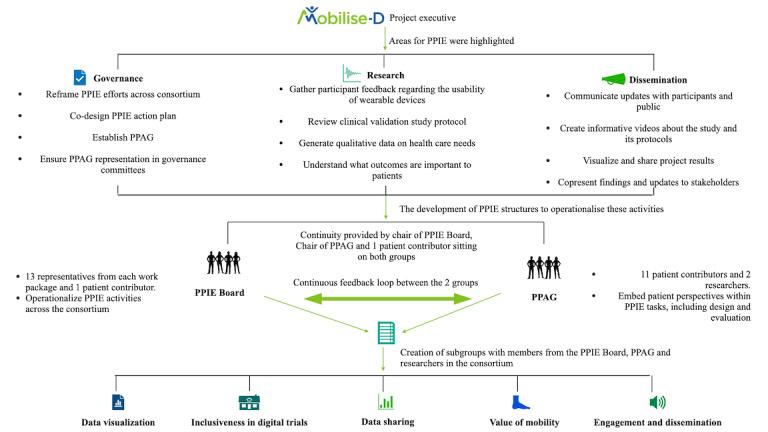
Although the value of patient and public involvement and engagement (PPIE) activities in the development of new interventions and tools is well known, little guidance exists on how to perform these activities in a meaningful way. This is particularly true within large research consortia that target multiple objectives, include multiple patient groups, and work across many countries. Without clear guidance, there is a risk that PPIE may not capture patient opinions and needs correctly, thereby reducing the usefulness and effectiveness of new tools. Mobilise-D is an example of a large research consortium that aims to develop new digital outcome measures for real-world walking in 4 patient cohorts. Mobility is an important indicator of physical health. As such, there is potential clinical value in being able to accurately measure a person's mobility in their daily life environment to help researchers and clinicians better track changes and patterns in a person's daily life and activities. To achieve this, there is a need to create new ways of measuring walking. Recent advancements in digital technology help researchers meet this need. However, before any new measure can be used, researchers, health care professionals, and regulators need to know that the digital method is accurate and both accepted by and produces meaningful outcomes for patients and clinicians. Therefore, this paper outlines how PPIE structures were developed in the Mobilise-D consortium, providing details about the steps taken to implement PPIE, the experiences PPIE contributors had within this process, the lessons learned from the experiences, and recommendations for others who may want to do similar work in the future. The work outlined in this paper provided the Mobilise-D consortium with a foundation from which future PPIE tasks can be created and managed with clearly defined collaboration between researchers and patient representatives across Europe. This paper provides guidance on the work required to set up PPIE structures within a large consortium to promote and support the creation of meaningful and efficient PPIE related to the development of digital mobility outcomes.
尽管患者和公众参与和投入(PPIE)活动在新干预措施和工具的开发中的价值是众所周知的,但关于如何以有意义的方式开展这些活动的指导很少。在针对多个目标、包含多个患者群体并在多个国家开展工作的大型研究联盟中尤其如此。如果没有明确的指导,就有可能无法正确捕捉患者的意见和需求,从而降低新工具的有用性和有效性。Mobilise-D 是一个大型研究联盟的示例,旨在为 4 个患者群体开发新的真实世界行走的数字结局测量工具。移动能力是身体健康的一个重要指标。因此,能够准确测量一个人在日常生活环境中的移动能力,从而帮助研究人员和临床医生更好地跟踪一个人的日常生活和活动中的变化和模式,这具有潜在的临床价值。为了实现这一目标,需要创造新的行走测量方法。数字技术的最新进展帮助研究人员满足了这一需求。然而,在任何新措施可以使用之前,研究人员、医疗保健专业人员和监管机构需要知道数字方法是准确的,并且既被患者和临床医生接受,又能为他们产生有意义的结果。因此,本文概述了 Mobilise-D 联盟中如何制定 PPIE 结构,详细介绍了实施 PPIE 所采取的步骤、PPIE 参与者在这一过程中的体验、从经验中吸取的教训以及对未来可能从事类似工作的人的建议。本文概述的工作为 Mobilise-D 联盟提供了一个基础,在此基础上可以创建和管理未来的 PPIE 任务,并在整个欧洲的研究人员和患者代表之间建立明确界定的合作关系。本文为在大型联盟中建立 PPIE 结构提供了指导,以促进和支持与数字移动结局开发相关的有意义和高效的 PPIE 活动。
 Zotero 插件