
联合治疗策略克服 PARP 抑制剂耐药性。
Combination Treatment Strategies to Overcome PARP Inhibitor Resistance.
机构信息
Department of Pathology, Renaissance School of Medicine, Stony Brook University, Stony Brook, NY 11794, USA.
出版信息
Biomolecules. 2023 Oct 3;13(10):1480. doi: 10.3390/biom13101480.
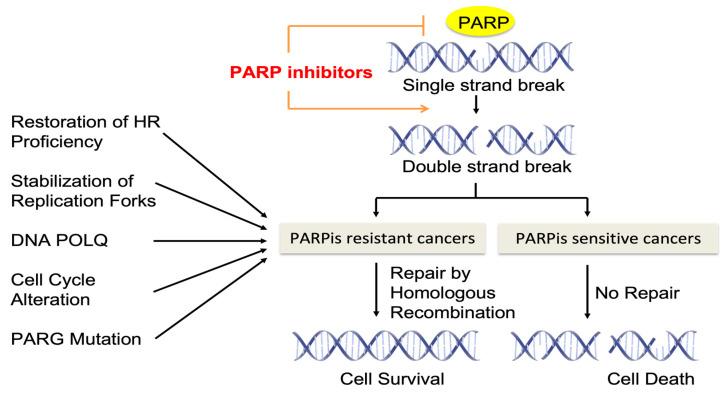
Poly(ADP-ribose) polymerase (PARP) enzymes have been shown to be essential for DNA repair pathways, including homologous recombination repair (HRR). Cancers with HRR defects (e.g., BRCA1 and BRCA2 mutations) are targets for PARP inhibitors (PARPis) based on the exploitation of "synthetic lethality". As a result, PARPis offer a promising treatment option for advanced ovarian and breast cancers with deficiencies in HRR. However, acquired resistance to PARPis has been reported for most tumors, and not all patients with BRCA1/2 mutations respond to PARPis. Therefore, the formulation of effective treatment strategies to overcome resistance to PARPis is urgently necessary. This review summarizes the molecular mechanism of therapeutic action and resistance to PARPis, in addition to emerging combination treatment options involving PARPis.
聚(ADP-核糖)聚合酶(PARP)酶已被证明对于包括同源重组修复(HRR)在内的 DNA 修复途径是必不可少的。具有 HRR 缺陷的癌症(例如,BRCA1 和 BRCA2 突变)是 PARP 抑制剂(PARPi)的靶点,这是基于对“合成致死性”的利用。因此,PARPi 为 HRR 缺陷的晚期卵巢癌和乳腺癌提供了一种有前途的治疗选择。然而,大多数肿瘤都报道了对 PARPi 的获得性耐药,并非所有 BRCA1/2 突变的患者都对 PARPi 有反应。因此,迫切需要制定有效的治疗策略来克服对 PARPi 的耐药性。本综述总结了 PARPi 的治疗作用和耐药性的分子机制,以及涉及 PARPi 的新兴联合治疗选择。
 Zotero 插件