
利用临床病理特征和pERK1/2免疫组化表达建立预测甲状腺乳头状癌V600E及突变状态的模型。
Developing Models to Predict V600E and Mutational Status in Papillary Thyroid Carcinoma Using Clinicopathological Features and pERK1/2 Immunohistochemistry Expression.
作者信息
Harahap Agnes Stephanie, Subekti Imam, Panigoro Sonar Soni, Werdhani Retno Asti, Agustina Hasrayati, Khoirunnisa Dina, Mutmainnah Mutiah, Gultom Fajar Lamhot, Assadyk Abdillah Hasbi, Ham Maria Francisca
机构信息
Department of Anatomical Pathology, Faculty of Medicine, Universitas Indonesia, Dr. Cipto Mangunkusumo Hospital, Jakarta 10430, Indonesia.
Human Cancer Research Center-Indonesian Medical Education and Research Institute, Faculty of Medicine, Universitas Indonesia, Jakarta 10430, Indonesia.
出版信息
Biomedicines. 2023 Oct 16;11(10):2803. doi: 10.3390/biomedicines11102803.
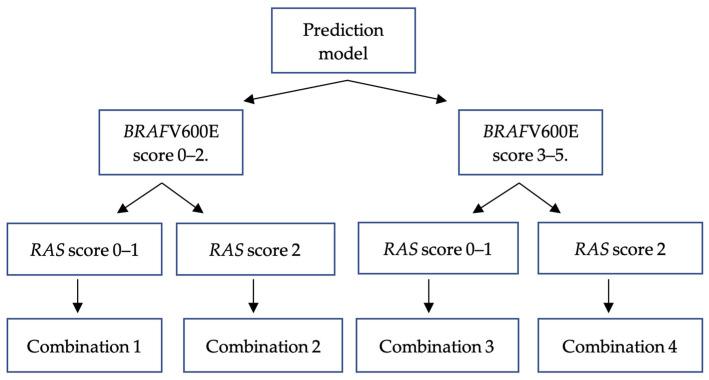
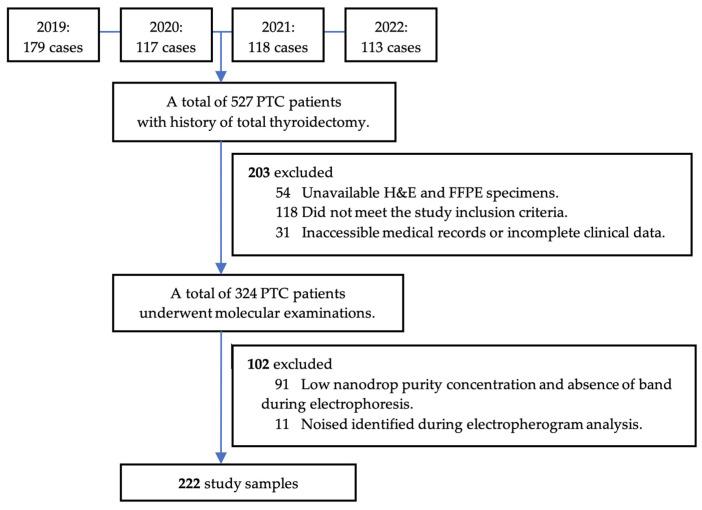
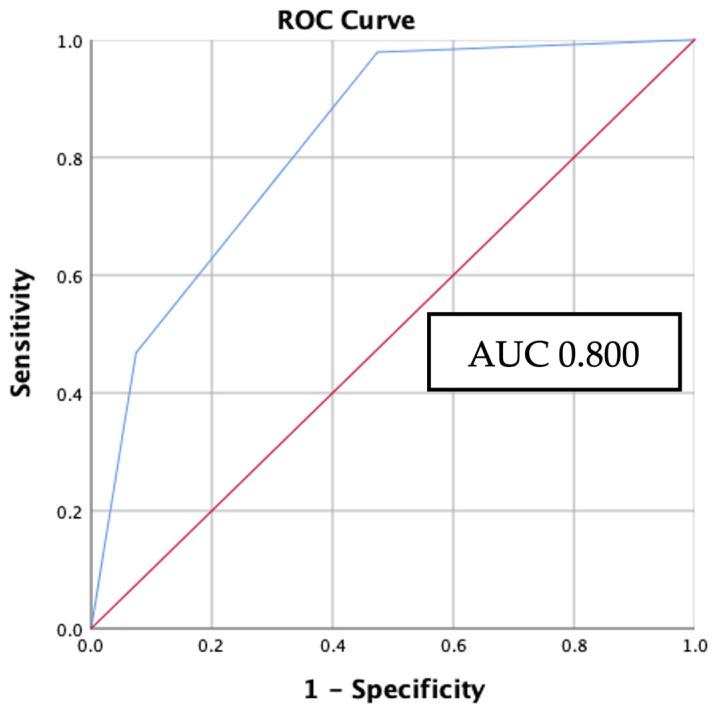
The Cancer Genome Atlas (TCGA) has classified papillary thyroid carcinoma (PTC) into indolent RAS-like and aggressive BRAF-like based on its distinct driver gene mutations. This retrospective study aimed to assess clinicopathology and pERK1/2 expression variations between BRAF-like and RAS-like PTCs and establish predictive models for V600E and -mutated PTCs. A total of 222 PTCs underwent immunohistochemistry staining to assess pERK1/2 expression and Sanger sequencing to analyze the and genes. Multivariate logistic regression was employed to develop prediction models. Independent predictors of the V600E mutation include a nuclear score of 3, the absence of capsules, an aggressive histology subtype, and pERK1/2 levels exceeding 10% (X = 0.128, > 0.05, AUC = 0.734, < 0.001). The mutation predictive model includes follicular histology subtype and pERK1/2 expression > 10% (X = 0.174, > 0.05, AUC = 0.8, < 0.001). We propose using the prediction model concurrently with four potential combination group outcomes. PTC cases included in a combination of the low-V600E-scoring group and high--scoring group are categorized as RAS-like (adjOR = 4.857, = 0.01, 95% CI = 1.470-16.049). PTCs included in a combination of the high-V600E-scoring group and low--scoring group are categorized as BRAF-like PTCs (adjOR = 3.091, = 0.001, 95% CI = 1.594-5.995). The different prediction models indicate variations in biological behavior between BRAF-like and RAS-like PTCs.
癌症基因组图谱(TCGA)根据乳头状甲状腺癌(PTC)不同的驱动基因突变,将其分为惰性RAS样和侵袭性BRAF样。本回顾性研究旨在评估BRAF样和RAS样PTC之间的临床病理学及pERK1/2表达差异,并建立V600E和 -突变PTC的预测模型。共222例PTC进行免疫组织化学染色以评估pERK1/2表达,并采用桑格测序法分析 和 基因。采用多因素逻辑回归建立预测模型。V600E突变的独立预测因素包括核评分3分、无包膜、侵袭性组织学亚型以及pERK1/2水平超过10%(X = 0.128, > 0.05,AUC = 0.734, < 0.001)。 突变预测模型包括滤泡性组织学亚型和pERK1/2表达> 10%(X = 0.174, > 0.05,AUC = 0.8, < 0.001)。我们建议将预测模型与四个潜在组合组结果同时使用。低V600E评分组和高 -评分组组合中的PTC病例归类为RAS样(校正比值比 = 4.857, = 0.01,95%可信区间 = 1.470 - 16.049)。高V600E评分组和低 -评分组组合中的PTC归类为BRAF样PTC(校正比值比 = 3.091, = 0.001,95%可信区间 = 1.594 - 5.995)。不同的预测模型表明BRAF样和RAS样PTC之间生物学行为存在差异。




 Zotero 插件