
TIM-3在TGFβ激活的结直肠癌肿瘤微环境中巨噬细胞的表达及M2极化
TIM-3 Expression and M2 Polarization of Macrophages in the TGFβ-Activated Tumor Microenvironment in Colorectal Cancer.
作者信息
Katagata Masanori, Okayama Hirokazu, Nakajima Shotaro, Saito Katsuharu, Sato Takahiro, Sakuma Mei, Fukai Satoshi, Endo Eisei, Sakamoto Wataru, Saito Motonobu, Saze Zenichiro, Momma Tomoyuki, Mimura Kosaku, Kono Koji
机构信息
Department of Gastrointestinal Tract Surgery, Fukushima Medical University School of Medicine, Fukushima 960-1295, Japan.
Department of Multidisciplinary Treatment of Cancer and Regional Medical Support, Fukushima Medical University School of Medicine, Fukushima 960-1295, Japan.
出版信息
Cancers (Basel). 2023 Oct 11;15(20):4943. doi: 10.3390/cancers15204943.
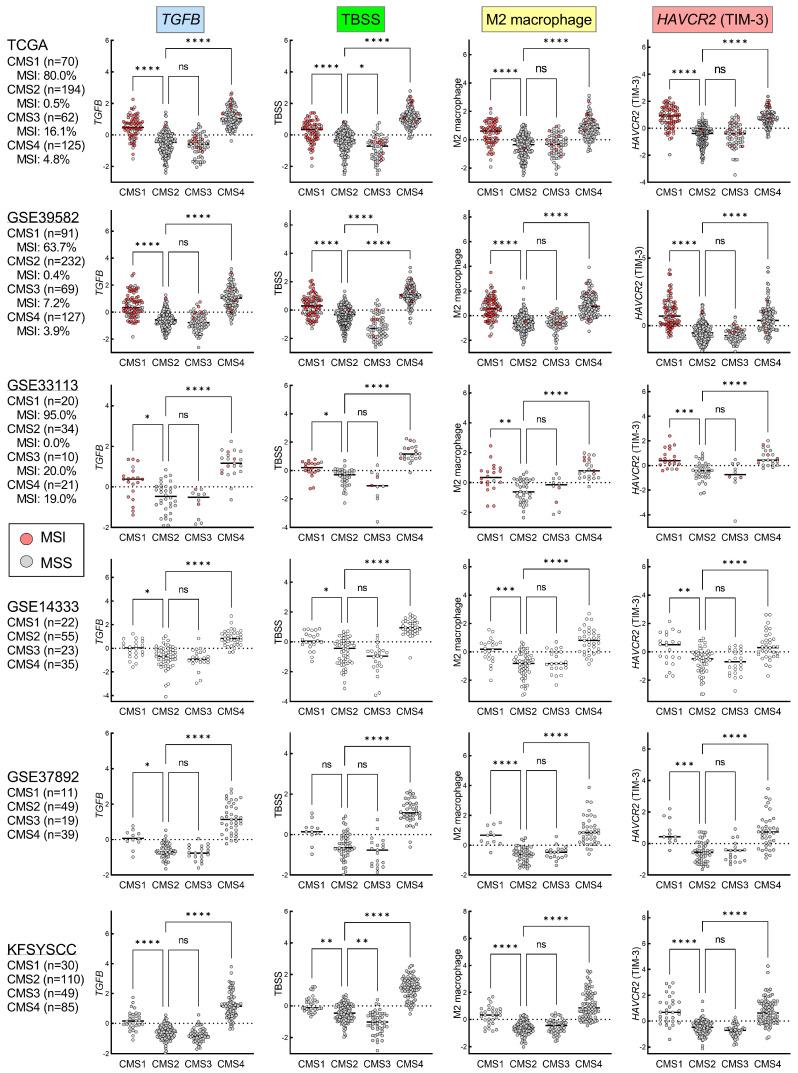
TGFβ signaling in the tumor microenvironment (TME) drives immune evasion and is a negative predictor of immune checkpoint inhibitor (ICI) efficacy in colorectal cancer (CRC). TIM-3, an inhibitory receptor implicated in anti-tumor immune responses and ICI resistance, has emerged as an immunotherapeutic target. This study investigated TIM-3, M2 macrophages and the TGFβ-activated TME, in association with microsatellite instability (MSI) status and consensus molecular subtypes (CMSs). Transcriptomic cohorts of CRC tissues, organoids and xenografts were examined ( = 2240). TIM-3 and a TGFβ-inducible stromal protein, VCAN, were evaluated in CRC specimens using immunohistochemistry ( = 45). TIM-3 expression on monocytes and generated M2 macrophages was examined by flow cytometry. We found that the expression of (TIM-3) significantly correlated with the transcriptional signatures of TGFβ, TGFβ-dependent stromal activation and M2 macrophage, each of which were co-upregulated in CMS4, CMS1 and MSI CRCs across all datasets. Tumor-infiltrating TIM-3 immune cells accumulated in TGFβ-responsive cancer stroma. TIM-3 was increased on M2-polarized macrophages, and on monocytes in response to TGFβ treatment. In conclusion, we identified a close association between TIM-3 and M2-like polarization of macrophages in the TGFβ-rich TME. Our findings provide new insights into personalized immunotherapeutic strategies based on the TME for CRCs.
肿瘤微环境(TME)中的转化生长因子β(TGFβ)信号传导驱动免疫逃逸,是结直肠癌(CRC)中免疫检查点抑制剂(ICI)疗效的负性预测指标。T细胞免疫球蛋白和粘蛋白结构域分子3(TIM-3)是一种与抗肿瘤免疫反应和ICI耐药相关的抑制性受体,已成为一种免疫治疗靶点。本研究调查了TIM-3、M2巨噬细胞和TGFβ激活的TME,以及微卫星不稳定性(MSI)状态和共识分子亚型(CMS)。对CRC组织、类器官和异种移植的转录组队列进行了检查(n = 2240)。使用免疫组织化学方法在CRC标本中评估了TIM-3和一种TGFβ诱导的基质蛋白VCAN(n = 45)。通过流式细胞术检测单核细胞和诱导产生的M2巨噬细胞上的TIM-3表达。我们发现TIM-3的表达与TGFβ、TGFβ依赖性基质激活和M2巨噬细胞的转录特征显著相关,在所有数据集中,这些特征在CMS4、CMS1和MSI CRC中均共同上调。肿瘤浸润的TIM-3免疫细胞在TGFβ反应性癌基质中积累。在M2极化的巨噬细胞上以及经TGFβ处理后的单核细胞上,TIM-3表达增加。总之,我们发现了在富含TGFβ的TME中,TIM-3与巨噬细胞的M2样极化之间存在密切关联。我们的研究结果为基于TME的CRC个性化免疫治疗策略提供了新的见解。




 Zotero 插件