
原发性硬化性胆管炎相关胆管癌:从发病机制到诊断与监测策略
Primary Sclerosing Cholangitis-Associated Cholangiocarcinoma: From Pathogenesis to Diagnostic and Surveillance Strategies.
作者信息
Catanzaro Elisa, Gringeri Enrico, Burra Patrizia, Gambato Martina
机构信息
Gastroenterology, Department of Surgery, Oncology, and Gastroenterology, Padova University Hospital, 35128 Padova, Italy.
Multivisceral Transplant Unit, Department of Surgery, Oncology, and Gastroenterology, Padova University Hospital, 35128 Padova, Italy.
出版信息
Cancers (Basel). 2023 Oct 11;15(20):4947. doi: 10.3390/cancers15204947.
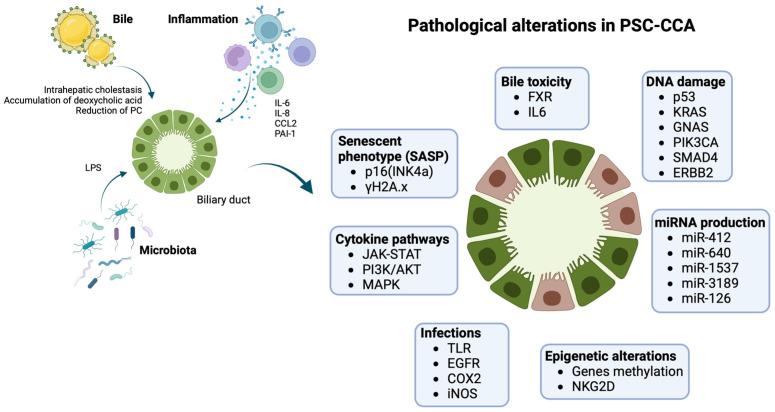
Cholangiocarcinoma (CCA) is the most common malignancy in patients with primary sclerosing cholangitis (PSC), accounting for 2-8% of cases and being the leading cause of death in these patients. The majority of PSC-associated CCAs (PSC-CCA) develop within the first few years after PSC diagnosis. Older age and male sex, as well as concomitant inflammatory bowel disease (IBD) or high-grade biliary stenosis, are some of the most relevant risk factors. A complex combination of molecular mechanisms involving inflammatory pathways, direct cytopathic damage, and epigenetic and genetic alterations are involved in cholangiocytes carcinogenesis. The insidious clinical presentation makes early detection difficult, and the integration of biochemical, radiological, and histological features does not always lead to a definitive diagnosis of PSC-CCA. Surveillance is mandatory, but current guideline strategies failed to improve early detection and consequently a higher patient survival rate. MicroRNAs (miRNAs), gene methylation, proteomic and metabolomic profile, and extracellular vesicle components are some of the novel biomarkers recently applied in PSC-CCA detection with promising results. The integration of these new molecular approaches in PSC diagnosis and monitoring could contribute to new diagnostic and surveillance strategies.
胆管癌(CCA)是原发性硬化性胆管炎(PSC)患者中最常见的恶性肿瘤,占病例的2%-8%,并且是这些患者的主要死亡原因。大多数PSC相关的CCA(PSC-CCA)在PSC诊断后的头几年内发生。年龄较大、男性以及合并炎症性肠病(IBD)或严重胆管狭窄是一些最相关的危险因素。涉及炎症途径、直接细胞病变损伤以及表观遗传和基因改变的复杂分子机制组合参与胆管细胞的致癌过程。隐匿的临床表现使得早期检测困难,并且生化、放射学和组织学特征的综合并不总是能明确诊断PSC-CCA。监测是必要的,但当前的指南策略未能改善早期检测,因此未能提高患者生存率。微小RNA(miRNA)、基因甲基化、蛋白质组学和代谢组学特征以及细胞外囊泡成分是最近应用于PSC-CCA检测且取得了有前景结果的一些新型生物标志物。将这些新的分子方法整合到PSC的诊断和监测中可能有助于制定新的诊断和监测策略。
 Zotero 插件