
利用系统代谢工程进行生物技术塑料的降解和增值。
Biotechnological Plastic Degradation and Valorization Using Systems Metabolic Engineering.
机构信息
Clean Energy Research Center, Korea Institute of Science and Technology, Seoul 02792, Republic of Korea.
Department of Biotechnology, Korea University, Seoul 02841, Republic of Korea.
出版信息
Int J Mol Sci. 2023 Oct 14;24(20):15181. doi: 10.3390/ijms242015181.
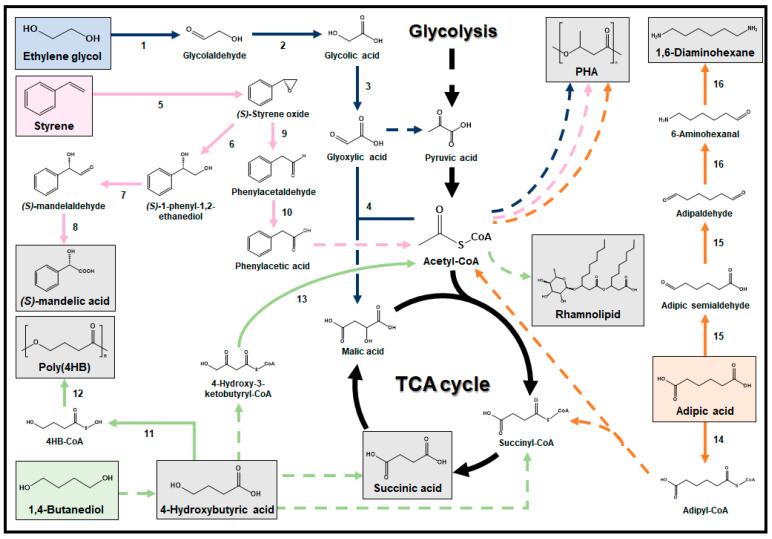
Various kinds of plastics have been developed over the past century, vastly improving the quality of life. However, the indiscriminate production and irresponsible management of plastics have led to the accumulation of plastic waste, emerging as a pressing environmental concern. To establish a clean and sustainable plastic economy, plastic recycling becomes imperative to mitigate resource depletion and replace non-eco-friendly processes, such as incineration. Although chemical and mechanical recycling technologies exist, the prevalence of composite plastics in product manufacturing complicates recycling efforts. In recent years, the biodegradation of plastics using enzymes and microorganisms has been reported, opening a new possibility for biotechnological plastic degradation and bio-upcycling. This review provides an overview of microbial strains capable of degrading various plastics, highlighting key enzymes and their role. In addition, recent advances in plastic waste valorization technology based on systems metabolic engineering are explored in detail. Finally, future perspectives on systems metabolic engineering strategies to develop a circular plastic bioeconomy are discussed.
在过去的一个世纪中,人们开发出了各种塑料,极大地提高了生活质量。然而,塑料的无节制生产和不负责任的管理导致了塑料废物的积累,成为一个紧迫的环境问题。为了建立一个清洁和可持续的塑料经济,塑料回收对于缓解资源枯竭和取代非环保工艺(如焚烧)至关重要。尽管存在化学和机械回收技术,但产品制造中复合材料塑料的普遍存在使得回收工作变得复杂。近年来,已有使用酶和微生物来生物降解塑料的报道,为生物技术塑料降解和生物升级提供了新的可能性。本文综述了能够降解各种塑料的微生物菌株,重点介绍了关键酶及其作用。此外,还详细探讨了基于系统代谢工程的塑料废物增值利用技术的最新进展。最后,讨论了系统代谢工程策略在开发循环塑料生物经济方面的未来前景。


 Zotero 插件