
将塑料降解真菌的代谢活性与其分类学和进化联系起来。
Linking the Metabolic Activity of Plastic-Degrading Fungi to Their Taxonomy and Evolution.
作者信息
Ekanayaka Anusha H, De Silva Namali T, Tarafder Entaj, Chen Xue-Mei, Dai Dong-Qin, Stephenson Steven L, Asad Suhail, Tibpromma Saowaluck, Karunarathana Samantha C
机构信息
Center for Yunnan Plateau Biological Resources Protection and Utilization, College of Biology and Food Engineering, Qujing Normal University, Qujing 655011, China.
Department of Urban Bioresources, Faculty of Urban and Aquatic Bioresources, University of Sri Jayewardenepura, Gangodawila, Nugegoda, Colombo 10250, Sri Lanka.
出版信息
J Fungi (Basel). 2025 May 15;11(5):378. doi: 10.3390/jof11050378.
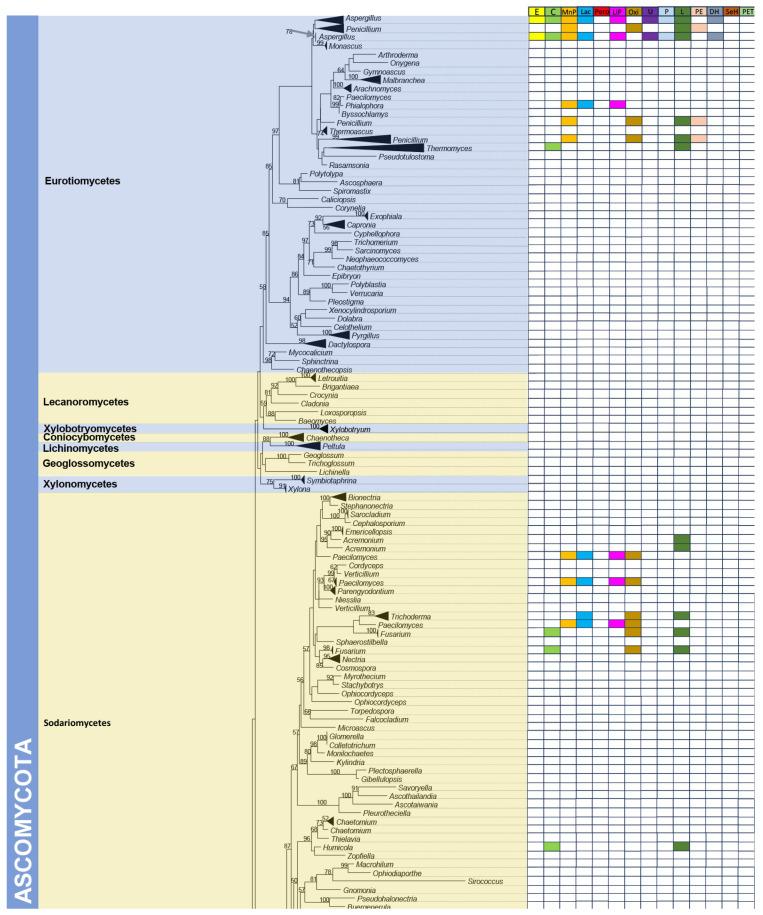
Plastic, a ubiquitous part of our daily lives, has become a global necessity, with annual production exceeding 300 million tons. However, the accumulation of synthetic polymers in our environment poses a pressing global challenge. To address this urgent issue, fungi have emerged as potential agents for plastic degradation. In our previous manuscript, 'A Review of the Fungi That Degrade Plastic', we explored the taxonomic placement of plastic-degrading fungi across three main phyla: Ascomycota, Basidiomycota, and Mucoromycota. In this review, we built upon that foundation and aimed to further explore the taxonomic relationships of these fungi in a comprehensive and detailed manner, leaving no stone unturned. Moreover, we linked metabolic activity and enzyme production of plastic-degrading fungi to their taxonomy and summarized a phylogenetic tree and a detailed table on enzyme production of plastic-degrading fungi presented here. Microbial enzymes are key players in polymer degradation, operating intra-cellularly and extra-cellularly. Fungi, one of the well-studied groups of microbes with respect to plastic degradation, are at the forefront of addressing the global issue of plastic accumulation. Their unique ability to hydrolyze synthetic plastic polymers and produce a wide range of specific enzymes is a testament to their potential. In this review, we gather and synthesize information concerning the metabolic pathways of fungi involved in the degradation of plastics. The manuscript explores the diverse range of specific enzymes that fungi can produce for plastic degradation and the major pathways of plastic metabolism. We provide a listing of 14 fungal enzymes (Esterase, Cutinase, Laccase, Peroxidases, Manganese peroxidase, Lignin peroxidase, Oxidoreductases, Urease, Protease, Lipase, Polyesterase, Dehydrogenase, Serine hydrolase, and PETase) involved in pathways for plastic degradation alongside the relevant fungi known to produce these enzymes. Furthermore, we integrate the fungi's enzyme-producing capabilities with their taxonomy and phylogeny. Taxonomic and phylogenetic investigations have pinpointed three primary fungal classes (Eurotiomycetes, Sordariomycetes (Ascomycota), and Agaricomycetes (Basidiomycota)) as significant plastic degraders that produce the vital enzymes mentioned earlier. This paper provides a foundational resource for recognizing fungal involvement in the biodegradation of synthetic polymers. It will ultimately advance fungal biotechnology efforts to address the global issue of plastic accumulation in natural environments.
塑料作为我们日常生活中无处不在的一部分,已成为全球必需品,其年产量超过3亿吨。然而,合成聚合物在我们环境中的积累构成了紧迫的全球挑战。为解决这一紧迫问题,真菌已成为塑料降解的潜在媒介。在我们之前的论文《降解塑料的真菌综述》中,我们探讨了降解塑料真菌在三个主要门:子囊菌门、担子菌门和毛霉门中的分类地位。在本综述中,我们在此基础上进一步全面、详细地探索这些真菌的分类关系,力求详尽无遗。此外,我们将降解塑料真菌的代谢活性和酶产生与其分类学联系起来,并总结了此处呈现的降解塑料真菌的系统发育树和酶产生的详细表格。微生物酶是聚合物降解的关键参与者,在细胞内和细胞外发挥作用。真菌是在塑料降解方面研究较为深入的微生物群体之一,处于应对全球塑料积累问题的前沿。它们水解合成塑料聚合物并产生多种特定酶的独特能力证明了其潜力。在本综述中,我们收集并综合了有关参与塑料降解的真菌代谢途径的信息。该论文探讨了真菌可产生用于塑料降解的多种特定酶以及塑料代谢的主要途径。我们列出了参与塑料降解途径的14种真菌酶(酯酶、角质酶、漆酶、过氧化物酶、锰过氧化物酶、木质素过氧化物酶、氧化还原酶、脲酶、蛋白酶、脂肪酶、聚酯酶、脱氢酶、丝氨酸水解酶和PET酶)以及已知产生这些酶的相关真菌。此外,我们将真菌的酶产生能力与其分类学和系统发育相结合。分类学和系统发育研究已确定三个主要真菌类群(散囊菌纲、粪壳菌纲(子囊菌门)和伞菌纲(担子菌门))是产生上述重要酶的主要塑料降解者。本文为认识真菌参与合成聚合物生物降解提供了基础资源。它最终将推动真菌生物技术努力应对自然环境中全球塑料积累问题。
 Zotero 插件