
来自[具体来源未提及]的暗罗酸具有防龋和抗寄生虫特性,可安全使用。
Polyalthic Acid from Demonstrates Anticariogenic and Antiparasitic Properties for Safe Use.
作者信息
Santiago Mariana B, Dos Santos Vinicius Cristian O, Teixeira Samuel C, Silva Nagela B S, de Oliveira Pollyanna F, Ozelin Saulo D, Furtado Ricardo A, Tavares Denise C, Ambrósio Sergio Ricardo, Veneziani Rodrigo Cassio S, Ferro Eloisa Amália V, Bastos Jairo K, Martins Carlos Henrique G
机构信息
Laboratory of Antimicrobial Testing, Institute of Biomedical Sciences, Federal University of Uberlândia, Uberlândia 38405318, MG, Brazil.
Laboratory of Immunophysiology of Reproduction, Institute of Biomedical Science, Federal University of Uberlândia, Uberlândia 38405318, MG, Brazil.
出版信息
Pharmaceuticals (Basel). 2023 Sep 26;16(10):1357. doi: 10.3390/ph16101357.
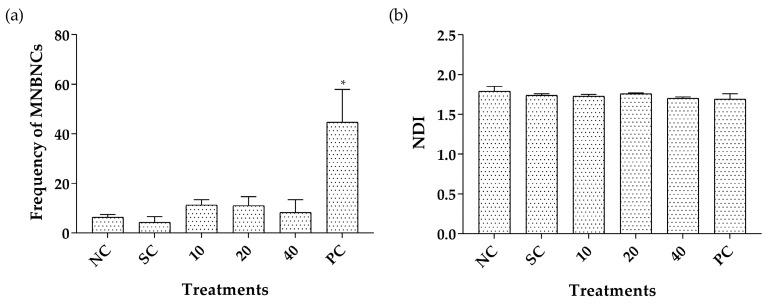
This study aimed at evaluating the potential of , specifically its oleoresin (CLO), extract (CECL), and the compound -polyalthic acid (PA), in combating caries and toxoplasmosis, while also assessing its toxicity. The study involved multiple assessments, including determining the minimum inhibitory concentration (MIC) and minimum bactericidal concentration (MBC) against cariogenic bacteria. CLO and PA exhibited MIC and MBC values ranging from 25 to 50 μg/mL, whereas CECL showed values equal to or exceeding 400 μg/mL. PA also displayed antibiofilm activity with minimum inhibitory concentration of biofilm (MICB) values spanning from 62.5 to 1000 μg/mL. Moreover, PA effectively hindered the intracellular proliferation of at 64 μg/mL, even after 24 h without treatment. Toxicological evaluations included in vitro tests on V79 cells, where concentrations ranged from 78.1 to 1250 μg/mL of PA reduced colony formation. Additionally, using the model, the lethal concentration (LC) of PA was determined as 1000 μg/mL after 48 h of incubation. Notably, no significant differences in micronucleus induction and the NDI were observed in cultures treated with 10, 20, or 40 μg/mL of CLO. These findings underscore the safety profile of CLO and PA, highlighting their potential as alternative treatments for caries and toxoplasmosis.
本研究旨在评估[具体物质名称未给出],特别是其油树脂(CLO)、提取物(CECL)和化合物聚阿尔泰酸(PA)在对抗龋齿和弓形虫病方面的潜力,同时评估其毒性。该研究涉及多项评估,包括测定对致龋菌的最低抑菌浓度(MIC)和最低杀菌浓度(MBC)。CLO和PA的MIC和MBC值范围为25至50μg/mL,而CECL的值等于或超过400μg/mL。PA还表现出抗生物膜活性,生物膜最低抑菌浓度(MICB)值范围为62.5至1000μg/mL。此外,即使在未经处理24小时后,PA在64μg/mL时也能有效阻碍[未明确的病原体名称]的细胞内增殖。毒理学评估包括对V79细胞的体外测试,其中浓度范围为78.1至1250μg/mL的PA会减少集落形成。此外,使用[未明确的模型名称]模型,在孵育48小时后,PA的致死浓度(LC)被确定为1000μg/mL。值得注意的是,在用10、20或40μg/mL的CLO处理的培养物中,未观察到微核诱导和核分裂指数(NDI)的显著差异。这些发现强调了CLO和PA的安全性,突出了它们作为龋齿和弓形虫病替代治疗方法的潜力。


 Zotero 插件