
乌拉圭戊型肝炎病毒 (HEV) 的流行病学最新情况:亚型、环境监测和人畜共患病传播。
Epidemiology Update of Hepatitis E Virus (HEV) in Uruguay: Subtyping, Environmental Surveillance and Zoonotic Transmission.
机构信息
Departamento de Bacteriología y Virología, Instituto de Higiene, Facultad de Medicina, Universidad de la República, Montevideo 11600, Uruguay.
Sección Virología, Instituto de Química Biológica, Facultad de Ciencias, Universidad de la República, Montevideo 11600, Uruguay.
出版信息
Viruses. 2023 Sep 27;15(10):2006. doi: 10.3390/v15102006.
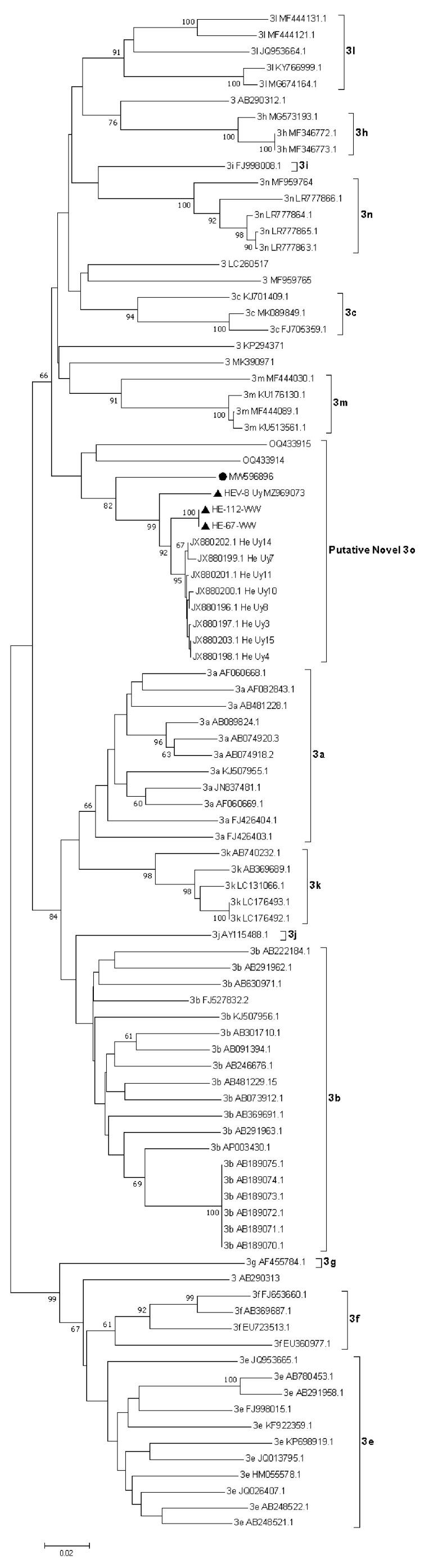
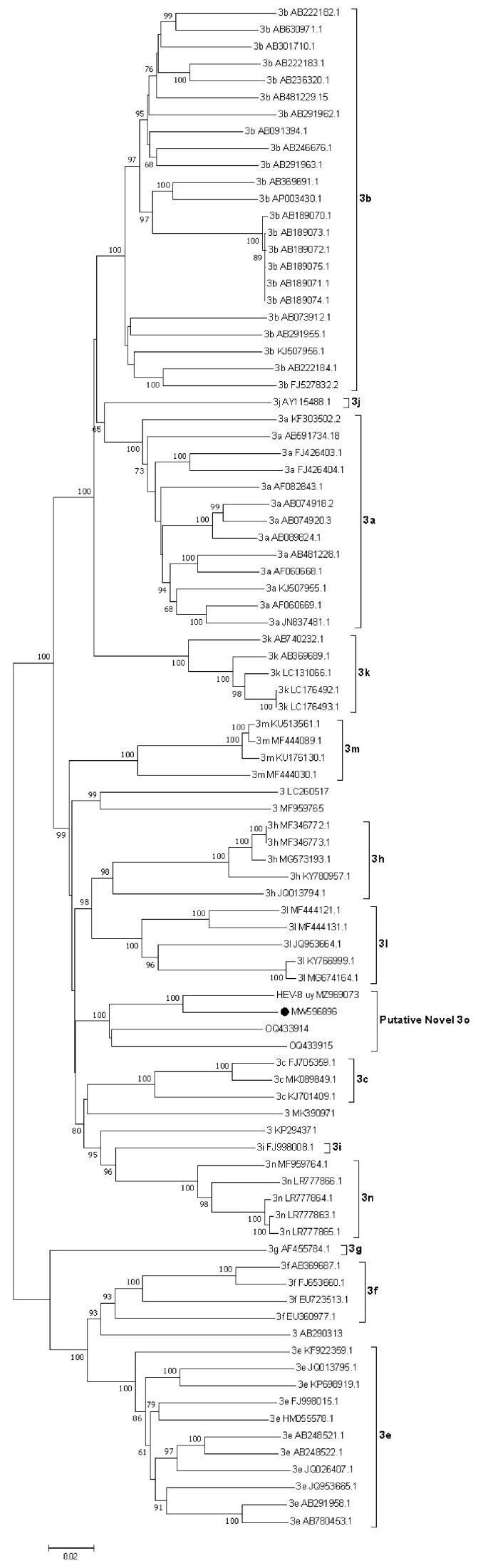
Hepatitis E Virus (HEV) infection is an emergent zoonotic disease of increasing concern in developed regions. HEV genotype 3 (HEV-3) is mainly transmitted through consumption of contaminated food in high-income countries and is classified into at least 13 subtypes (3a-3n), based on -distance values from complete genomes. In Latin America, HEV epidemiology studies are very scant. Our group has previously detected HEV3 in clinical cases, swine, wild boars, captive white-collared peccaries, and spotted deer from Uruguay. Herein, we aimed to provide novel insights and an updated overview of the molecular epidemiology of zoonotic HEV in Uruguay, including data from wastewater-based surveillance studies. A thorough analysis of HEV whole genomes and partial ORF2 sequences from Uruguayan human and domestic pig strains showed that they formed a separate monophyletic cluster with high nucleotide identity and exhibited p-distance values over the established cut-off (0.093) compared with reference subtypes' sequences. Furthermore, we found an overall prevalence of 10.87% (10/92) in wastewater, where two samples revealed a close relationship with humans, and animal reservoirs/hosts isolates from Uruguay. In conclusion, a single, new HEV-3 subtype currently circulates in different epidemiological settings in Uruguay, and we propose its designation as 3o along with its reference sequence.
戊型肝炎病毒(HEV)感染是一种在发达国家日益受到关注的新兴人畜共患病。HEV 基因型 3(HEV-3)主要通过在高收入国家食用受污染的食物传播,根据完整基因组的 -距离值,至少可分为 13 个亚型(3a-3n)。在拉丁美洲,HEV 流行病学研究非常匮乏。我们的研究小组之前在乌拉圭的临床病例、猪、野猪、圈养白颈野猪和梅花鹿中检测到 HEV3。在此,我们旨在提供关于乌拉圭人畜共患 HEV 的分子流行病学的新见解和最新概述,包括基于废水的监测研究数据。对来自乌拉圭人类和家猪株的 HEV 全基因组和部分 ORF2 序列进行的彻底分析表明,它们与参考亚型序列相比,形成了一个单独的单系聚类,具有高核苷酸同一性和 p-距离值超过既定的截止值(0.093)。此外,我们在废水中发现了 10.87%(10/92)的总体阳性率,其中两个样本与人类密切相关,与乌拉圭的动物储存宿主分离株也密切相关。总之,目前在乌拉圭的不同流行病学环境中仅循环着一种新的 HEV-3 亚型,我们建议将其命名为 3o,并提供其参考序列。

 Zotero 插件