
母亲孕前 BMI 与成年儿子生殖健康:丹麦全国出生队列研究。
Maternal pre-pregnancy BMI and reproductive health in adult sons: a study in the Danish National Birth Cohort.
机构信息
Department of Public Health, Research Unit for Epidemiology, Aarhus University, Aarhus, Denmark.
Department of Occupational and Environmental Medicine, Copenhagen University Hospital-Bispebjerg and Frederiksberg, Copenhagen, Denmark.
出版信息
Hum Reprod. 2024 Jan 5;39(1):219-231. doi: 10.1093/humrep/dead230.
STUDY QUESTION
Is maternal pre-pregnancy BMI associated with semen quality, testes volume, and reproductive hormone levels in sons?
SUMMARY ANSWER
Maternal pre-pregnancy BMI was associated with an altered reproductive hormone profile in young adult sons, characterized by higher levels of oestradiol, LH, and free androgen index (FAI) and lower levels of sex hormone-binding globulin (SHBG) in sons born of mothers with pre-pregnancy overweight and obesity.
WHAT IS KNOWN ALREADY
Evidence suggests that maternal pre-pregnancy BMI may influence reproductive health later in life. Only one pilot study has investigated the association between maternal pre-pregnancy BMI and reproductive health outcomes in sons, suggesting that a high BMI was associated with impaired reproductive function in the adult sons.
STUDY DESIGN, SIZE, DURATION: A population-based follow-up study of 1058 young men from the Fetal Programming of Semen Quality (FEPOS) cohort nested within the Danish National Birth Cohort (DNBC), 1998-2019, was carried out.
PARTICIPANTS/MATERIALS, SETTING, METHODS: In total, 1058 adult sons (median age 19 years, 2 months), born 1998-2000 by mothers included in the DNBC, participated in FEPOS. At a clinical examination, they provided a semen and blood sample, measured their testes volume, and had height and weight measured. Maternal pre-pregnancy BMI was obtained by self-report in early pregnancy. Semen characteristics, testes volume, and reproductive hormone levels were analysed according to maternal pre-pregnancy BMI categories and as restricted cubic splines using negative binomial and ordinary least square regression models. Mediation analyses examined potential mediation by the sons' birthweight, pubertal timing, fat mass, and BMI. Additional analyses investigated the role of paternal BMI in the potential associations between maternal BMI and reproductive health outcomes.
MAIN RESULTS AND THE ROLE OF CHANCE
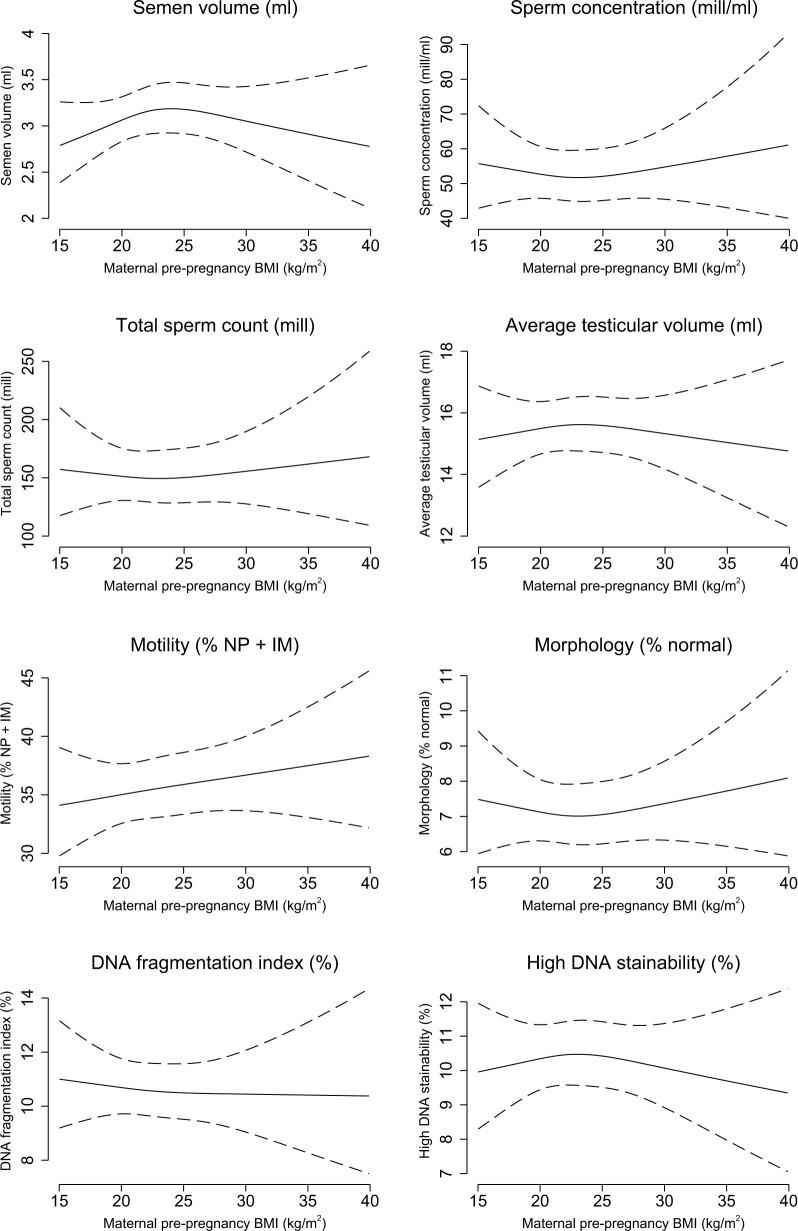
We found no consistent associations between maternal pre-pregnancy BMI and semen characteristics or testes volume. Sons of mothers with higher pre-pregnancy BMI had higher oestradiol and lower SHBG levels, both in a dose-dependent manner. Sons of mothers with pre-pregnancy obesity (≥30 kg/m2) had higher LH levels and a higher FAI than sons born by mothers with normal pre-pregnancy BMI (18.5-24.9 kg/m2). The mediation analyses suggested that the effect of maternal pre-pregnancy BMI on higher levels of oestrogen, LH, and FAI was partly mediated by the sons' birthweight, in addition to adult fat mass and BMI measured at the clinical examination, whereas most of the effect on lower levels of SHBG was primarily mediated by the sons' own fat mass and BMI. Paternal BMI was not a strong confounder of the associations in this study.
LIMITATIONS, REASONS FOR CAUTION: This study was based in a population-based cohort with a low prevalence of overweight and obesity in both mothers and adult sons. Some men (10%) had blood for reproductive hormone assessment drawn in the evening. While several potential confounding factors were accounted for, this study's inherent risk of residual and unmeasured confounding precludes provision of causal estimates. Therefore, caution should be given when interpreting the causal effect of maternal BMI on sons' reproductive health.
WIDER IMPLICATIONS OF THE FINDINGS
Given the widespread occurrence of overweight and obesity among pregnant women, it is imperative to thoroughly examine the potential consequences for reproductive hormone levels in adult sons. The potential effects of maternal pre-pregnancy obesity on sons' reproductive hormone profile may potentially be partly avoided by the prevention of overweight and obesity in the sons.
STUDY FUNDING/COMPETING INTEREST(S): The project was funded by the Lundbeck Foundation (R170-2014-855), the Capital Region of Denmark, Medical doctor Sofus Carl Emil Friis and spouse Olga Doris Friis's Grant, Axel Muusfeldt's Foundation (2016-491), AP Møller Foundation (16-37), the Health Foundation, Dagmar Marshall's Fond, Aarhus University, Independent Research Fund Denmark (9039-00128B), and the European Union (ERC, BIOSFER, 101071773). Views and opinions expressed are, however, those of the authors only and do not necessarily reflect those of the European Union or the European Research Council. Neither the European Union nor the granting authority can be held responsible. The authors declare that they have no conflict of interest.
TRIAL REGISTRATION NUMBER
N/A.
研究问题
母亲孕前 BMI 是否与儿子的精液质量、睾丸体积和生殖激素水平有关?
总结答案
母亲孕前 BMI 与年轻成年儿子的生殖激素谱发生改变有关,表现在超重和肥胖母亲所生儿子的雌二醇、LH 和游离雄激素指数(FAI)水平升高,而性激素结合球蛋白(SHBG)水平降低。
已知情况
有证据表明,母亲孕前 BMI 可能会影响儿子以后的生殖健康。仅有一项试点研究调查了母亲孕前 BMI 与儿子生殖健康结果之间的关系,表明高 BMI 与成年儿子的生殖功能受损有关。
研究设计、规模、持续时间:在丹麦全国出生队列(DNBC)中嵌套的精液质量的胎儿编程(FEPOS)队列中,对 1998 年至 2019 年期间出生的 1058 名年轻男性进行了一项基于人群的随访研究。
参与者/材料、设置、方法:共有 1058 名成年儿子(中位年龄 19 岁,2 个月)参加了 FEPOS,他们的母亲参加了 DNBC,于 1998 年至 2000 年期间出生。在临床检查中,他们提供了精液和血液样本,测量了睾丸体积,并测量了身高和体重。母亲的孕前 BMI 通过孕早期的自我报告获得。根据母亲孕前 BMI 类别和负二项式和普通最小二乘回归模型的限制立方样条,分析精液特征、睾丸体积和生殖激素水平。中介分析检验了儿子的出生体重、青春期时间、体脂肪量和 BMI 对潜在中介的影响。另外的分析调查了父亲 BMI 在母亲 BMI 与生殖健康结果之间的潜在关联中的作用。
主要结果及其机遇作用
我们没有发现母亲孕前 BMI 与精液特征或睾丸体积之间存在一致的关联。母亲 BMI 较高的儿子雌二醇水平较高,SHBG 水平较低,且呈剂量依赖性。与正常孕前 BMI(18.5-24.9kg/m2)的儿子相比,母亲肥胖(≥30kg/m2)的儿子 LH 水平较高,FAI 较高。中介分析表明,母亲孕前 BMI 对雌激素、LH 和 FAI 水平升高的影响部分通过儿子的出生体重介导,此外还通过临床检查时成年体脂肪量和 BMI 介导,而对 SHBG 水平降低的影响主要通过儿子自身的体脂肪量和 BMI 介导。父亲 BMI 不是本研究中关联的一个强有力的混杂因素。
局限性、谨慎的原因:本研究基于人群的队列,母亲和成年儿子的超重和肥胖患病率均较低。一些男性(10%)的生殖激素检测血样是在晚上采集的。尽管考虑了几个潜在的混杂因素,但由于本研究中存在不可避免的残余和未测量的混杂因素,因此无法提供因果估计。因此,在解释母亲 BMI 对儿子生殖健康的因果效应时应谨慎。
更广泛的影响
鉴于孕妇超重和肥胖的普遍发生,彻底检查其对成年儿子生殖激素水平的潜在影响至关重要。通过预防儿子超重和肥胖,可能部分避免母亲孕前肥胖对儿子生殖激素谱的潜在影响。
研究基金/利益冲突:该项目由隆德基金会(R170-2014-855)、丹麦首都大区、丹麦医学博士 Sofus Carl Emil Friis 及其配偶 Olga Doris Friis 赠款、Axel Muusfeldt 基金会(2016-491)、AP 莫勒基金会(16-37)、健康基金会、Dagmar Marshall 基金会、奥胡斯大学、独立研究基金会丹麦(9039-00128B)和欧盟(ERC、BIOSFER、101071773)资助。但是,观点和意见仅代表作者本人,不一定反映欧盟或欧洲研究理事会的观点。欧盟或拨款机构对此不承担任何责任。作者声明他们没有利益冲突。
试验注册编号
无。


 Zotero 插件