
具有抗乳腺癌潜在增殖活性的新型2-取代喹喔啉类似物:对细胞周期阻滞、拓扑异构酶II和表皮生长因子受体活性的深入研究
Novel 2-substituted-quinoxaline analogs with potential antiproliferative activity against breast cancer: insights into cell cycle arrest, topoisomerase II, and EGFR activity.
作者信息
Salem Manar G, Abu El-Ata Sara A, Elsayed Elsherbiny H, Mali Suraj N, Alshwyeh Hussah Abdullah, Almaimani Ghassan, Almaimani Riyad A, Almasmoum Hussain A, Altwaijry Najla, Al-Olayan Ebtesam, Saied Essa M, Youssef Mohamed F
机构信息
Department of Pharmaceutical Organic Chemistry, Faculty of Pharmacy, Suez Canal University Ismailia 41522 Egypt.
Department of Chemistry, Faculty of Science, Port Said University Port Said Egypt.
出版信息
RSC Adv. 2023 Nov 9;13(47):33080-33095. doi: 10.1039/d3ra06189b. eCollection 2023 Nov 7.
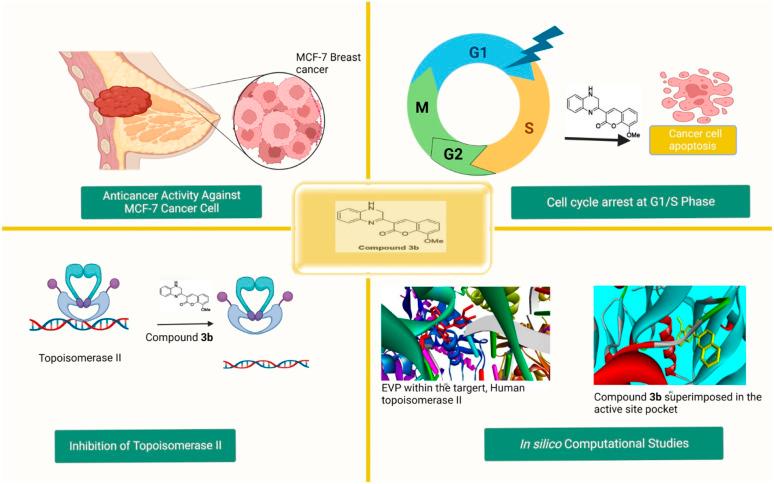
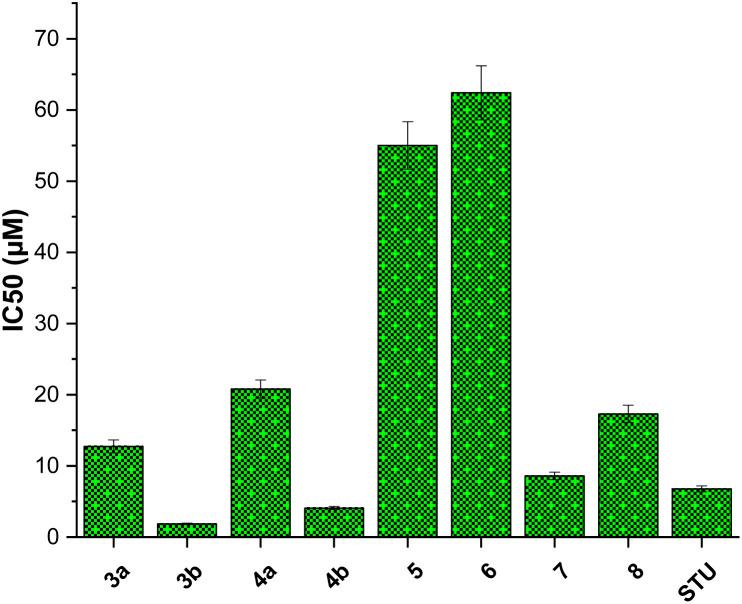
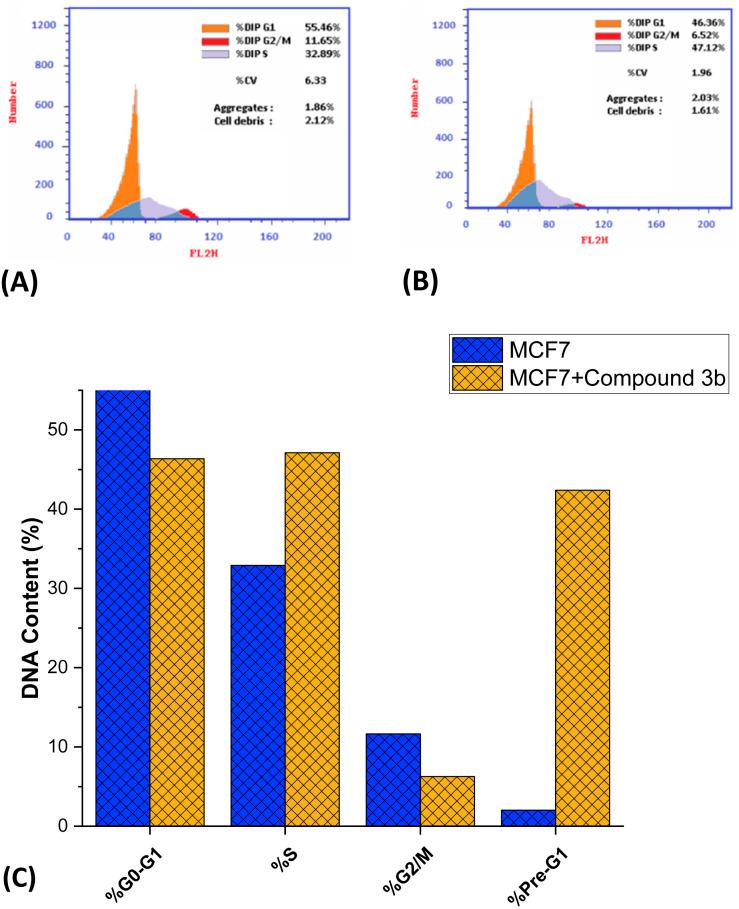
Breast cancer is a global health concern, with increasing disease burden and disparities in access to healthcare. Late diagnosis and limited treatment options in underserved areas contribute to poor outcomes. In response to this challenge, we developed a novel family of 2-substituted-quinoxaline analogues, combining coumarin and quinoxaline scaffolds known for their anticancer properties. Through a versatile synthetic approach, we designed, synthesized, and characterized a set of 2-substituted quinoxaline derivatives. The antiproliferative activity of the synthesized compounds was assessed toward the MCF-7 breast cancer cells. Our investigations showed that the synthesized compounds exhibit considerable antiproliferative activity toward MCF-7 cells. Notably, compound 3b, among examined compounds, displayed a superior inhibitory effect (IC = 1.85 ± 0.11 μM) toward the growth of MCF-7 cells compared to the conventional anticancer drug staurosporine (IC = 6.77 ± 0.41 μM) and showed minimal impact on normal cells (MCF-10A cell lines, IC = 33.7 ± 2.04 μM). Mechanistic studies revealed that compound 3b induced cell cycle arrest at the G1 transition and triggered apoptosis in MCF-7 cells, as evidenced by increasing the percentage of cells arrested in the G2/M and pre-G1 phases utilizing flow cytometric analysis and Annexin V-FITC/PI analysis. Moreover, compound 3b was found to substantially suppress topoisomerase enzyme activity in MCF-7 cells. Molecular modeling studies further supported the potential of compound 3b as a therapeutic candidate by demonstrating significant binding affinity to the active sites of both topoisomerase II and EGFR proteins. Taken together, the presented 2-substituted-quinoxaline analogues, especially compound 3b, show promise as potential candidates for the development of effective anti-breast cancer drugs.
乳腺癌是一个全球性的健康问题,疾病负担不断增加,医疗保健获取方面存在差异。服务不足地区的晚期诊断和有限的治疗选择导致了不良后果。为应对这一挑战,我们开发了一类新型的2-取代喹喔啉类似物,将以其抗癌特性而闻名的香豆素和喹喔啉支架结合在一起。通过一种通用的合成方法,我们设计、合成并表征了一组2-取代喹喔啉衍生物。评估了合成化合物对MCF-7乳腺癌细胞的抗增殖活性。我们的研究表明,合成化合物对MCF-7细胞表现出相当大的抗增殖活性。值得注意的是,在所检测的化合物中,化合物3b对MCF-7细胞生长的抑制作用优于传统抗癌药物星形孢菌素(IC = 6.77 ± 0.41 μM)(IC = 1.85 ± 0.11 μM),并且对正常细胞(MCF-10A细胞系,IC = 33.7 ± 2.04 μM)的影响最小。机制研究表明,化合物3b诱导MCF-7细胞在G1期转变时细胞周期停滞并触发凋亡,这通过流式细胞术分析和膜联蛋白V-FITC/PI分析增加了停滞在G2/M和G1前期的细胞百分比得到证明。此外,发现化合物3b可显著抑制MCF-7细胞中的拓扑异构酶活性。分子模拟研究进一步支持了化合物3b作为治疗候选物的潜力,证明其对拓扑异构酶II和表皮生长因子受体(EGFR)蛋白的活性位点具有显著的结合亲和力。综上所述,所展示的2-取代喹喔啉类似物,尤其是化合物3b,有望成为开发有效抗乳腺癌药物的潜在候选物。




 Zotero 插件