
控制PHA基生物聚合物共混物银纹变形的方法。
Approaches to Control Crazing Deformation of PHA-Based Biopolymeric Blends.
作者信息
Hosseinnezhad Ramin, Elumalai Dhanumalayan, Vozniak Iurii
机构信息
Centre of Molecular and Macromolecular Studies, Polish Academy of Sciences, 90-363 Lodz, Poland.
出版信息
Polymers (Basel). 2023 Oct 26;15(21):4234. doi: 10.3390/polym15214234.
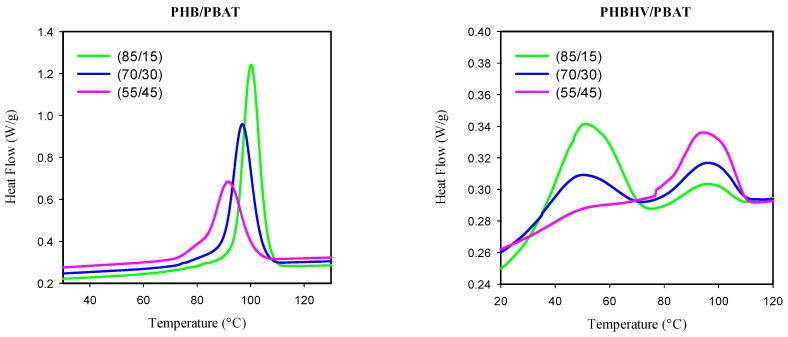
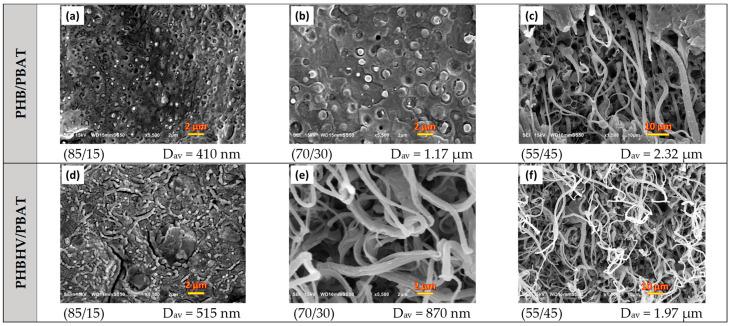
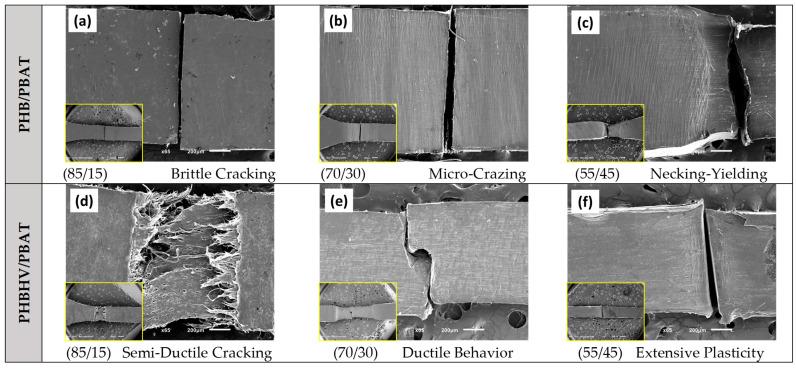
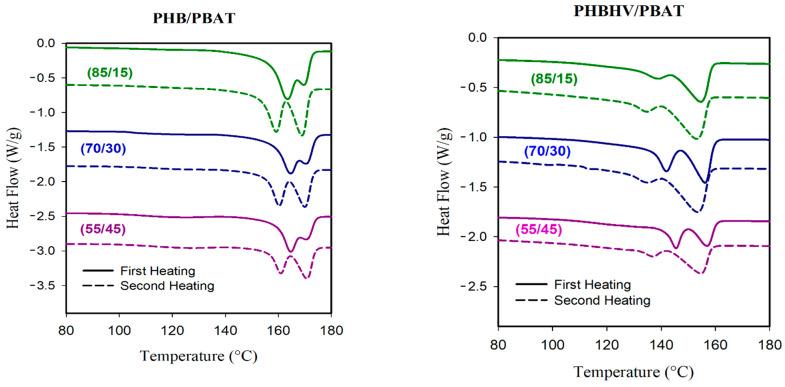
The mechanical behavior of polymer materials is heavily influenced by a phenomenon known as crazing. Crazing is a precursor to damage and leads to the formation of cracks as it grows in both thickness and tip size. The current research employs an in situ SEM method to investigate the initiation and progression of crazing in all-biopolymeric blends based on Polyhydroxyalkanoates (PHAs). To this end, two chemically different grades of PHA, namely poly(hydroxybutyrate) (PHB) and poly(3-hydroxybutyrate-co-3-hydroxyvalerate) (PHBHV), were melt-blended with polybutyrate adipate terephthalate (PBAT). The obtained morphologies of blends, the droplet/fibrillar matrix, were highly influenced by the plasticity of the matrices as well as the content of the minor phase. Increasing the concentration of PBAT from 15 to 30 wt.% resulted in the brittle to ductile transition. It changed the mechanism of plastic deformation from single craze-cracking to homogeneous and heterogeneous intensified crazing for PHB and PHBHV matrices, respectively. Homogeneous tensile crazes formed perpendicularly to the draw direction at the initial stages of deformation, transformed into shear crazes characterized by oblique edge propagation for the PHBHV/PBAT blend. Such angled crazes suggested that the displacement might be caused by shear localized deformation. The crazes' strength and the time to failure increased with the minor phase fibers. These fibers, aligned with the tensile direction and spanning the width of the crazes, were in the order of a few micrometers in diameter depending on the concentration. The network of fibrillar PBAT provided additional integrity for larger plastic deformation values. This study elucidates the mechanism of crazing in PHA blends and provides strategies for controlling it.
聚合物材料的力学行为受到一种称为银纹化现象的严重影响。银纹化是损伤的先兆,随着其厚度和尖端尺寸的增加会导致裂纹的形成。当前的研究采用原位扫描电子显微镜方法来研究基于聚羟基脂肪酸酯(PHA)的全生物聚合物共混物中银纹化的引发和发展。为此,将两种化学性质不同的PHA,即聚(3-羟基丁酸酯)(PHB)和聚(3-羟基丁酸酯-co-3-羟基戊酸酯)(PHBHV)与聚己二酸丁二醇酯-对苯二甲酸丁二醇酯(PBAT)进行熔融共混。所获得的共混物形态,即液滴/纤维状基体,受到基体的可塑性以及次要相含量的高度影响。将PBAT的浓度从15 wt.%增加到30 wt.%导致了从脆性到韧性的转变。它分别改变了PHB和PHBHV基体的塑性变形机制,从单一银纹开裂转变为均匀和非均匀强化银纹化。在变形初期,均匀的拉伸银纹垂直于拉伸方向形成,对于PHBHV/PBAT共混物,转变为以斜边缘扩展为特征的剪切银纹。这种成角度的银纹表明位移可能是由剪切局部变形引起的。银纹的强度和失效时间随着次要相纤维的增加而增加。这些纤维与拉伸方向对齐并跨越银纹的宽度,根据浓度不同,直径在几微米左右。纤维状PBAT的网络为更大的塑性变形值提供了额外的完整性。这项研究阐明了PHA共混物中银纹化的机制,并提供了控制它的策略。


 Zotero 插件