
使用分子动力学模拟预测聚羟基脂肪酸酯生物聚合物的力学响应。
Predicting the Mechanical Response of Polyhydroxyalkanoate Biopolymers Using Molecular Dynamics Simulations.
作者信息
Bejagam Karteek K, Gupta Nevin S, Lee Kwan-Soo, Iverson Carl N, Marrone Babetta L, Pilania Ghanshyam
机构信息
Los Alamos National Laboratory, Materials Science and Technology Division, Los Alamos, NM 87545, USA.
Los Alamos National Laboratory, Chemistry Division, Los Alamos, NM 87545, USA.
出版信息
Polymers (Basel). 2022 Jan 17;14(2):345. doi: 10.3390/polym14020345.
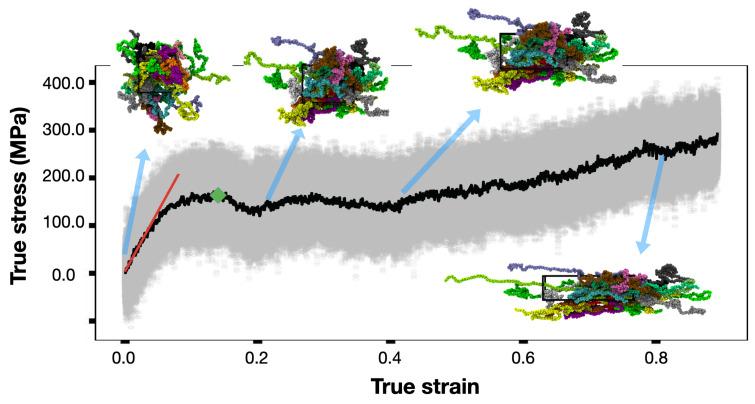
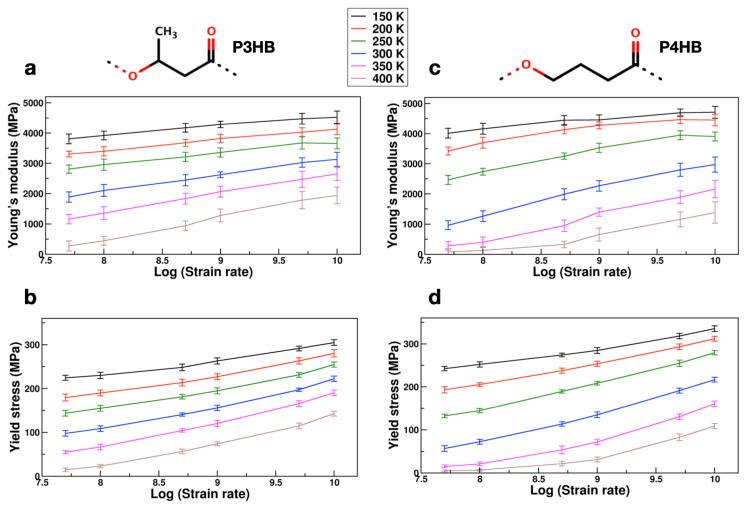
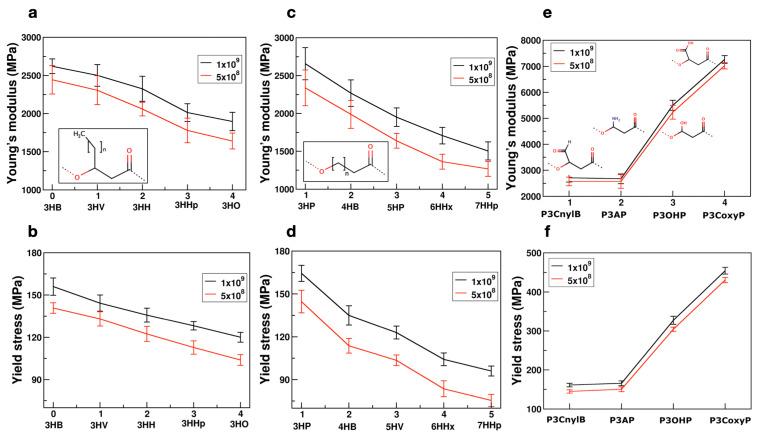
Polyhydroxyalkanoates (PHAs) have emerged as a promising class of biosynthesizable, biocompatible, and biodegradable polymers to replace petroleum-based plastics for addressing the global plastic pollution problem. Although PHAs offer a wide range of chemical diversity, the structure-property relationships in this class of polymers remain poorly established. In particular, the available experimental data on the mechanical properties is scarce. In this contribution, we have used molecular dynamics simulations employing a recently developed forcefield to predict chemical trends in mechanical properties of PHAs. Specifically, we make predictions for Young's modulus, and yield stress for a wide range of PHAs that exhibit varying lengths of backbone and side chains as well as different side chain functional groups. Deformation simulations were performed at six different strain rates and six different temperatures to elucidate their influence on the mechanical properties. Our results indicate that Young's modulus and yield stress decrease systematically with increase in the number of carbon atoms in the side chain as well as in the polymer backbone. In addition, we find that the mechanical properties were strongly correlated with the chemical nature of the functional group. The functional groups that enhance the interchain interactions lead to an enhancement in both the Young's modulus and yield stress. Finally, we applied the developed methodology to study composition-dependence of the mechanical properties for a selected set of binary and ternary copolymers. Overall, our work not only provides insights into rational design rules for tailoring mechanical properties in PHAs, but also opens up avenues for future high throughput atomistic simulation studies geared towards identifying functional PHA polymer candidates for targeted applications.
聚羟基脂肪酸酯(PHA)已成为一类有前景的可生物合成、生物相容且可生物降解的聚合物,有望取代石油基塑料,以解决全球塑料污染问题。尽管PHA具有广泛的化学多样性,但这类聚合物的结构-性能关系仍未得到很好的确立。特别是,关于其力学性能的现有实验数据稀缺。在本论文中,我们使用了分子动力学模拟,采用一种最近开发的力场来预测PHA力学性能的化学趋势。具体而言,我们对一系列具有不同主链和侧链长度以及不同侧链官能团的PHA的杨氏模量和屈服应力进行了预测。在六种不同的应变速率和六种不同的温度下进行了变形模拟,以阐明它们对力学性能的影响。我们的结果表明,杨氏模量和屈服应力会随着侧链以及聚合物主链中碳原子数目的增加而系统性地降低。此外,我们发现力学性能与官能团的化学性质密切相关。增强链间相互作用的官能团会导致杨氏模量和屈服应力均有所提高。最后,我们应用所开发的方法研究了一组选定的二元和三元共聚物力学性能的组成依赖性。总体而言,我们的工作不仅为PHA力学性能定制的合理设计规则提供了见解,还为未来旨在识别用于特定应用的功能性PHA聚合物候选物的高通量原子模拟研究开辟了道路。

 Zotero 插件