
人源化揭示了酵母和人类动粒组分普遍存在的不兼容性。
Humanization reveals pervasive incompatibility of yeast and human kinetochore components.
机构信息
Institute for Systems Genetics and Department of Biochemistry and Molecular Pharmacology, NYU Langone Health, New York, NY 10016, USA.
Vilcek Institute of Graduate Biomedical Sciences, NYU School of Medicine, New York, NY 10016, USA.
出版信息
G3 (Bethesda). 2023 Dec 29;14(1). doi: 10.1093/g3journal/jkad260.
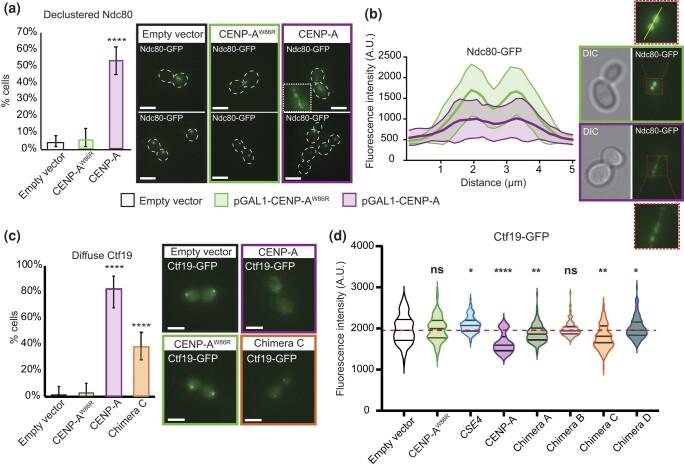
Kinetochores assemble on centromeres to drive chromosome segregation in eukaryotic cells. Humans and budding yeast share most of the structural subunits of the kinetochore, whereas protein sequences have diverged considerably. The conserved centromeric histone H3 variant, CenH3 (CENP-A in humans and Cse4 in budding yeast), marks the site for kinetochore assembly in most species. A previous effort to complement Cse4 in yeast with human CENP-A was unsuccessful; however, co-complementation with the human core nucleosome was not attempted. Previously, our lab successfully humanized the core nucleosome in yeast; however, this severely affected cellular growth. We hypothesized that yeast Cse4 is incompatible with humanized nucleosomes and that the kinetochore represented a limiting factor for efficient histone humanization. Thus, we argued that including the human CENP-A or a Cse4-CENP-A chimera might improve histone humanization and facilitate kinetochore function in humanized yeast. The opposite was true: CENP-A expression reduced histone humanization efficiency, was toxic to yeast, and disrupted cell cycle progression and kinetochore function in wild-type (WT) cells. Suppressors of CENP-A toxicity included gene deletions of subunits of 3 conserved chromatin remodeling complexes, highlighting their role in CenH3 chromatin positioning. Finally, we attempted to complement the subunits of the NDC80 kinetochore complex, individually and in combination, without success, in contrast to a previous study indicating complementation by the human NDC80/HEC1 gene. Our results suggest that limited protein sequence similarity between yeast and human components in this very complex structure leads to failure of complementation.
动粒在着丝粒上组装,以驱动真核细胞中的染色体分离。人类和 budding yeast 共享大部分动粒的结构亚基,而蛋白质序列则有很大的差异。保守的着丝粒组蛋白 H3 变体,CenH3(人类中的 CENP-A 和 budding yeast 中的 Cse4),标记了大多数物种中动粒组装的位点。之前尝试用人源 CENP-A 补充酵母中的 Cse4 是不成功的;然而,并没有尝试与人源核心核小体共同互补。之前,我们的实验室成功地在酵母中实现了核心核小体的人源化;然而,这严重影响了细胞生长。我们假设酵母 Cse4 与人源化核小体不兼容,而动粒是高效的组蛋白人源化的限制因素。因此,我们认为包含人源 CENP-A 或 Cse4-CENP-A 嵌合体可能会提高组蛋白人源化的效率,并促进人源化酵母中的动粒功能。事实恰恰相反:CENP-A 的表达降低了组蛋白人源化的效率,对酵母有毒,并破坏了野生型(WT)细胞的细胞周期进程和动粒功能。CENP-A 毒性的抑制剂包括 3 个保守染色质重塑复合物的亚基的基因缺失,这突出了它们在 CenH3 染色质定位中的作用。最后,我们尝试单独和组合地互补 NDC80 动粒复合物的亚基,但没有成功,与之前的一项研究表明人源 NDC80/HEC1 基因可以互补形成鲜明对比。我们的结果表明,在这个非常复杂的结构中,酵母和人类组件之间有限的蛋白质序列相似性导致了互补的失败。



 Zotero 插件