
新冠疫情期间抗菌药物的使用:尼泊尔利益相关者的定性研究
Use of antimicrobials during the COVID-19 pandemic: A qualitative study among stakeholders in Nepal.
作者信息
Dhungel Binod, Thapa Shrestha Upendra, Adhikari Sanjib, Adhikari Nabaraj, Bhattarai Alisha, Pokharel Sunil, Karkey Abhilasha, Limmathurotsakul Direk, Ghimire Prakash, Rijal Komal Raj, Cheah Phaik Yeong, Pell Christopher, Adhikari Bipin
机构信息
Central Department of Microbiology, Tribhuvan University, Kathmandu, Nepal.
Manmohan Cardiothoracic Vascular and Transplant Center, Institute of Medicine, Tribhuvan University, Kathmandu, Nepal.
出版信息
PLOS Glob Public Health. 2023 Nov 14;3(11):e0002166. doi: 10.1371/journal.pgph.0002166. eCollection 2023.
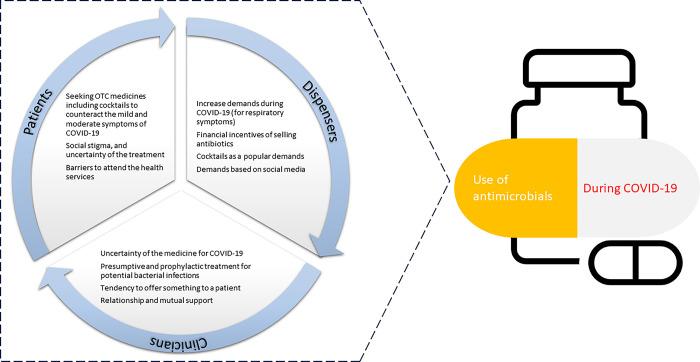
The COVID-19 pandemic was a major public health threat and the pressure to find curative therapies was tremendous. Particularly in the early critical phase of the pandemic, a lot of empirical treatments, including antimicrobials, were recommended. Drawing on interviews with patients, clinicians and drug dispensers, this article explores the use of antimicrobials for the management of COVID-19 in Nepal. A total of 30 stakeholders (10 clinicians, 10 dispensers and 10 COVID-19 patients) were identified purposively and were approached for an interview. Clinicians and dispensers in three tertiary hospitals in Kathmandu assisted in the recruitment of COVID-19 patients who were undergoing follow-up at an out-patient department. Interviews were audio recorded, translated and transcribed into English, and were analyzed thematically. The respondents report that over-the-counter (OTC) use of antibiotics was widespread during the COVID-19 pandemic in Nepal. This was mostly rooted in patients' attempts to mitigate the potential severity of respiratory illnesses, and the fear of the stigmatization and social isolation linked to being identified as a COVID-19 patient. Patients who visited drug shops and physicians reportedly requested specific medicines including antibiotics. Clinicians reported uncertainty when treating COVID-19 cases that added pressure to prescribe antimicrobials. Respondents from all stakeholder groups recognized the dangers of excessive use of antimicrobials, with some referring to the development of resistance. The COVID-19 pandemic added pressure to prescribe, dispense and overuse antimicrobials, accentuating the pre-existing OTC use of antimicrobials. Infectious disease outbreaks and epidemics warrant special caution regarding the use of antimicrobials and specific policy response.
新冠疫情是一项重大的公共卫生威胁,寻找治愈性疗法的压力巨大。尤其是在疫情早期的关键阶段,人们推荐了许多经验性治疗方法,包括使用抗菌药物。本文通过对患者、临床医生和药剂师的访谈,探讨了尼泊尔使用抗菌药物治疗新冠的情况。我们有目的地确定了30名利益相关者(10名临床医生、10名药剂师和10名新冠患者)并邀请他们接受访谈。加德满都三家三级医院的临床医生和药剂师协助招募了在门诊部接受随访的新冠患者。访谈进行了录音,翻译成英文并转录,然后进行主题分析。受访者表示,在尼泊尔新冠疫情期间,非处方使用抗生素的情况很普遍。这主要源于患者试图减轻呼吸道疾病的潜在严重程度,以及担心被认定为新冠患者而受到污名化和社会隔离。据报道,前往药店和看医生的患者会要求使用包括抗生素在内的特定药物。临床医生表示,在治疗新冠病例时存在不确定性,这增加了开具抗菌药物的压力。所有利益相关者群体的受访者都认识到过度使用抗菌药物的危害,一些人提到了耐药性的产生。新冠疫情增加了开具、分发和过度使用抗菌药物的压力,加剧了此前就已存在的非处方使用抗菌药物的情况。传染病爆发和流行需要特别谨慎使用抗菌药物并做出具体的政策应对。
 Zotero 插件