
牡荆素,牡丹皮的主要活性成分,通过阻断电压门控钠离子通道缓解慢性口腔颌面疼痛。
Quercetin, Main Active Ingredient of Moutan Cortex, Alleviates Chronic Orofacial Pain via Block of Voltage-Gated Sodium Channel.
机构信息
From the Department of Anesthesiology, Shenzhen People's Hospital (The First Affiliated Hospital, Southern University of Science and Technology), Shenzhen, China.
Laboratory and Clinical Research Institute for Pain, Department of Anaesthesiology, School of Clinical Medicine, Li Ka Shing Faculty of Medicine, the University of Hong Kong, Hong Kong, China.
出版信息
Anesth Analg. 2024 Jun 1;138(6):1324-1336. doi: 10.1213/ANE.0000000000006730. Epub 2024 May 20.
BACKGROUND
Chronic orofacial pain (COP) therapy is challenging, as current medical treatments are extremely lacking. Moutan Cortex (MC) is a traditional Chinese medicine herb widely used for chronic inflammatory diseases. However, the mechanism behind MC in COP therapy has not been well-established. The purpose of this study was to identify the active ingredients of MC and their specific underlying mechanisms in COP treatment.
METHODS
In this study, the main active ingredients and compound-target network of MC in COP therapy were identified through network pharmacology and bioinformatics analysis. Adult male Sprague-Dawley rats received oral mucosa lipopolysaccharide (LPS) injection to induce COP. Pain behaviors were evaluated by orofacial mechanical nociceptive assessment after intraganglionar injection. In vitro inflammatory cytokines in LPS-pretreated human periodontal ligament stem cells (hPDLSCs) and rat primary cultural trigeminal ganglion (TG) neurons were quantified by real-time quantitative polymerase chain reaction (RT-qPCR). Schrödinger software was used to verify the molecular docking of quercetin and critical targets. Whole-cell recording electrophysiology was used to evaluate the effect of quercetin on voltage-gated sodium (Na v ) channel in rat TG neurons.
RESULTS
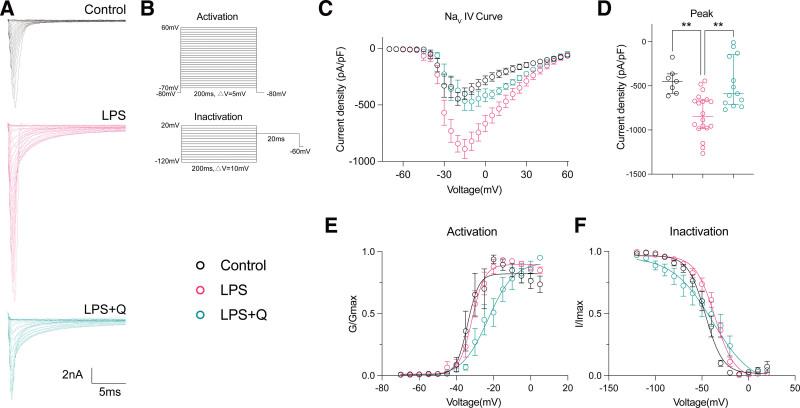
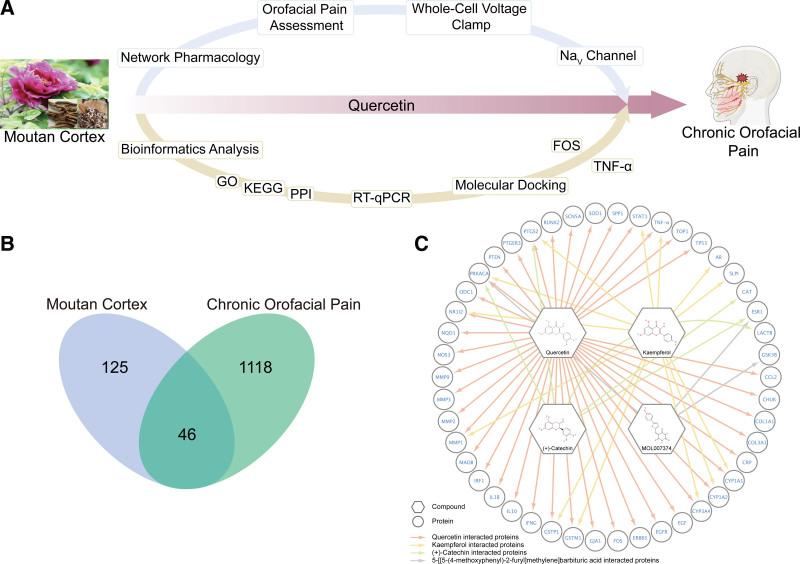
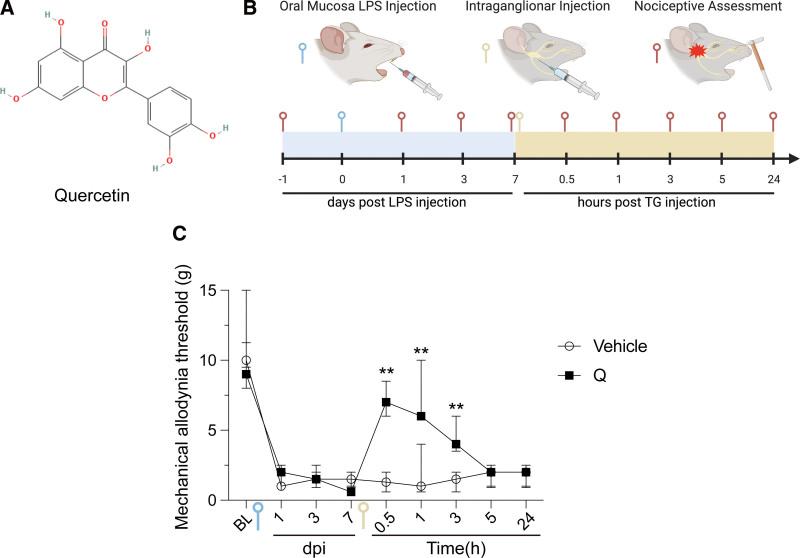
The assembled compound-target network consisted of 4 compounds and 46 targets. As 1 of the active components of MC correlated with most related targets, quercetin alleviated mechanical allodynia in LPS-induced rat model of COP (mechanical allodynia threshold median [interquartile range (IQR) 0.5 hours after drug administration: vehicle 1.3 [0.6-2.0] g vs quercetin 7.0 [6.0-8.5] g, P = .002). Gene ontology (GO) enrichment and Kyoto Encyclopedia of Genes and Genomes (KEGG) pathway analysis revealed that immune response and membrane functions play essential roles in MC-COP therapy. Five of the related targets were identified as core targets by protein-protein interaction analysis. Quercetin exerted an analgesic effect, possibly through blocking Na v channel in TG sensory neurons (peak current density median [IQR]: LPS -850.2 [-983.6 to -660.7] mV vs LPS + quercetin -589.6 [-711.0 to -147.8] mV, P = .006) while downregulating the expression level of proinflammatory cytokines-FOS (normalized messenger RNA [mRNA] level mean ± standard error of mean [SEM]: LPS [2. 22 ± 0.33] vs LPS + quercetin [1. 33 ± 0.14], P = .034) and TNF-α (normalized mRNA level mean ± SEM: LPS [8. 93 ± 0.78] vs LPS + quercetin [3. 77 ± 0.49], P < .0001).
CONCLUSIONS
Identifying Na v as the molecular target of quercetin clarifies the analgesic mechanism of MC, and provides ideas for the development of novel selective and efficient chronic pain relievers.
背景
慢性口腔面部疼痛(COP)的治疗极具挑战性,因为目前的医学治疗方法极其缺乏。丹皮(MC)是一种传统的中药,广泛用于治疗慢性炎症性疾病。然而,MC 治疗 COP 的机制尚未得到充分证实。本研究的目的是确定 MC 的活性成分及其在 COP 治疗中的具体潜在机制。
方法
本研究通过网络药理学和生物信息学分析,确定了 MC 治疗 COP 的主要活性成分及其化合物-靶标网络。成年雄性 Sprague-Dawley 大鼠接受口腔黏膜脂多糖(LPS)注射,以诱导 COP。通过在三叉神经节内注射后进行口腔机械性伤害感受评估,评估疼痛行为。实时定量聚合酶链反应(RT-qPCR)定量检测 LPS 预处理的人牙周膜干细胞(hPDLSCs)和大鼠原代培养三叉神经节(TG)神经元中的炎症细胞因子。使用 Schrödinger 软件验证槲皮素和关键靶标的分子对接。全细胞膜片钳电生理学用于评估槲皮素对大鼠 TG 神经元电压门控钠(Na v )通道的影响。
结果
所构建的化合物-靶标网络由 4 种化合物和 46 个靶标组成。由于 MC 的 1 种活性成分与大多数相关靶标相关,槲皮素缓解了 LPS 诱导的 COP 大鼠模型中的机械性痛觉过敏(药物给药后 0.5 小时机械性痛觉过敏阈值中位数[四分位距(IQR)]:载体 1.3[0.6-2.0]g 与槲皮素 7.0[6.0-8.5]g,P=0.002)。基因本体(GO)富集和京都基因与基因组百科全书(KEGG)通路分析表明,免疫反应和膜功能在 MC-COP 治疗中发挥重要作用。通过蛋白质-蛋白质相互作用分析,确定了 5 个相关靶标作为核心靶标。槲皮素可能通过阻断 TG 感觉神经元中的 Na v 通道发挥镇痛作用(峰电流密度中位数[IQR]:LPS-850.2[-983.6 至-660.7]mV 与 LPS+槲皮素-589.6[-711.0 至-147.8]mV,P=0.006),同时下调促炎细胞因子 FOS(标准化信使 RNA[mRNA]水平平均值±标准误差[SEM]:LPS[2.22±0.33]与 LPS+槲皮素[1.33±0.14],P=0.034)和 TNF-α(标准化 mRNA 水平平均值±SEM:LPS[8.93±0.78]与 LPS+槲皮素[3.77±0.49],P<0.0001)的表达水平。
结论
确定 Na v 为槲皮素的分子靶标,阐明了 MC 的镇痛机制,并为开发新型选择性和高效的慢性止痛药提供了思路。


 Zotero 插件