
基于抗体的疗法在神经肿瘤学中的作用。
The Role of Antibody-Based Therapies in Neuro-Oncology.
作者信息
Ramapriyan Rishab, Sun Jing, Curry Annabel, Richardson Leland G, Ramesh Tarun, Gaffey Matthew A, Gedeon Patrick C, Gerstner Elizabeth R, Curry William T, Choi Bryan D
机构信息
Department of Neurosurgery, Massachusetts General Hospital, Boston, MA 02114, USA.
Harvard Medical School, Boston, MA 02115, USA.
出版信息
Antibodies (Basel). 2023 Nov 13;12(4):74. doi: 10.3390/antib12040074.
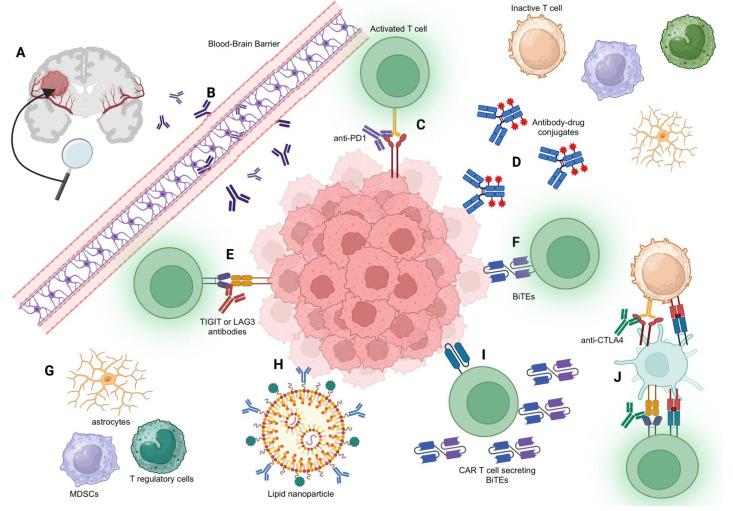
This review explores the evolving landscape of antibody-based therapies in neuro-oncology, in particular, immune checkpoint inhibitors and immunomodulatory antibodies. We discuss their mechanisms of action, blood-brain barrier (BBB) penetration, and experience in neuro-oncological conditions. Evidence from recent trials indicates that while these therapies can modulate the tumor immune microenvironment, their clinical benefits remain uncertain, largely due to challenges with BBB penetration and tumor-derived immunosuppression. This review also examines emerging targets such as TIGIT and LAG3, the potential of antibodies in modulating the myeloid compartment, and tumor-specific targets for monoclonal antibody therapy. We further delve into advanced strategies such as antibody-drug conjugates and bispecific T cell engagers. Lastly, we explore innovative techniques being investigated to enhance antibody delivery, including CAR T cell therapy. Despite current limitations, these therapies hold significant therapeutic potential for neuro-oncology. Future research should focus on optimizing antibody delivery to the CNS, identifying novel biological targets, and discovering combination therapies to address the hostile tumor microenvironment.
本综述探讨了神经肿瘤学中基于抗体的治疗方法的发展态势,特别是免疫检查点抑制剂和免疫调节抗体。我们讨论了它们的作用机制、血脑屏障(BBB)穿透情况以及在神经肿瘤疾病中的应用经验。近期试验的证据表明,虽然这些疗法可以调节肿瘤免疫微环境,但其临床益处仍不明确,这在很大程度上是由于血脑屏障穿透和肿瘤源性免疫抑制方面存在挑战。本综述还研究了新兴靶点,如TIGIT和LAG3,抗体在调节髓系细胞区室方面的潜力,以及单克隆抗体治疗的肿瘤特异性靶点。我们进一步深入探讨了抗体药物偶联物和双特异性T细胞衔接器等先进策略。最后,我们探索了正在研究的增强抗体递送的创新技术,包括嵌合抗原受体(CAR)T细胞疗法。尽管目前存在局限性,但这些疗法对神经肿瘤学具有巨大的治疗潜力。未来的研究应专注于优化抗体向中枢神经系统的递送,确定新的生物学靶点,并发现联合疗法以应对恶劣的肿瘤微环境。
 Zotero 插件