
芬兰消毒和未消毒饮用水分配系统中活性细菌群落的组成和机会性病原体的存在。
Composition of active bacterial communities and presence of opportunistic pathogens in disinfected and non-disinfected drinking water distribution systems in Finland.
机构信息
Finnish Institute for Health and Welfare, Department of Health Security, P.O. Box 95, 70701 Kuopio, Finland; University of Eastern Finland, Department of Environmental and Biological Sciences, P.O. Box 1627, 70211 Kuopio, Finland.
Finnish Institute for Health and Welfare, Department of Health Security, P.O. Box 95, 70701 Kuopio, Finland.
出版信息
Water Res. 2024 Jan 1;248:120858. doi: 10.1016/j.watres.2023.120858. Epub 2023 Nov 11.
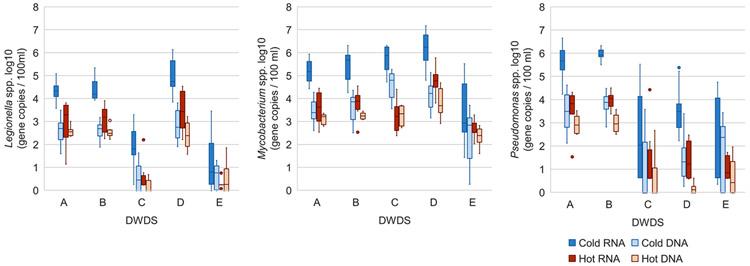
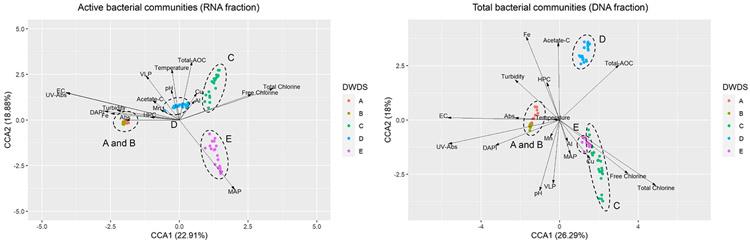
Many factors, including microbiome structure and activity in the drinking water distribution system (DWDS), affect the colonization potential of opportunistic pathogens. The present study aims to describe the dynamics of active bacterial communities in DWDS and identify the factors that shape the community structures and activity in the selected DWDSs. Large-volume drinking water and hot water, biofilm, and water meter deposit samples were collected from five DWDSs. Total nucleic acids were extracted, and RNA was further purified and transcribed into its cDNA from a total of 181 water and biofilm samples originating from the DWDS of two surface water supplies (disinfected with UV and chlorine), two artificially recharged groundwater supplies (non-disinfected), and a groundwater supply (disinfected with UV and chlorine). In chlorinated DWDSs, concentrations of <0.02-0.97 mg/l free chlorine were measured. Bacterial communities in the RNA and DNA fractions were analysed using Illumina MiSeq sequencing with primer pair 341F-785R targeted to the 16S rRNA gene. The sequence libraries were analysed using QIIME pipeline, Program R, and MicrobiomeAnalyst. Not all bacterial cells were active based on their 16S rRNA content, and species richness was lower in the RNA fraction (Chao1 mean value 490) than in the DNA fraction (710). Species richness was higher in the two DWDSs distributing non-disinfected artificial groundwater (Chao1 mean values of 990 and 1 000) as compared to the two disinfected DWDSs using surface water (Chao1 mean values 190 and 460) and disinfected DWDS using ground water as source water (170). The difference in community structures between non-disinfected and disinfected water was clear in the beta-diversity analysis. Distance from the waterworks also affected the beta diversity of community structures, especially in disinfected distribution systems. The two most abundant bacteria in the active part of the community (RNA) and total bacterial community (DNA) belonged to the classes Alphaproteobacteria (RNA 28 %, DNA 44 %) and Gammaproteobacteria (RNA 32 %, DNA 30 %). The third most abundant and active bacteria class was Vampirovibrionia (RNA 15 %), whereas in the total community it was Paceibacteria (DNA 11 %). Class Nitrospiria was more abundant and active in both cold and hot water in DWDS that used chloramine disinfection compared to non-chlorinated or chlorine-using DWDSs. Thirty-eight operational taxonomic units (OTU) of Legionella, 30 of Mycobacterium, and 10 of Pseudomonas were detected among the sequences. The (RT)-qPCR confirmed the presence of opportunistic pathogens in the DWDSs studied as Legionella spp. was detected in 85 % (mean value 4.5 × 10 gene copies/100 ml), Mycobacterium spp. in 95 % (mean value 8.3 × 10 gene copies/100 ml), and Pseudomonas spp. in 78 % (mean value 1.6 × 10 gene copies/100 ml) of the water and biofilm samples. Sampling point inside the system (distance from the waterworks and cold/hot system) affected the active bacterial community composition. Chloramine as a chlorination method resulted in a recognizable community composition, with high abundance of bacteria that benefit from the excess presence of nitrogen. The results presented here confirm that each DWDS is unique and that opportunistic pathogens are present even in conditions when water quality is considered excellent.
许多因素,包括饮用水分配系统(DWDS)中的微生物群落结构和活性,都会影响机会性病原体的定植潜力。本研究旨在描述 DWDS 中活性细菌群落的动态,并确定塑造所选 DWDS 群落结构和活性的因素。从五个 DWDS 中采集了大量饮用水和热水、生物膜和水表沉积物样本。从来自两个地表水供应源的 DWDS(用紫外线和氯消毒)、两个人工补给地下水供应源(未消毒)和一个地下水供应源(用紫外线和氯消毒)的 181 个水和生物膜样本中提取总核酸,并进一步纯化 RNA 并将其 cDNA 转录。在氯消毒的 DWDS 中,测量到的游离氯浓度为<0.02-0.97mg/l。使用 Illumina MiSeq 测序,用引物对 341F-785R 靶向 16S rRNA 基因,分析 RNA 和 DNA 部分的细菌群落。使用 QIIME 管道、R 程序和 MicrobiomeAnalyst 分析序列库。并非所有细菌细胞都是基于其 16S rRNA 含量而活跃的,并且 RNA 部分的物种丰富度(Chao1 平均值为 490)低于 DNA 部分(710)。与使用地表水的两个消毒 DWDS(Chao1 平均值为 190 和 460)和使用地下水作为水源的消毒 DWDS(170)相比,分配未消毒人工地下水的两个 DWDS(Chao1 平均值为 990 和 1000)的物种丰富度更高。非消毒水和消毒水之间的群落结构差异在 beta 多样性分析中很明显。与水厂的距离也会影响群落结构的 beta 多样性,特别是在消毒的分配系统中。在活性部分(RNA)和总细菌群落(DNA)中最丰富的两种细菌属于 Alphaproteobacteria 类(RNA 28%,DNA 44%)和 Gammaproteobacteria 类(RNA 32%,DNA 30%)。第三丰富和活跃的细菌类是 Vampirovibrionia 类(RNA 15%),而在总群落中是 Paceibacteria 类(DNA 11%)。与非氯化或使用氯的 DWDS 相比,在使用氯胺消毒的 DWDS 中,硝化螺旋菌在冷热水中更丰富且活跃。在序列中检测到 38 个军团菌、30 个分枝杆菌和 10 个假单胞菌的操作分类单元(OTU)。(RT)-qPCR 证实了机会性病原体在研究的 DWDS 中的存在,军团菌在 85%(平均值为 4.5×10 个基因拷贝/100ml)、分枝杆菌在 95%(平均值为 8.3×10 个基因拷贝/100ml)和假单胞菌在 78%(平均值为 1.6×10 个基因拷贝/100ml)的水样和生物膜样本中被检测到。系统内的采样点(距离水厂和冷/热水系统的距离)影响了活性细菌群落的组成。氯胺作为一种氯化方法,导致了可识别的群落组成,具有丰富的受益于氮过量存在的细菌。本研究结果证实,每个 DWDS 都是独特的,即使在水质被认为极好的情况下,机会性病原体也存在。


 Zotero 插件