
在最不发达国家和低收入国家住院患者中实施抗菌药物管理的方案、政策和实践:系统评价。
Protocols, policies and practices for antimicrobial stewardship in hospitalized patients in least-developed and low-income countries: a systematic review.
机构信息
Malawi Liverpool Wellcome Trust Clinical Research Programme, Blantyre, Malawi.
Kamuzu University of Health Sciences, P/Bag 320, Blantyre, Malawi.
出版信息
Antimicrob Resist Infect Control. 2023 Nov 23;12(1):131. doi: 10.1186/s13756-023-01335-8.
BACKGROUND
We aimed to identify interventions used to implement antimicrobial stewardship practices among hospitalized patients in least-developed countries.
METHODS
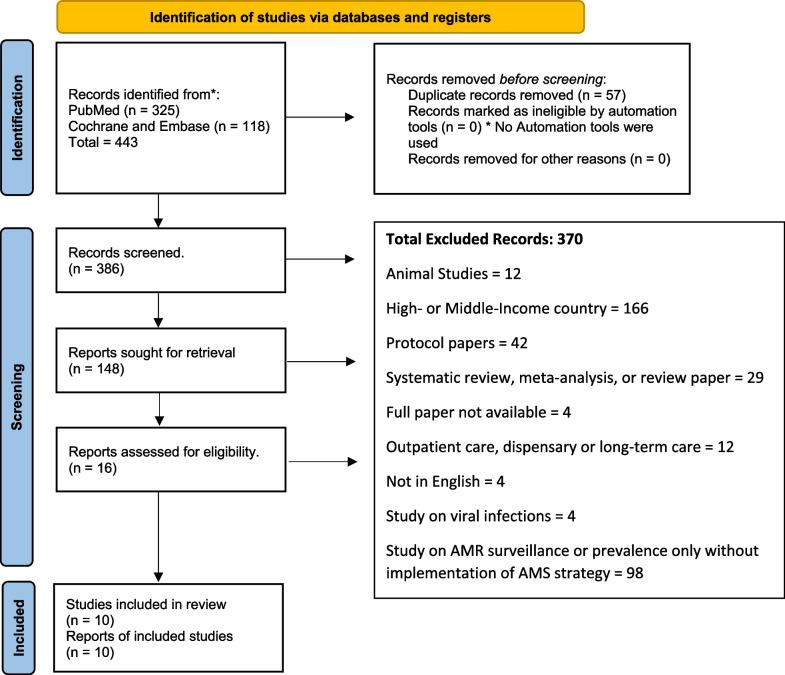
The research team searched PubMed, EMBASE, and Cochrane Central Register of Controlled Trials for studies of AMS interventions in the least developed and low-income countries, published between 2000 and 2023. Included studies had a population of hospitalized patients of all age groups in least-developed countries, implemented an AMS intervention, and reported its impact on prescription practices, clinical outcomes, or microbiological results. The risk of bias was assessed using the integrated quality criteria for review of multiple study designs. A total of 443 articles were identified, 386 articles were screened, 16 full-text papers were reviewed, and 10 studies were included in the analysis.
RESULTS
The ten studies included three controlled before and after, two qualitative, one controlled interrupted time series, two non-controlled interrupted time series, one quasi-experimental study, and one randomized controlled trial. Three studies implemented either enabling, persuasive, or structural interventions respectively. The rest used bundled strategies, including a combination of persuasive, enabling, structural, and restrictive interventions. Bundled interventions using enabling and persuasive strategies were the most common. These involved creating a prescription guideline, training prescribers on updated methods, and subsequent review and feedback of patient files by members of an AMS team. Improved microbiological surveillance was important to most studies but, sustained improvement in appropriate prescriptions was dependent on enabling or persuasive efforts. Studies noted significant improvements in appropriate prescriptions and savings on the costs of antibiotics. None evaluated the impact of AMS on AMR.
CONCLUSION
AMS practices generally involve multiple strategies to improve prescription practices. In the setting of least-developed countries, enabling and persuasive interventions are popular AMS measures. However, measured outcomes are heterogeneous, and we suggest that further studies assessing the impact of AMS should report changes in AMR patterns (microbiological outcomes), patient length of stay and mortality (patient outcomes), and changes in prescription practices (prescription outcomes). Reporting on these as outcomes of AMS interventions could make it easier for policymakers to compare which interventions have desirable outcomes that can be generalized to similar settings.
背景
我们旨在确定在最不发达国家住院患者中实施抗菌药物管理实践的干预措施。
方法
研究团队在 PubMed、EMBASE 和 Cochrane 对照试验中心注册库中检索了 2000 年至 2023 年期间在最不发达国家和低收入国家开展的抗菌药物管理干预措施研究。纳入研究的人群为最不发达国家所有年龄段的住院患者,实施了抗菌药物管理干预措施,并报告了其对处方实践、临床结局或微生物学结果的影响。使用综合质量标准评估了多项研究设计的偏倚风险。共确定了 443 篇文章,筛选了 386 篇文章,审查了 16 篇全文论文,最终有 10 项研究纳入分析。
结果
这 10 项研究包括 3 项对照前后研究、2 项定性研究、1 项对照中断时间序列研究、2 项非对照中断时间序列研究、1 项准实验研究和 1 项随机对照试验。其中 3 项研究分别实施了赋权、劝导或结构性干预措施。其余研究采用了捆绑策略,包括劝导、赋权、结构性和限制干预措施的组合。最常见的是使用赋权和劝导策略的捆绑干预措施。这些措施包括制定处方指南、培训医生使用最新方法,以及由抗菌药物管理团队成员对患者病历进行后续审查和反馈。大多数研究认为加强微生物监测非常重要,但要持续改善处方的合理性,还需要赋权或劝导措施。研究表明,在适当的处方和抗生素成本节约方面取得了显著改善。没有研究评估抗菌药物管理对抗生素耐药性的影响。
结论
抗菌药物管理实践通常涉及多种策略来改善处方实践。在最不发达国家,赋权和劝导干预措施是流行的抗菌药物管理措施。然而,测量结果存在异质性,我们建议进一步评估抗菌药物管理影响的研究应报告抗生素耐药模式(微生物学结果)、患者住院时间和死亡率(患者结果)以及处方实践变化(处方结果)的变化。将这些作为抗菌药物管理干预措施的结果进行报告,可以使政策制定者更容易比较哪些干预措施具有理想的结果,可以推广到类似的环境。
 Zotero 插件