
小肠镜与视频胶囊内镜在小肠疾病自动诊断中的应用——人工智能应用的比较分析
Enteroscopy versus Video Capsule Endoscopy for Automatic Diagnosis of Small Bowel Disorders-A Comparative Analysis of Artificial Intelligence Applications.
作者信息
Popa Stefan Lucian, Stancu Bogdan, Ismaiel Abdulrahman, Turtoi Daria Claudia, Brata Vlad Dumitru, Duse Traian Adrian, Bolchis Roxana, Padureanu Alexandru Marius, Dita Miruna Oana, Bashimov Atamyrat, Incze Victor, Pinna Edoardo, Grad Simona, Pop Andrei-Vasile, Dumitrascu Dinu Iuliu, Munteanu Mihai Alexandru, Surdea-Blaga Teodora, Mihaileanu Florin Vasile
机构信息
2nd Medical Department, "Iuliu Hatieganu" University of Medicine and Pharmacy, 400000 Cluj-Napoca, Romania.
2nd Surgical Department, "Iuliu Hatieganu" University of Medicine and Pharmacy, 400347 Cluj-Napoca, Romania.
出版信息
Biomedicines. 2023 Nov 7;11(11):2991. doi: 10.3390/biomedicines11112991.
BACKGROUND
Small bowel disorders present a diagnostic challenge due to the limited accessibility of the small intestine. Accurate diagnosis is made with the aid of specific procedures, like capsule endoscopy or double-ballon enteroscopy, but they are not usually solicited and not widely accessible. This study aims to assess and compare the diagnostic effectiveness of enteroscopy and video capsule endoscopy (VCE) when combined with artificial intelligence (AI) algorithms for the automatic detection of small bowel diseases.
MATERIALS AND METHODS
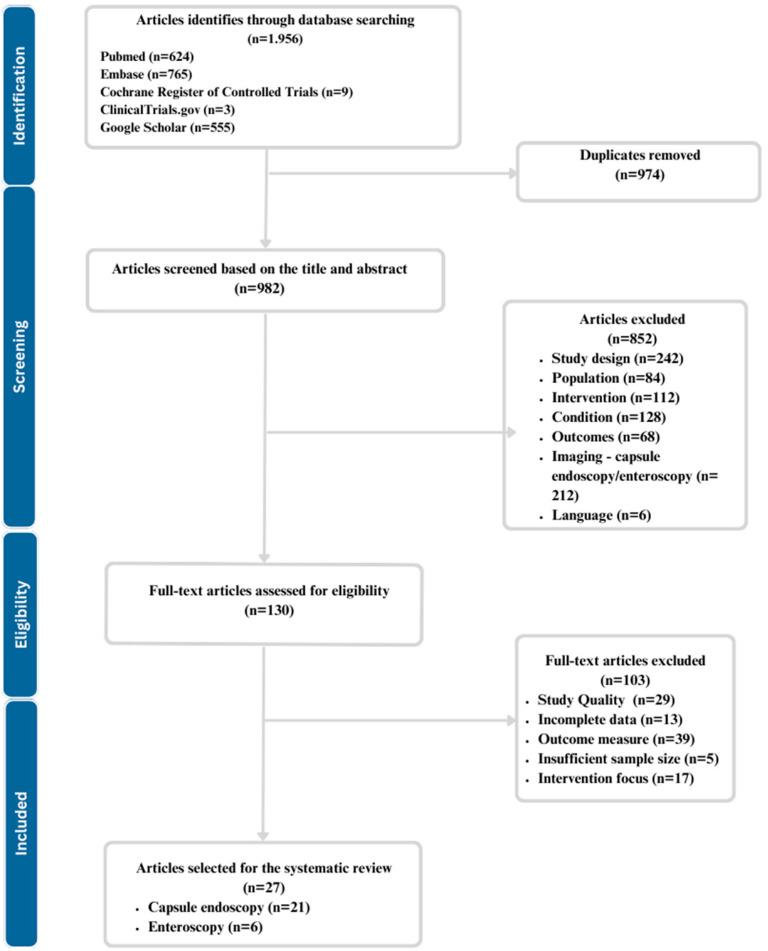
We performed an extensive literature search for relevant studies about AI applications capable of identifying small bowel disorders using enteroscopy and VCE, published between 2012 and 2023, employing PubMed, Cochrane Library, Google Scholar, Embase, Scopus, and ClinicalTrials.gov databases.
RESULTS
Our investigation discovered a total of 27 publications, out of which 21 studies assessed the application of VCE, while the remaining 6 articles analyzed the enteroscopy procedure. The included studies portrayed that both investigations, enhanced by AI, exhibited a high level of diagnostic accuracy. Enteroscopy demonstrated superior diagnostic capability, providing precise identification of small bowel pathologies with the added advantage of enabling immediate therapeutic intervention. The choice between these modalities should be guided by clinical context, patient preference, and resource availability. Studies with larger sample sizes and prospective designs are warranted to validate these results and optimize the integration of AI in small bowel diagnostics.
CONCLUSIONS
The current analysis demonstrates that both enteroscopy and VCE with AI augmentation exhibit comparable diagnostic performance for the automatic detection of small bowel disorders.
背景
由于小肠难以触及,小肠疾病的诊断具有挑战性。借助特定程序,如胶囊内镜或双气囊小肠镜,可以做出准确诊断,但这些程序通常不常使用且不易广泛获得。本研究旨在评估和比较小肠镜检查和视频胶囊内镜检查(VCE)与人工智能(AI)算法相结合自动检测小肠疾病时的诊断效果。
材料与方法
我们对2012年至2023年间发表的有关使用小肠镜检查和VCE识别小肠疾病的AI应用的相关研究进行了广泛的文献检索,使用了PubMed、Cochrane图书馆、谷歌学术、Embase、Scopus和ClinicalTrials.gov数据库。
结果
我们的调查共发现27篇出版物,其中21项研究评估了VCE的应用,其余6篇文章分析了小肠镜检查程序。纳入的研究表明,在AI的辅助下,这两种检查都表现出很高的诊断准确性。小肠镜检查显示出卓越的诊断能力,能够精确识别小肠病变,并且具有能够立即进行治疗干预的额外优势。在这些检查方式之间的选择应根据临床情况、患者偏好和资源可用性来指导。需要更大样本量和前瞻性设计的研究来验证这些结果,并优化AI在小肠诊断中的整合。
结论
当前分析表明,小肠镜检查和VCE结合AI增强在自动检测小肠疾病方面具有可比的诊断性能。


 Zotero 插件