
急性肾损伤向慢性肾脏病的转变:尿毒症毒素的作用。
The AKI-to-CKD Transition: The Role of Uremic Toxins.
机构信息
Department of Clinical Pharmacology, Amiens Medical Center, 80000 Amiens, France.
GRAP Laboratory, INSERM UMR 1247, University of Picardy Jules Verne, 80000 Amiens, France.
出版信息
Int J Mol Sci. 2023 Nov 10;24(22):16152. doi: 10.3390/ijms242216152.
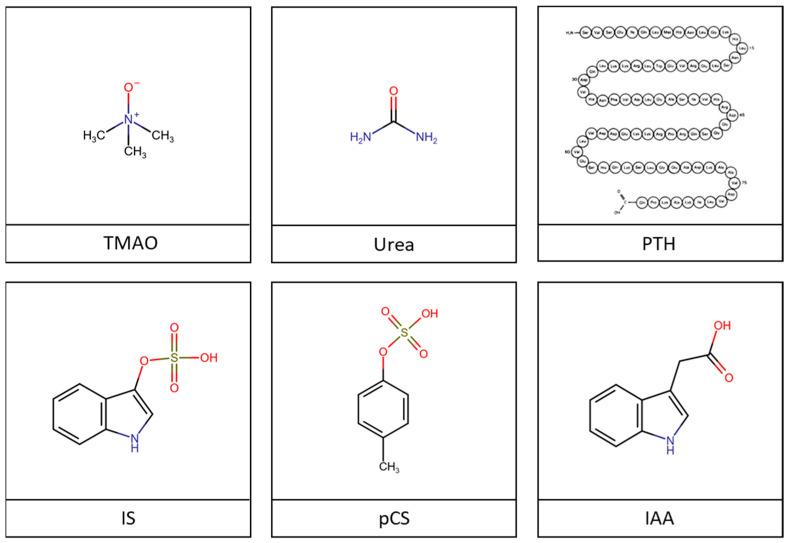
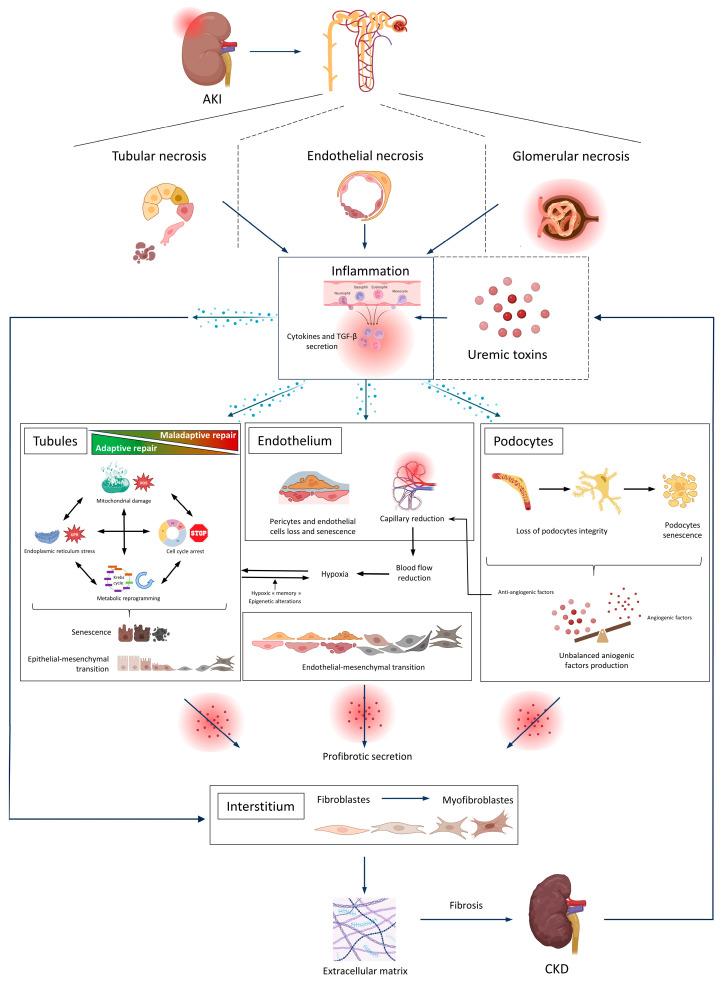
After acute kidney injury (AKI), renal function continues to deteriorate in some patients. In a pro-inflammatory and profibrotic environment, the proximal tubules are subject to maladaptive repair. In the AKI-to-CKD transition, impaired recovery from AKI reduces tubular and glomerular filtration and leads to chronic kidney disease (CKD). Reduced kidney secretion capacity is characterized by the plasma accumulation of biologically active molecules, referred to as uremic toxins (UTs). These toxins have a role in the development of neurological, cardiovascular, bone, and renal complications of CKD. However, UTs might also cause CKD as well as be the consequence. Recent studies have shown that these molecules accumulate early in AKI and contribute to the establishment of this pro-inflammatory and profibrotic environment in the kidney. The objective of the present work was to review the mechanisms of UT toxicity that potentially contribute to the AKI-to-CKD transition in each renal compartment.
急性肾损伤 (AKI) 后,一些患者的肾功能持续恶化。在促炎和致纤维化的环境中,近端小管易发生适应性修复不良。在 AKI 向 CKD 的转变过程中,AKI 恢复不良会降低肾小管和肾小球滤过率,导致慢性肾脏病 (CKD)。肾脏分泌能力降低的特征是血浆中生物活性分子的蓄积,称为尿毒症毒素 (UTs)。这些毒素在 CKD 的神经、心血管、骨骼和肾脏并发症的发展中起作用。然而,UTs 既可能导致 CKD,也可能是其结果。最近的研究表明,这些分子在 AKI 早期蓄积,并有助于在肾脏中建立这种促炎和致纤维化的环境。本研究的目的是综述潜在导致每个肾脏区室 AKI 向 CKD 转变的 UT 毒性机制。
 Zotero 插件