
mRNA新冠疫苗接种后母血清和母乳中的SARS-CoV-2抗体谱:一项纵向前瞻性观察队列研究。
SARS-CoV-2 Antibody Profiles in Maternal Serum and Breast Milk Following mRNA COVID-19 Vaccination: A Longitudinal Prospective Observational Cohort Study.
作者信息
Hsiao Hui-Mien, DiMaggio Langdon S, Perez Maria A, Chen Xuemin, Stephens Kathleen, Gibson Theda, Anderson Evan J, Rostad Christina A
机构信息
Department of Pediatrics, Emory University School of Medicine, Atlanta, GA 30322, USA.
Center for Childhood Infections and Vaccines, Children's Healthcare of Atlanta, Atlanta, GA 30322, USA.
出版信息
Vaccines (Basel). 2023 Oct 26;11(11):1643. doi: 10.3390/vaccines11111643.
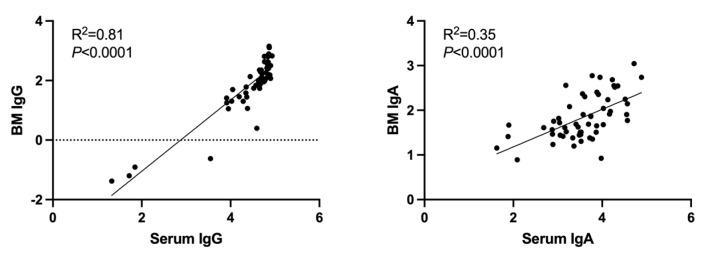
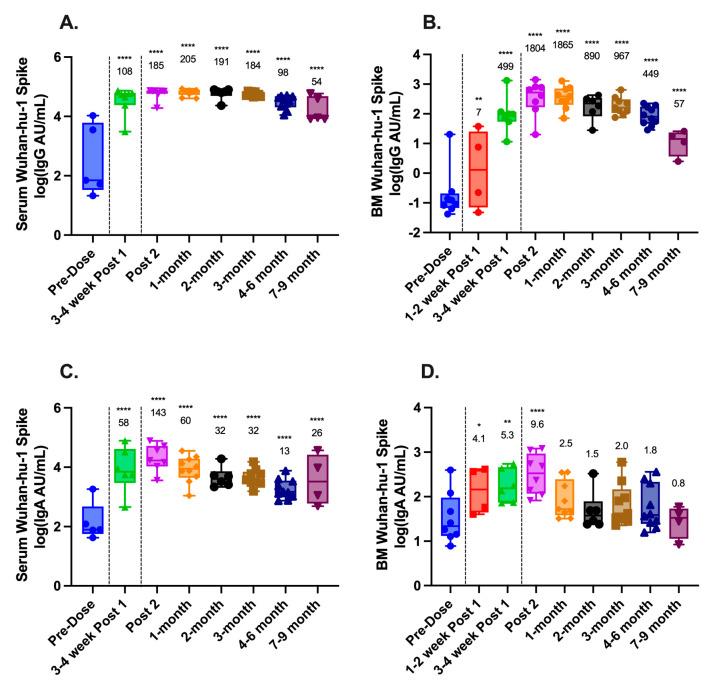
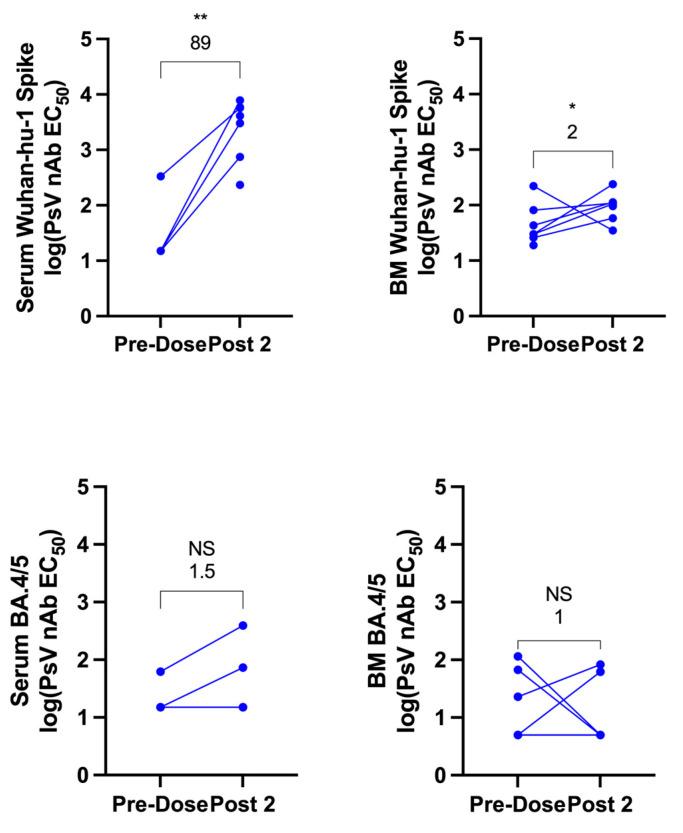
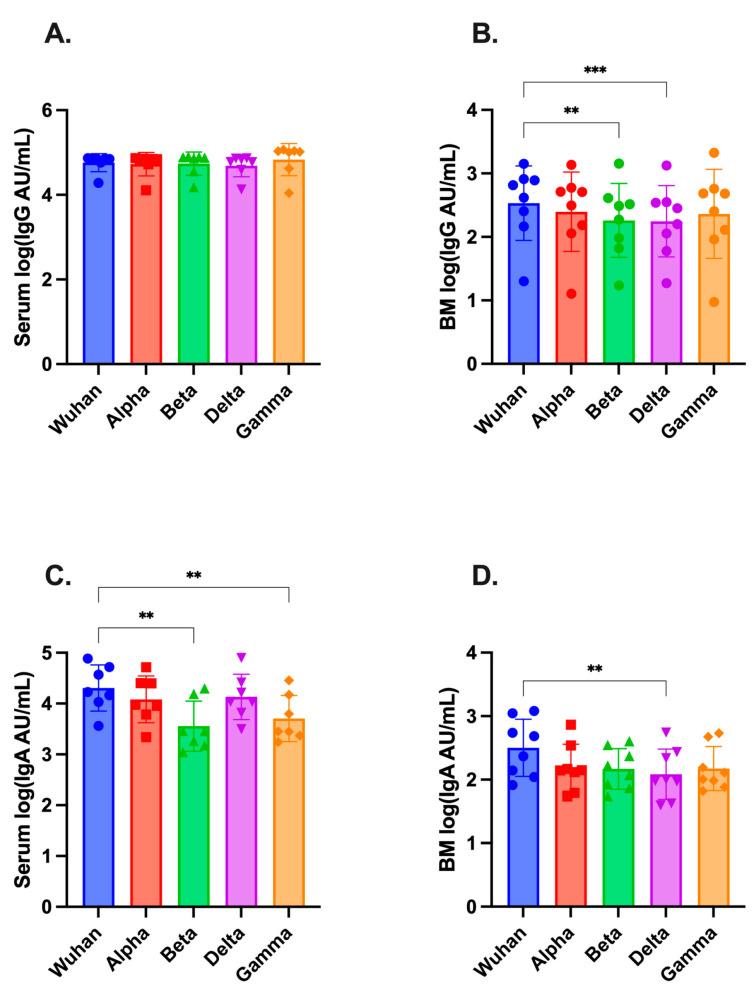
COVID-19 vaccination during pregnancy protects infants against symptomatic COVID-19. Vaccination of lactating mothers may offer additional protection, but our understanding of immune responses in breast milk is limited. We, therefore, performed a single-center prospective cohort study of lactating mothers who received a COVID-19 mRNA primary vaccine series to evaluate the durability, breadth, and neutralizing capacity of the antibody responses in breast milk. Spike IgG- and IgA-binding antibodies of ancestral SARS-CoV-2 in serum and breast milk were quantified over 9 months using Meso Scale Discovery (MSD) V-PLEX assays, and ancestral titers were compared to four variants of concern (Alpha, Beta, Delta, Gamma) at a single time point. Neutralizing antibodies against ancestral SARS-CoV-2 and Omicron BA.4/5 were compared before and after vaccination using a pseudovirus-neutralization assay. Eleven lactating mothers received either Pfizer BNT162b2 (7/11) or Moderna mRNA-1273 (4/11) vaccine primary series. IgG and IgA titers increased in serum and breast milk following each dose, peaking 1-4 weeks after series completion. Titers remained significantly elevated for 7-9 months, except for in breast milk IgA which returned to baseline within 1 month. Furthermore, binding antibodies against all included variants were detected in breast milk collected 1-3 weeks after series completion. However, while vaccination induced a strong neutralizing response against ancestral SARS-CoV-2 in serum and more modest response in breast milk, it did not induce neutralizing antibodies against Omicron BA.4/5 in either specimen type. This study demonstrates that maternal COVID-19 mRNA vaccination may enhance immune protection for infants through breast milk via increased IgG- and IgA-binding-and-neutralizing antibodies; although, variant-specific boosters may be required to optimize immune protection.
孕期接种新冠病毒疫苗可保护婴儿预防有症状的新冠病毒感染。哺乳期母亲接种疫苗可能会提供额外保护,但我们对母乳中免疫反应的了解有限。因此,我们对接受新冠病毒信使核糖核酸(mRNA)基础疫苗系列接种的哺乳期母亲进行了一项单中心前瞻性队列研究,以评估母乳中抗体反应的持久性、广度和中和能力。使用梅索尺度发现(MSD)V-PLEX检测法在9个月内对血清和母乳中原始严重急性呼吸综合征冠状病毒2(SARS-CoV-2)的刺突蛋白IgG和IgA结合抗体进行定量,并在单个时间点将原始毒株滴度与四种受关注变体(阿尔法、贝塔、德尔塔、伽马)进行比较。使用假病毒中和试验比较接种疫苗前后针对原始SARS-CoV-2和奥密克戎BA.4/5的中和抗体。11名哺乳期母亲接受了辉瑞BNT162b2(7/11)或莫德纳mRNA-1273(4/11)疫苗基础系列接种。每次接种后,血清和母乳中的IgG和IgA滴度均升高,在系列接种完成后1至4周达到峰值。除母乳中的IgA在1个月内恢复至基线水平外,滴度在7至9个月内仍显著升高。此外,在系列接种完成后1至3周采集的母乳中检测到针对所有纳入变体的结合抗体。然而,虽然接种疫苗在血清中诱导了针对原始SARS-CoV-2的强烈中和反应,在母乳中诱导的反应较为适度,但在两种样本类型中均未诱导出针对奥密克戎BA.4/5的中和抗体。这项研究表明,母亲接种新冠病毒mRNA疫苗可能通过增加IgG和IgA结合及中和抗体,通过母乳增强对婴儿的免疫保护;不过,可能需要特定变体的加强针来优化免疫保护。
 Zotero 插件