
多囊卵巢综合征临床预测模型应用进展。
Progress of the application clinical prediction model in polycystic ovary syndrome.
机构信息
The First People's Hospital of Lianyungang, Lianyungang, Jiangsu, 222002, China.
Xuzhou Medical University affiliated hospital of Lianyungang, Lianyungang, Jiangsu, 222002, China.
出版信息
J Ovarian Res. 2023 Nov 25;16(1):230. doi: 10.1186/s13048-023-01310-2.
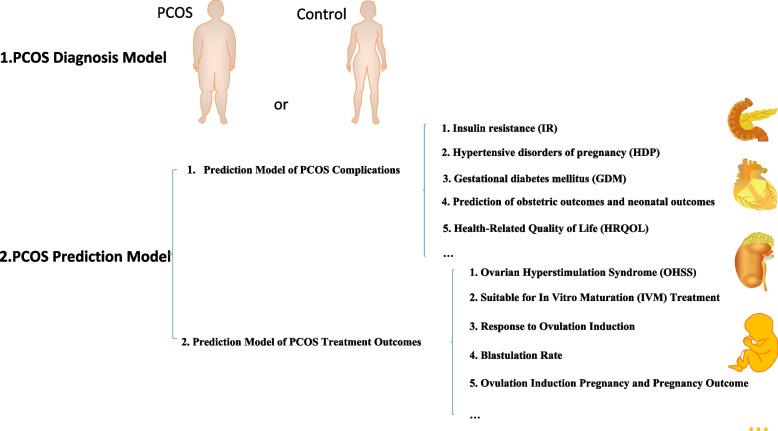
Clinical prediction models play an important role in the field of medicine. These can help predict the probability of an individual suffering from disease, complications, and treatment outcomes by applying specific methodologies. Polycystic ovary syndrome (PCOS) is a common disease with a high incidence rate, huge heterogeneity, short- and long-term complications, and complex treatments. In this systematic review study, we reviewed the progress of clinical prediction models in PCOS patients, including diagnosis and prediction models for PCOS complications and treatment outcomes. We aimed to provide ideas for medical researchers and clues for the management of PCOS. In the future, models with poor accuracy can be greatly improved by adding well-known parameters and validations, which will further expand our understanding of PCOS in terms of precision medicine. By developing a series of predictive models, we can make the definition of PCOS more accurate, which can improve the diagnosis of PCOS and reduce the likelihood of false positives and false negatives. It will also help discover complications earlier and treatment outcomes being known earlier, which can result in better outcomes for women with PCOS.
临床预测模型在医学领域发挥着重要作用。这些模型可以通过应用特定的方法来帮助预测个体患病、并发症和治疗结果的概率。多囊卵巢综合征(PCOS)是一种常见疾病,发病率高、异质性大、有短期和长期并发症,治疗复杂。在本系统评价研究中,我们综述了临床预测模型在 PCOS 患者中的研究进展,包括 PCOS 并发症和治疗结果的诊断和预测模型。我们旨在为医学研究人员提供思路,并为 PCOS 的管理提供线索。未来,可以通过添加知名参数和验证来大大提高准确性较差的模型,从而进一步提高我们对精准医学中 PCOS 的认识。通过开发一系列预测模型,可以使 PCOS 的定义更加准确,从而提高 PCOS 的诊断准确性,减少假阳性和假阴性的可能性。这也有助于更早地发现并发症和更早地了解治疗结果,从而改善 PCOS 女性的治疗效果。
 Zotero 插件