
脑卒中后高血糖管理:TEXAIS 随机临床试验结果。
Management of Poststroke Hyperglycemia: Results of the TEXAIS Randomized Clinical Trial.
机构信息
Department of Neurosciences, Eastern Health and Eastern Health Clinical School, Department of Neurology, Monash University, Clayton, Victoria, Australia (C.F.B., H.M.D., P.M.C.C.).
The Florey Institute of Neuroscience and Mental Health (C.F.B., V.T., B.C.V.C.), University of Melbourne, Parkville, Australia.
出版信息
Stroke. 2023 Dec;54(12):2962-2971. doi: 10.1161/STROKEAHA.123.044568. Epub 2023 Nov 27.
BACKGROUND
Hyperglycemia in acute ischemic stroke reduces the efficacy of stroke thrombolysis and thrombectomy, with worse clinical outcomes. Insulin-based therapies are difficult to implement and may cause hypoglycemia. We investigated whether exenatide, a GLP-1 (glucagon-like peptide-1) receptor agonist, would improve stroke outcomes, and control poststroke hyperglycemia with minimal hypoglycemia.
METHODS
The TEXAIS trial (Treatment With Exenatide in Acute Ischemic Stroke) was an international, multicenter, phase 2 prospective randomized clinical trial (PROBE [Prospective Randomized Open Blinded End-Point] design) enrolling adult patients with acute ischemic stroke ≤9 hours of stroke onset to receive exenatide (5 µg BID subcutaneous injection) or standard care for 5 days, or until hospital discharge (whichever sooner). The primary outcome (intention to treat) was the proportion of patients with ≥8-point improvement in National Institutes of Health Stroke Scale score (or National Institutes of Health Stroke Scale scores 0-1) at 7 days poststroke. Safety outcomes included death, episodes of hyperglycemia, hypoglycemia, and adverse event.
RESULTS
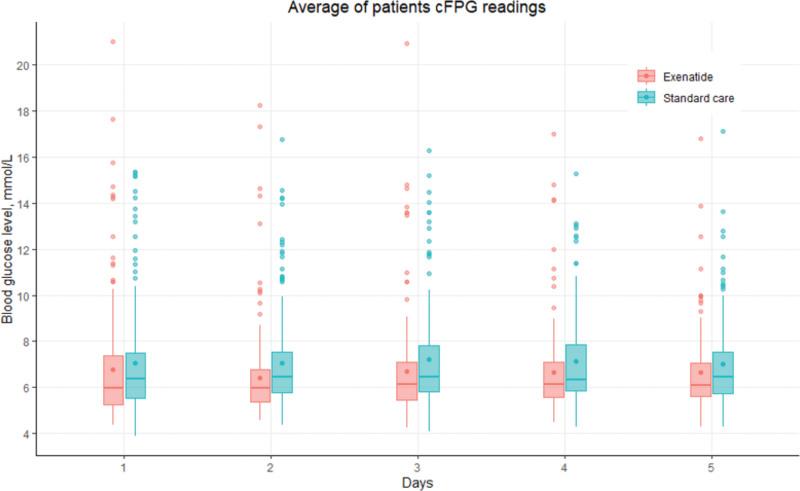
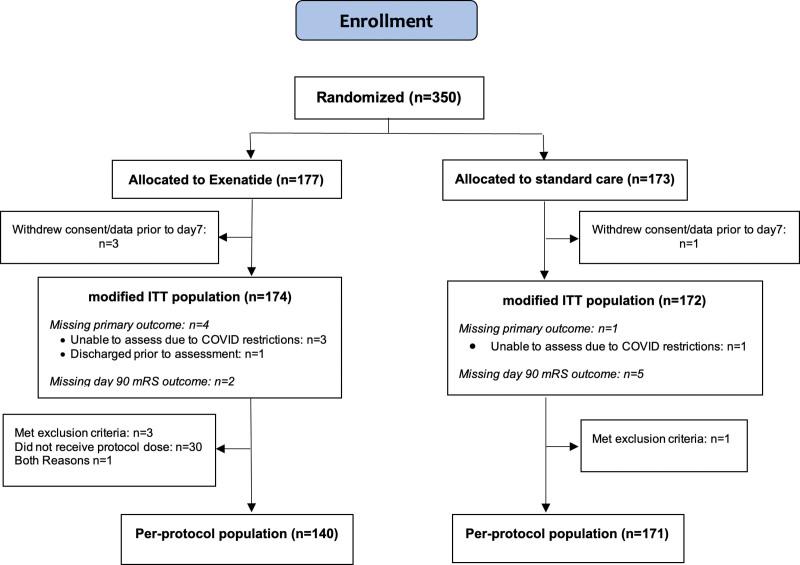
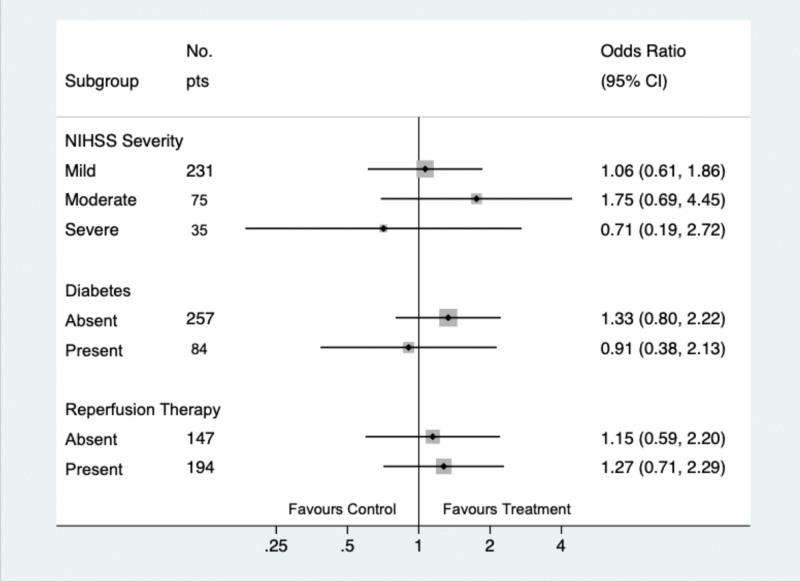
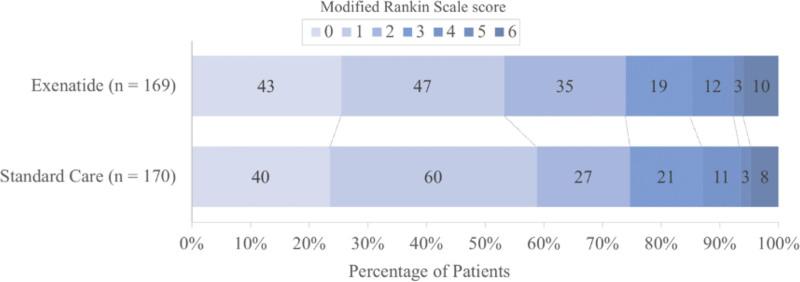
From April 2016 to June 2021, 350 patients were randomized (exenatide, n=177, standard care, n=173). Median age, 71 years (interquartile range, 62-79), median National Institutes of Health Stroke Scale score, 4 (interquartile range, 2-8). Planned recruitment (n=528) was stopped early due to COVID-19 disruptions and funding constraints. The primary outcome was achieved in 97 of 171 (56.7%) in the standard care group versus 104 of 170 (61.2%) in the exenatide group (adjusted odds ratio, 1.22 [95% CI, 0.79-1.88]; =0.38). No differences in secondary outcomes were observed. The per-patient mean daily frequency of hyperglycemia was significantly less in the exenatide group across all quartiles. No episodes of hypoglycemia were recorded over the treatment period. Adverse events of mild nausea and vomiting occurred in 6 (3.5%) exenatide patients versus 0 (0%) standard care with no withdrawal.
CONCLUSIONS
Treatment with exenatide did not reduce neurological impairment at 7 days in patients with acute ischemic stroke. Exenatide did significantly reduce the frequency of hyperglycemic events, without hypoglycemia, and was safe to use. Larger acute stroke trials using GLP-1 agonists such as exenatide should be considered.
REGISTRATION
URL: www.australianclinicaltrials.gov.au; Unique identifier: ACTRN12617000409370. URL: https://www.clinicaltrials.gov; Unique identifier: NCT03287076.
背景
急性缺血性脑卒中患者的高血糖会降低溶栓和取栓治疗的效果,导致更差的临床结局。基于胰岛素的治疗方法难以实施,并且可能导致低血糖。我们研究了 exenatide(一种 GLP-1 受体激动剂)是否会改善脑卒中结局,并在最小化低血糖的情况下控制脑卒中后高血糖。
方法
TEXAS 试验(急性缺血性脑卒中应用 exenatide 治疗)是一项国际多中心 2 期前瞻性随机临床试验(PROBE [前瞻性随机开放盲终点]设计),纳入了发病时间在 9 小时以内的急性缺血性脑卒中成年患者,接受 exenatide(5 µg BID 皮下注射)或标准护理治疗 5 天,或直至出院(以先发生者为准)。主要结局(意向治疗)是在脑卒中后 7 天,NIHSS 评分改善≥8 分的患者比例(或 NIHSS 评分 0-1 分)。安全性结局包括死亡、高血糖发作、低血糖和不良事件。
结果
2016 年 4 月至 2021 年 6 月,共纳入了 350 名患者进行随机分组(exenatide 组,n=177;标准护理组,n=173)。患者中位年龄为 71 岁(四分位距 62-79),NIHSS 评分中位数为 4 分(四分位距 2-8)。由于 COVID-19 疫情和资金限制,计划招募的 528 名患者提前停止。标准护理组中有 97 名(56.7%)患者达到主要结局,exenatide 组中有 104 名(61.2%)患者达到主要结局(调整后的优势比为 1.22 [95% CI,0.79-1.88];=0.38)。次要结局未见差异。在所有四分位数中,exenatide 组的患者每日高血糖发作频率均显著降低。治疗期间未发生低血糖发作。6 名(3.5%)exenatide 患者出现轻度恶心和呕吐的不良反应,而标准护理组无患者出现不良反应(0%),无患者退出试验。
结论
在急性缺血性脑卒中患者中,使用 exenatide 治疗未能在 7 天内减轻神经功能损伤。Exenatide 显著降低了高血糖事件的发生频率,且无低血糖发生,并且使用安全。应考虑开展更大规模的急性脑卒中试验,以评估 GLP-1 激动剂(如 exenatide)的疗效。
注册信息
 Zotero 插件