
第三剂mRNA新冠疫苗针对奥密克戎BA.1毒株在老年人中诱导产生的血清中和抗体滴度的大小和持续时间。
Magnitude and Duration of Serum Neutralizing Antibody Titers Induced by a Third mRNA COVID-19 Vaccination against Omicron BA.1 in Older Individuals.
作者信息
Park Jun-Sun, Jeon Jaehyun, Um Jihye, Choi Youn Young, Kim Min-Kyung, Lee Kyung-Shin, Sung Ho Kyung, Jang Hee-Chang, Chin BumSik, Kim Choon Kwan, Oh Myung-Don, Lee Chang-Seop
机构信息
Research Institute for Public Healthcare, National Medical Center, Seoul, Korea.
Department of Infectious Diseases, National Medical Center, Seoul, Korea.
出版信息
Infect Chemother. 2024 Mar;56(1):25-36. doi: 10.3947/ic.2023.0057. Epub 2023 Nov 1.
BACKGROUND
The severe acute respiratory syndrome coronavirus 2 (SARS-CoV-2) Omicron variant (B.1.1.529) is dominating coronavirus disease 2019 (COVID-19) worldwide. The waning protective effect of available vaccines against the Omicron variant is a critical public health issue. This study aimed to assess the impact of the third COVID-19 vaccination on immunity against the SARS-CoV-2 Omicron BA.1 strain in older individuals.
MATERIALS AND METHODS
Adults aged ≥60 years who had completed two doses of the homologous COVID-19 vaccine with either BNT162b2 (Pfizer/BioNTech, New York, NY, USA, BNT) or ChAdOx1 nCoV (SK bioscience, Andong-si, Gyeongsangbuk-do, Korea, ChAd) were registered to receive the third vaccination. Participants chose either BNT or mRNA-1273 (Moderna, Norwood, MA, USA, m1273) mRNA vaccine for the third dose and were categorized into four groups: ChAd/ChAd/BNT, ChAd/ChAd/m1273, BNT/BNT/BNT, and BNT/BNT/m1273. Four serum specimens were obtained from each participant at 0, 4, 12, and 24 weeks after the third dose (V1, V2, V3, and V4, respectively). Serum-neutralizing antibody (NAb) activity against BetaCoV/Korea/KCDC03/2020 (NCCP43326, ancestral strain) and B.1.1.529 (NCCP43411, Omicron BA.1 variant) was measured using plaque reduction neutralization tests. A 50% neutralizing dilution (ND) >10 was considered indicative of protective NAb titers.
RESULTS
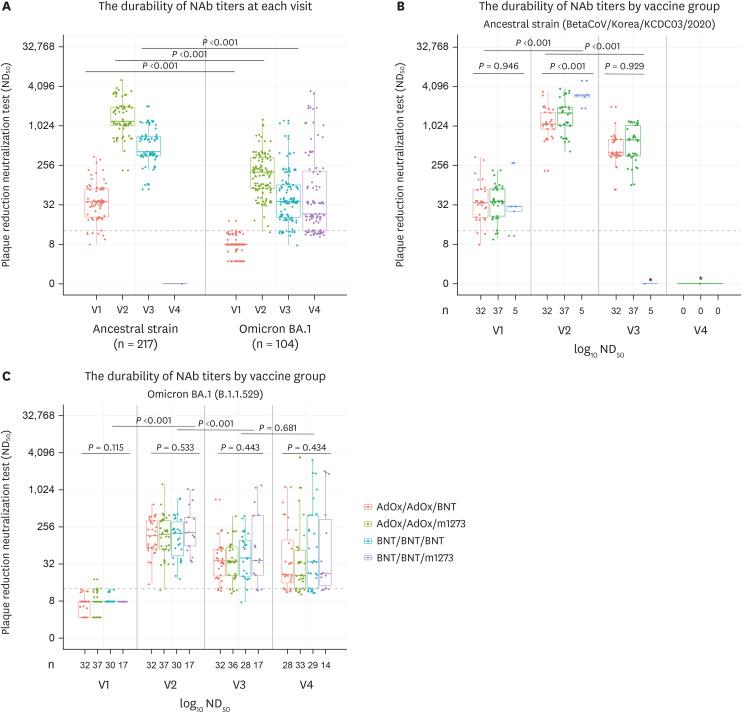
In total, 186 participants were enrolled between November 24, 2021, and June 30, 2022. The respective groups received the third dose at a median (interquartile range [IQR]) of 132 (125 - 191), 123 (122 - 126), 186 (166 - 193), and 182 (175 - 198) days after the second dose. Overall, ND was lower at V1 against Omicron BA.1 than against the ancestral strain. NAb titers against the ancestral strain and Omicron BA.1 variant at V2 were increased at least 30-fold (median [IQR], 1235.35 [1021.45 - 2374.65)] and 129.8 [65.3 - 250.7], respectively). ND titers against the ancestral strain and Omicron variant did not differ significantly among the four groups ( = 0.57). NAb titers were significantly lower against the Omicron variant than against the ancestral strain at V3 (median [IQR], 36.4 (17.55 - 75.09) 325.9 [276.07 - 686.97]; = 0.012). NAb titers against Omicron at V4 were 16 times lower than that at V3. Most sera exhibited a protective level (ND >10) at V4 (75.0% [24/32], 73.0% [27/37], 73.3% [22/30], and 70.6% [12/17] in the ChAd/ChAd/BNT, ChAd/ChAd/m1273, BNT/BNT/BNT, and BNT/BNT/m1273 groups, respectively), with no significant differences among groups ( = 0.99).
CONCLUSION
A third COVID-19 mRNA vaccine dose restored waning NAb titers against Omicron BA.1. Our findings support a third-dose vaccination program to prevent the waning of humoral immunity to SARS-CoV-2.
背景
严重急性呼吸综合征冠状病毒2(SARS-CoV-2)奥密克戎变异株(B.1.1.529)在全球范围内主导着2019冠状病毒病(COVID-19)。现有疫苗对奥密克戎变异株的保护作用减弱是一个关键的公共卫生问题。本研究旨在评估第三次COVID-19疫苗接种对老年人针对SARS-CoV-2奥密克戎BA.1毒株免疫力的影响。
材料与方法
≥60岁且已完成两剂同源COVID-19疫苗接种(分别为BNT162b2(辉瑞/生物新技术公司,美国纽约州,BNT)或ChAdOx1 nCoV(SK生物科学公司,韩国庆尚北道安东市,ChAd))的成年人登记接受第三次疫苗接种。参与者选择BNT或mRNA-1273(莫德纳公司,美国马萨诸塞州诺伍德市,m1273)mRNA疫苗作为第三剂,并分为四组:ChAd/ChAd/BNT、ChAd/ChAd/m1273、BNT/BNT/BNT和BNT/BNT/m127-3。在第三剂接种后的0、4、12和24周(分别为V1、V2、V3和V4)从每位参与者处采集四份血清样本。使用蚀斑减少中和试验测量针对BetaCoV/韩国/KCDC03/2020(NCCP43326,原始毒株)和B.1.1.529(NCCP43411,奥密克戎BA.1变异株)的血清中和抗体(NAb)活性。50%中和稀释度(ND)>10被认为表明具有保护性NAb滴度。
结果
2021年11月24日至2022年6月30日期间共招募了186名参与者。各组在第二剂接种后的中位数(四分位间距[IQR])分别为132(125 - 191)、123(122 - 126)、186(166 - 193)和182(175 - 198)天接受第三剂接种。总体而言,V1时针对奥密克戎BA.1的ND低于针对原始毒株的ND。V2时针对原始毒株和奥密克戎BA.1变异株的NAb滴度至少增加了30倍(中位数[IQR]分别为1235.35[1021.45 - 2374.65]和129.8[65.3 - 250.7])。四组之间针对原始毒株和奥密克戎变异株的ND滴度无显著差异(P = 0.57)。V3时针对奥密克戎变异株的NAb滴度显著低于针对原始毒株的滴度(中位数[IQR],36.4(17.55 - 75.09)对325.9[276.07 - 686.97];P = 0.012)。V4时针对奥密克戎的NAb滴度比V3时低16倍。大多数血清在V4时表现出保护水平(ND>10)(ChAd/ChAd/BNT组为75.0%[24/32],ChAd/ChAd/m1273组为73.0%[27/37],BNT/BNT/BNT组为73.3%[22/30],BNT/BNT/m1273组为70.6%[12/17]),各组之间无显著差异(P = 0.99)。
结论
第三次COVID-19 mRNA疫苗接种恢复了针对奥密克戎BA.1减弱的NAb滴度。我们的研究结果支持进行第三剂疫苗接种计划,以防止对SARS-CoV-2的体液免疫减弱。


 Zotero 插件