
二氢叶酸还原酶作为药物靶点在.中的药理学验证
Pharmacological validation of dihydrofolate reductase as a drug target in .
机构信息
Center for Discovery and Innovation, Hackensack Meridian Health , Nutley, New Jersey, USA.
Merck & Co., Inc. , West Point, Pennsylvania, USA.
出版信息
Antimicrob Agents Chemother. 2024 Jan 10;68(1):e0071723. doi: 10.1128/aac.00717-23. Epub 2023 Nov 29.
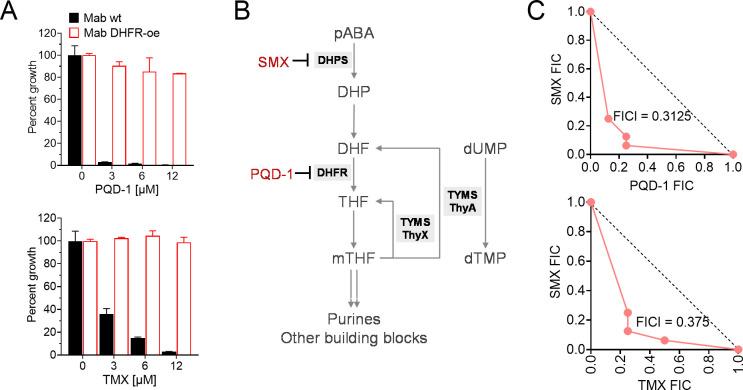
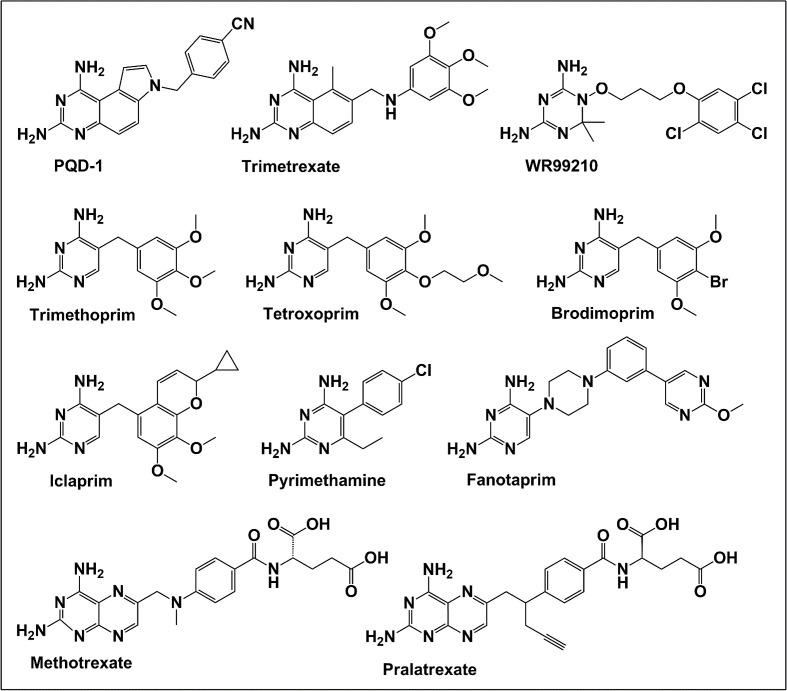
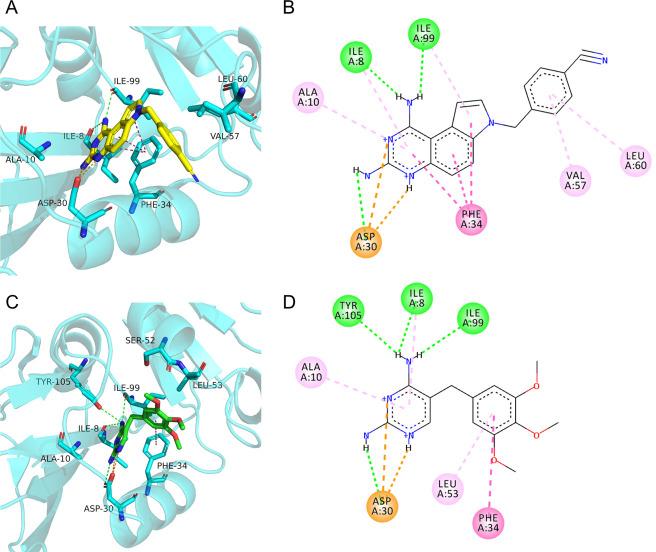
The drug development pipeline is poorly populated, with particularly few validated target-lead couples to initiate drug discovery. Trimethoprim, an inhibitor of dihydrofolate reductase (DHFR) used for the treatment of a range of bacterial infections, is not active against . Thus, evidence that DHFR is vulnerable to pharmacological intervention with a small molecule inhibitor is lacking. Here, we show that the pyrrolo-quinazoline PQD-1, previously identified as a DHFR inhibitor active against , exerts whole cell activity against . Enzyme inhibition studies showed that PQD-1, in contrast to trimethoprim, is a potent inhibitor of DHFR and over-expression of DHFR causes resistance to PQD-1, providing biochemical and genetic evidence that DHFR is a vulnerable target and mediates PQD-1's growth inhibitory activity in . As observed in , PQD-1 resistant mutations mapped to the folate pathway enzyme thymidylate synthase (TYMS) ThyA. Like trimethoprim in other bacteria, PQD-1 synergizes with the dihydropteroate synthase (DHPS) inhibitor sulfamethoxazole (SMX), offering an opportunity to exploit the successful dual inhibition of the folate pathway and develop similarly potent combinations against . PQD-1 is active against subspecies of and a panel of clinical isolates, providing epidemiological validation of the target-lead couple. Leveraging a series of PQD-1 analogs, we have demonstrated a dynamic structure-activity relationship (SAR). Collectively, the results identify DHFR as an attractive target and PQD-1 as a chemical starting point for the discovery of novel drugs and drug combinations that target the folate pathway in .
药物研发管道中可供选择的药物很少,特别是很少有经过验证的靶标-先导化合物对来启动药物发现。三甲氧苄氨嘧啶(TMP)是一种二氢叶酸还原酶(DHFR)抑制剂,用于治疗多种细菌感染,但对 无效。因此,缺乏小分子抑制剂对 DHFR 进行药理干预的证据。在这里,我们表明,先前被鉴定为对 有效且针对 DHFR 的吡咯并喹唑啉 PQD-1,对 具有全细胞活性。酶抑制研究表明,与 TMP 相反,PQD-1 是一种有效的 DHFR 抑制剂,DHFR 的过表达导致对 PQD-1 的耐药性,提供了生化和遗传证据,表明 DHFR 是一个脆弱的靶标,并介导了 PQD-1 在 中的生长抑制活性。与 在 中观察到的情况一样,PQD-1 耐药性突变映射到叶酸途径酶胸苷酸合成酶(TYMS)ThyA。与其他细菌中的 TMP 一样,PQD-1 与二氢喋呤合成酶(DHPS)抑制剂磺胺甲恶唑(SMX)协同作用,为利用叶酸途径的成功双重抑制提供了机会,并开发了针对 同样有效的组合。PQD-1 对 和一组临床分离株的亚种均有效,为目标-先导化合物对提供了流行病学验证。利用一系列 PQD-1 类似物,我们已经证明了一种动态的结构-活性关系(SAR)。总之,这些结果确定了 DHFR 作为一个有吸引力的靶标,以及 PQD-1 作为发现针对 叶酸途径的新型药物和药物组合的化学起点。

 Zotero 插件