
乳房重建中外科医生报告的腹壁下深动脉穿支皮瓣术后方案调查。
Survey of Surgeon-reported Postoperative Protocols for Deep Inferior Epigastric Perforator Flap in Breast Reconstruction.
作者信息
Araya Sthefano, Hackley Madison, Amadio Grace M, Deng Mengying, Moss Civanni, Reinhardt Eliann, Walchak Adam, Tecce Michael G, Patel Sameer A
机构信息
From the Division of Plastic and Reconstructive Surgery, Fox Chase Cancer Center, Philadelphia, Pa.
Lewis Katz School of Medicine, Temple University, Philadelphia, Pa.
出版信息
Plast Reconstr Surg Glob Open. 2023 Nov 15;11(11):e5402. doi: 10.1097/GOX.0000000000005402. eCollection 2023 Nov.
BACKGROUND
The use of deep inferior epigastric perforator (DIEP) flaps is a well-established breast reconstruction technique.
METHODS
A 29-question survey was e-mailed to 3186 active American Society of Plastic Surgeons members, aiming to describe postoperative monitoring practice patterns among surgeons performing DIEP flaps.
RESULTS
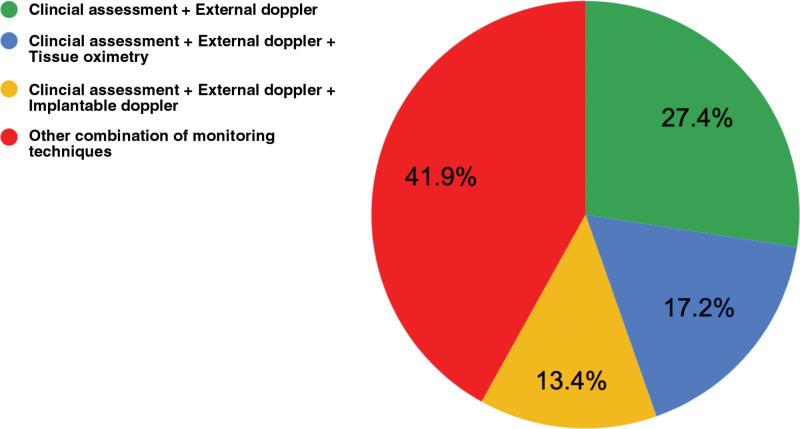
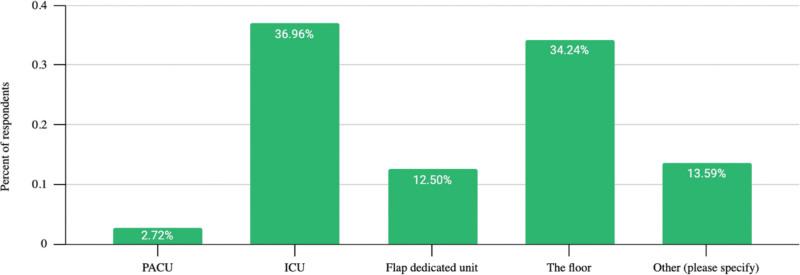
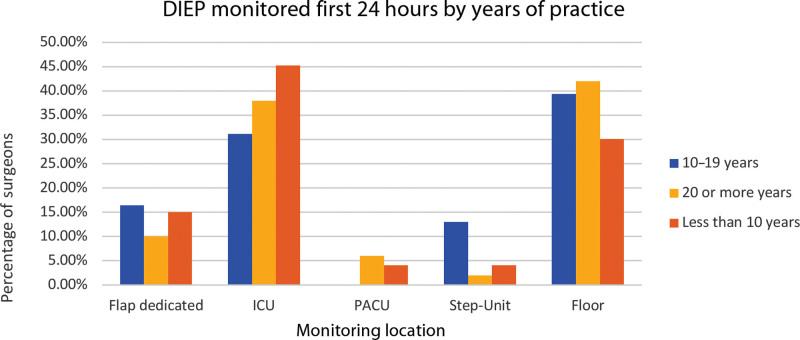
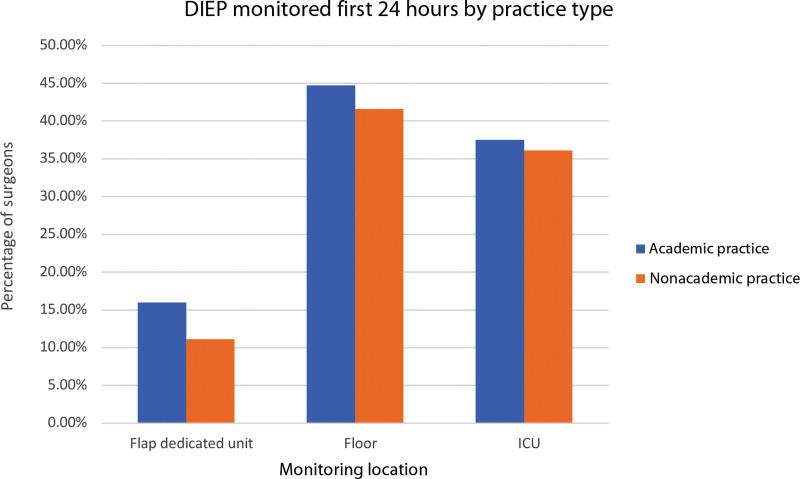
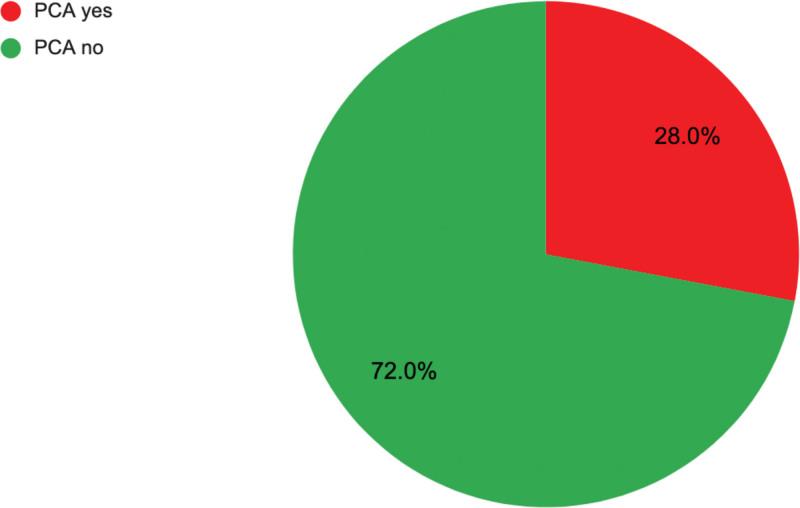
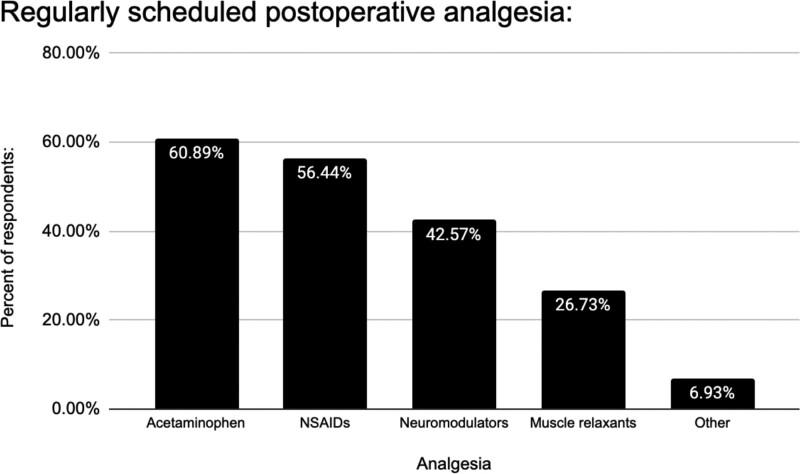
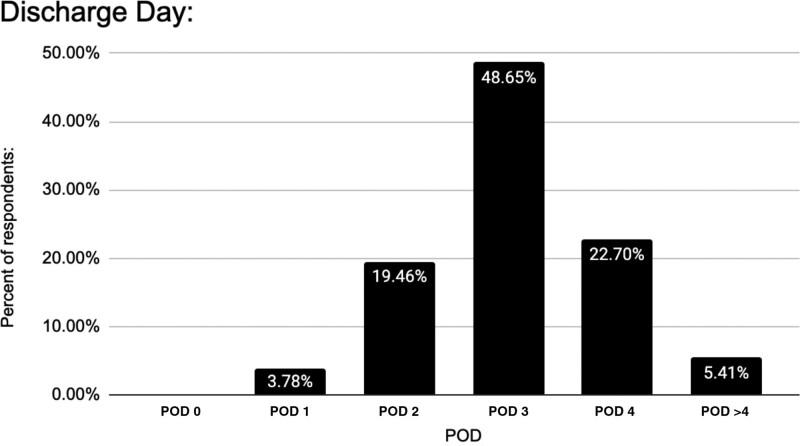
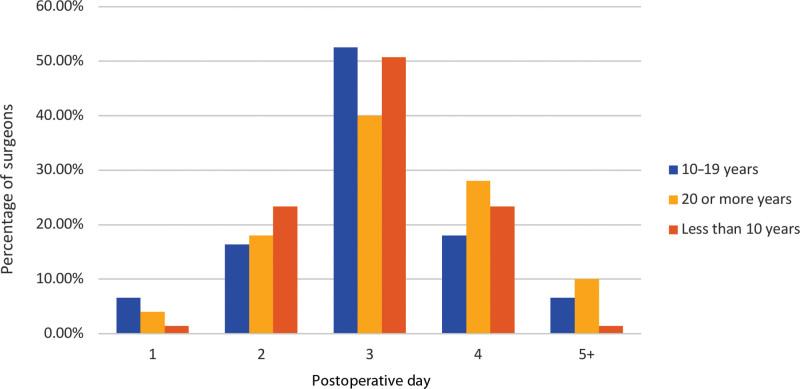
From 255 responses (8%), 79% performing DIEP surgery were analyzed. Among them, 34.8% practiced for more than 20 years, 34.3% for 10-20 years, and 30.9% for less than 10 years. Initial 24-hour post-DIEP monitoring: intensive care unit (39%) and floor (36%). Flap monitoring: external Doppler (71%), tissue oximetry (41%), and implantable Doppler (32%). Postoperative analgesia: acetaminophen (74%), non-steroidal anti-inflammatory drugs (69%), neuromodulators (52%), and opioids (4.4%) were administered on a scheduled basis. On postoperative day 1, 61% halt intravenous fluids, 67% allow ambulation, 70% remove Foley catheter, and 71% start diet. Most surgeons discharged patients from the hospital on postoperative day 3+. Regardless of experience, patients were commonly discharged on day 3. Half of the surgeons are in academic/nonacademic settings and discharge on/after day 3.
CONCLUSIONS
This study reveals significant heterogeneity among the practice patterns of DIEP surgeons. In light of these findings, it is recommended that a task force be convened to establish standardized monitoring protocols for DIEP flaps. Such protocols have the potential to reduce both the length of hospital stays and overall care costs all while ensuring optimal pain management and vigilant flap monitoring.
背景
使用腹壁下深动脉穿支(DIEP)皮瓣是一种成熟的乳房重建技术。
方法
通过电子邮件向3186名美国整形外科学会活跃会员发送了一份包含29个问题的调查问卷,旨在描述进行DIEP皮瓣手术的外科医生术后监测的实践模式。
结果
共收到255份回复(回复率8%),其中79%进行DIEP手术的医生参与了分析。其中,34.8%的医生从业超过20年,34.3%的医生从业10 - 20年,30.9%的医生从业少于10年。DIEP术后最初24小时的监测:重症监护病房(39%)和普通病房(36%)。皮瓣监测:外部多普勒(71%)、组织血氧饱和度监测(41%)和植入式多普勒(32%)。术后镇痛:按计划使用对乙酰氨基酚(74%)、非甾体类抗炎药(69%)、神经调节剂(52%)和阿片类药物(4.4%)。术后第1天,61%停止静脉输液,67%允许患者下床活动,70%拔除导尿管,71%开始进食。大多数外科医生在术后第3天及以后让患者出院。无论经验如何,患者通常在第3天出院。一半的外科医生在学术/非学术机构工作,在第3天或之后让患者出院。
结论
本研究揭示了DIEP手术医生实践模式存在显著异质性。鉴于这些发现,建议召集一个特别工作组来制定DIEP皮瓣的标准化监测方案。这样的方案有可能缩短住院时间并降低总体护理成本,同时确保最佳的疼痛管理和对皮瓣的密切监测。




 Zotero 插件