
摩洛哥青少年中与-JP2基因型相关的C级牙周炎的细菌群落分析。
Bacteriome analysis of -JP2 genotype-associated Grade C periodontitis in Moroccan adolescents.
作者信息
Molli Vijaya Lakshmi Pavani, Kissa Jamila, Baraniya Divyashri, Gharibi Amina, Chen Tsute, Al-Hebshi Nezar N, Albandar Jasim M
机构信息
Department of Periodontology and Oral Implantology, Maurice H. Kornberg School of Dentistry, Temple University, Philadelphia, PA, United States.
Department of Periodontology, Faculty of Dental Medicine, University of Hassan II, Casablanca, Morocco.
出版信息
Front Oral Health. 2023 Nov 14;4:1288499. doi: 10.3389/froh.2023.1288499. eCollection 2023.
BACKGROUND
Grade C (previously aggressive) periodontitis (GCP) in adolescents is prevalent in certain parts of Africa where it is associated with JP2 genotype, a highly virulent strain of . The aim of this study was to characterize the subgingival bacteriome in Moroccan subjects with GCP positive to JP2 genotype.
METHODS
Subgingival plaque samples were collected from shallow and deep pockets of 8 subjects with GCP (17.2 ± 1.5 years) and from gingival sulci of 13 controls with no periodontitis (14.6 ± 1.1 years). Identification and genotyping of was performed using PCR analysis of the operon, while bacteriome profiling was done by 16S rRNA gene sequencing (V1-V3 region). Groups were compared in terms of microbial diversity, abundances, and dysbiosis.
RESULTS
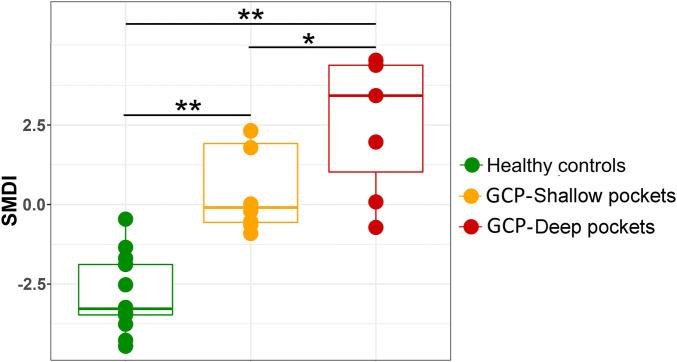
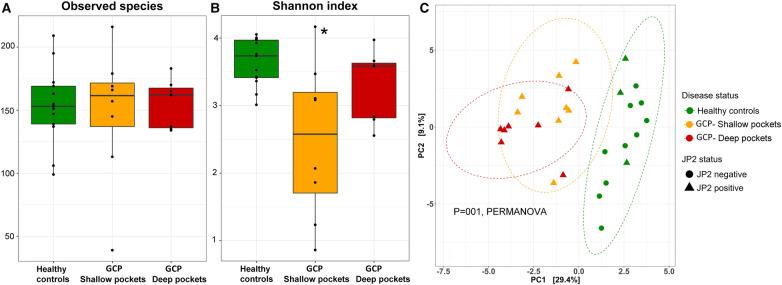
The shallow and deep pocket sites from GCP cases had a significantly altered microbial composition compared to controls. Species associated with health included and While known periodontal pathogens, including , , and , were significantly enriched in GCP, non-conventional taxa, including and were more abundant and showed stronger association with the disease. Less significant differences in abundances of individual taxa were observed between shallow and deep pockets. Overall dysbiosis measured in terms of Subgingival Microbial Dysbiosis Index (SMDI) differentiated between GCP and no-periodontitis with 95% accuracy.
CONCLUSIONS
The results suggest that several periodontal pathogens involved in the adult-type periodontitis also play a role in JP2 genotype-associated GCP. The potential role of non-conventional taxa in the pathogenesis of GCP warrants further investigation.
背景
青少年C级(以前称为侵袭性)牙周炎(GCP)在非洲某些地区很普遍,在那里它与JP2基因型有关,JP2是一种高毒力菌株。本研究的目的是对摩洛哥GCP阳性且携带JP2基因型的受试者的龈下细菌群落进行特征分析。
方法
从8名患有GCP的受试者(17.2±1.5岁)的浅袋和深袋以及13名无牙周炎的对照受试者(14.6±1.1岁)的龈沟中采集龈下菌斑样本。使用操纵子的PCR分析进行鉴定和基因分型,同时通过16S rRNA基因测序(V1-V3区域)进行细菌群落分析。在微生物多样性、丰度和生态失调方面对各组进行比较。
结果
与对照组相比,GCP病例的浅袋和深袋部位的微生物组成有显著改变。与健康相关的物种包括和。虽然已知的牙周病原体,包括、、和,在GCP中显著富集,但非传统分类群,包括和,更为丰富,并且与疾病的关联更强。浅袋和深袋之间单个分类群的丰度差异较小。根据龈下微生物生态失调指数(SMDI)衡量的总体生态失调以95%的准确率区分了GCP和无牙周炎。
结论
结果表明,几种参与成人型牙周炎的牙周病原体在与JP2基因型相关的GCP中也起作用。非传统分类群在GCP发病机制中的潜在作用值得进一步研究。



 Zotero 插件