
牙周炎细菌多样性研究的可行性及初步结果:来自西开普省的一项初步调查
Feasibility and preliminary findings of a bacterial diversity study in periodontitis: a pilot investigation from the Western Cape.
作者信息
Kabbashi Salma, Prince Yvonne, Ngwa Ndonwi Elvis, Holmes Haly, Davids Saarah F G, Chetty Manogari
机构信息
Department of Craniofacial Biology, Pathology, & Radiology, Faculty of Dentistry, University of the Western Cape, Cape Town, South Africa.
SAMRC/CPUT/Cardiometabolic Health Research Unit, Department of Biomedical Sciences, Faculty of Health & Wellness Sciences, Cape Peninsula University of Technology, Cape Town, South Africa.
出版信息
Front Oral Health. 2025 Apr 23;6:1568393. doi: 10.3389/froh.2025.1568393. eCollection 2025.
INTRODUCTION
Periodontitis is a significant health challenge caused by a complex interaction between bacterial infection, host immune response, and environmental factors, leading to tooth loss, bone loss, and potential associations with major systemic diseases and conditions. While the determinants of periodontitis have been extensively investigated in other populations, such studies are lacking in South Africa, which represents a high-risk population. Therefore, this study was conducted to characterize the subgingival bacterial biodiversity in the periodontal pockets of patients with periodontitis in a Western Cape population.
MATERIALS & METHODS: Pooled subgingival plaque samples were collected from the deepest pocket/crevices of five periodontitis cases and five controls using sterile paper points. Illumina MiSeq paired-end sequencing and QIIME2 software were employed for sequence filtration and analysis. Several alpha and beta-diversity metrics assessed biodiversity within-sample and population structure between different microbiota datasets, respectively. Statistical significance for alpha diversity was tested using the Kruskal-Wallis H test ( < 0.05), and beta diversity differences were evaluated using PERMANOVA. Data visualization, including beta diversity plots, was conducted with the Phyloseq package in R.
RESULTS
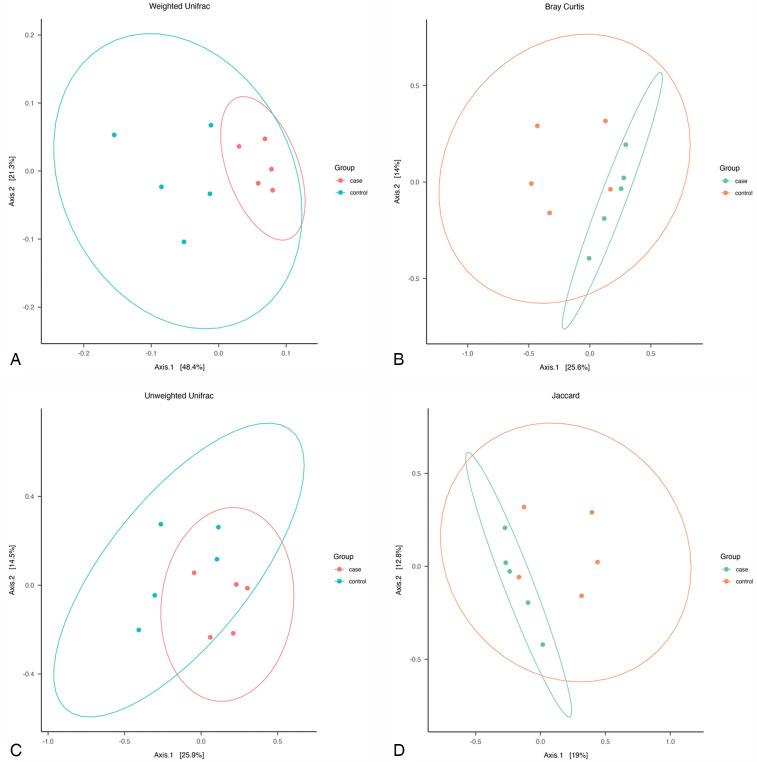
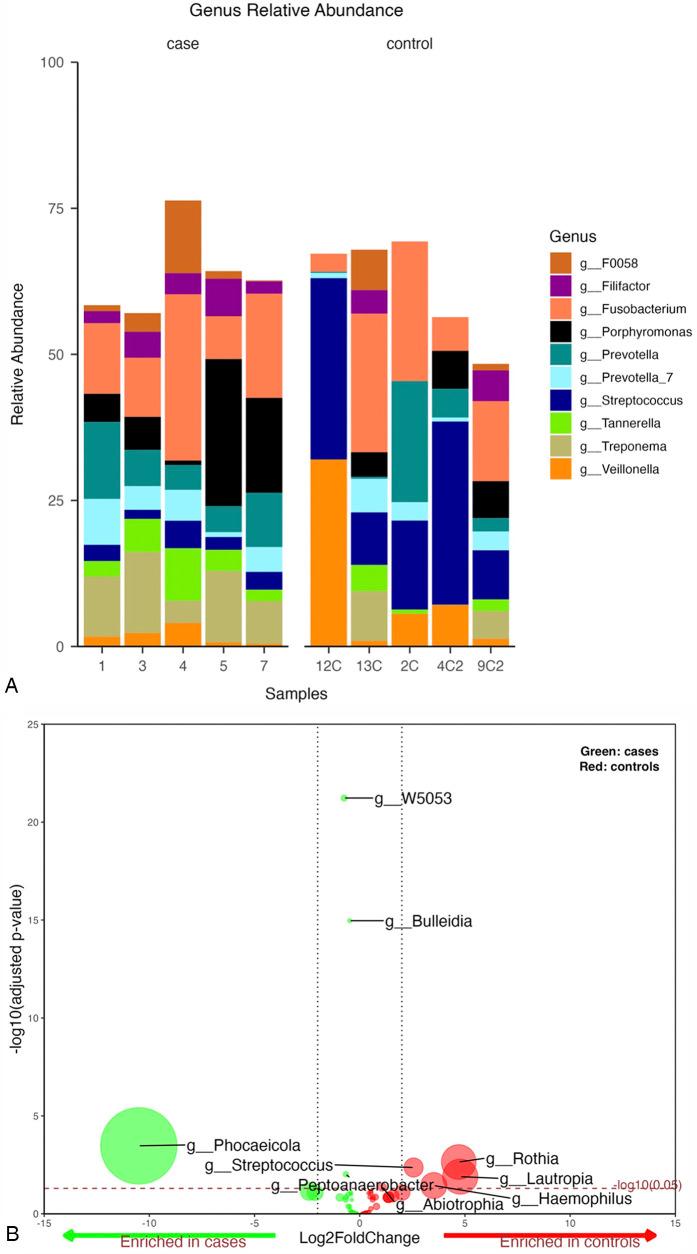
Beta-diversity measures revealed significant differences between periodontitis cases and controls (-value = 0.04), whereas alpha-diversity was higher in cases, though without statistical significance (-value ≥ 0.05). Cases group showed high relative abundance of (16%), (10%), and (9%), while the periodontally healthy controls were dominated by (20%), (15%), and (10%), with showing a significant difference (-value = 0.008). Differential abundance analysis revealed distinct bacterial genera enriched in cases (, , , ) and controls (, , , , ). Sample-specific variations included higher levels of (15%) in grade B and (20%) in grade C.
CONCLUSION
This exploratory study highlights distinct bacterial communities associated with periodontitis in a South African population. The findings emphasize the need for larger, population-based cohorts to validate these results and lay a foundation for future research into region-specific microbial profiles and their implications for personalized treatment strategies.
引言
牙周炎是由细菌感染、宿主免疫反应和环境因素之间复杂的相互作用引起的重大健康挑战,会导致牙齿脱落、骨质流失,并可能与主要的全身性疾病和病症相关联。虽然在其他人群中对牙周炎的决定因素进行了广泛研究,但在代表高风险人群的南非缺乏此类研究。因此,本研究旨在描述西开普省人群中牙周炎患者牙周袋内龈下细菌生物多样性的特征。
材料与方法
使用无菌纸尖从5例牙周炎病例和5例对照的最深牙周袋/裂隙中收集混合龈下菌斑样本。采用Illumina MiSeq双端测序和QIIME2软件进行序列过滤和分析。分别使用几个α和β多样性指标评估样本内的生物多样性以及不同微生物群数据集之间的群体结构。使用Kruskal-Wallis H检验(<0.05)检验α多样性的统计学显著性,并使用PERMANOVA评估β多样性差异。使用R中的Phyloseq包进行数据可视化,包括β多样性图。
结果
β多样性测量显示牙周炎病例与对照之间存在显著差异(P值=0.04),而病例组的α多样性较高,但无统计学显著性(P值≥0.05)。病例组显示[具体细菌名称1](16%)、[具体细菌名称2](10%)和[具体细菌名称3](9%)的相对丰度较高,而牙周健康对照组以[具体细菌名称4](20%)、[具体细菌名称5](15%)和[具体细菌名称6](10%)为主,[具体细菌名称7]表现出显著差异(P值=0.008)。差异丰度分析揭示了病例组([具体细菌属1]、[具体细菌属2]、[具体细菌属3]、[具体细菌属4])和对照组([具体细菌属5]、[具体细菌属6]、[具体细菌属7]、[具体细菌属8]、[具体细菌属9])中富集的不同细菌属。样本特异性变化包括B级中[具体细菌名称8]水平较高(15%)和C级中[具体细菌名称9]水平较高(20%)。
结论
这项探索性研究突出了南非人群中与牙周炎相关的独特细菌群落。研究结果强调需要更大规模的基于人群的队列研究来验证这些结果,并为未来针对特定区域微生物谱及其对个性化治疗策略的影响的研究奠定基础。

 Zotero 插件