
肽支架内双核镍金属中心的pH依赖性可逆形成
pH Dependent Reversible Formation of a Binuclear Ni Metal-Center Within a Peptide Scaffold.
作者信息
Keegan Brenna C, Ocampo Daniel, Shearer Jason
机构信息
Department of Chemistry, Trinity University, 1 Trinity Place, San Antonio, TX 78212, U.S.A.
出版信息
Inorganics (Basel). 2019 Jul;7(7). doi: 10.3390/inorganics7070090. Epub 2019 Jul 16.
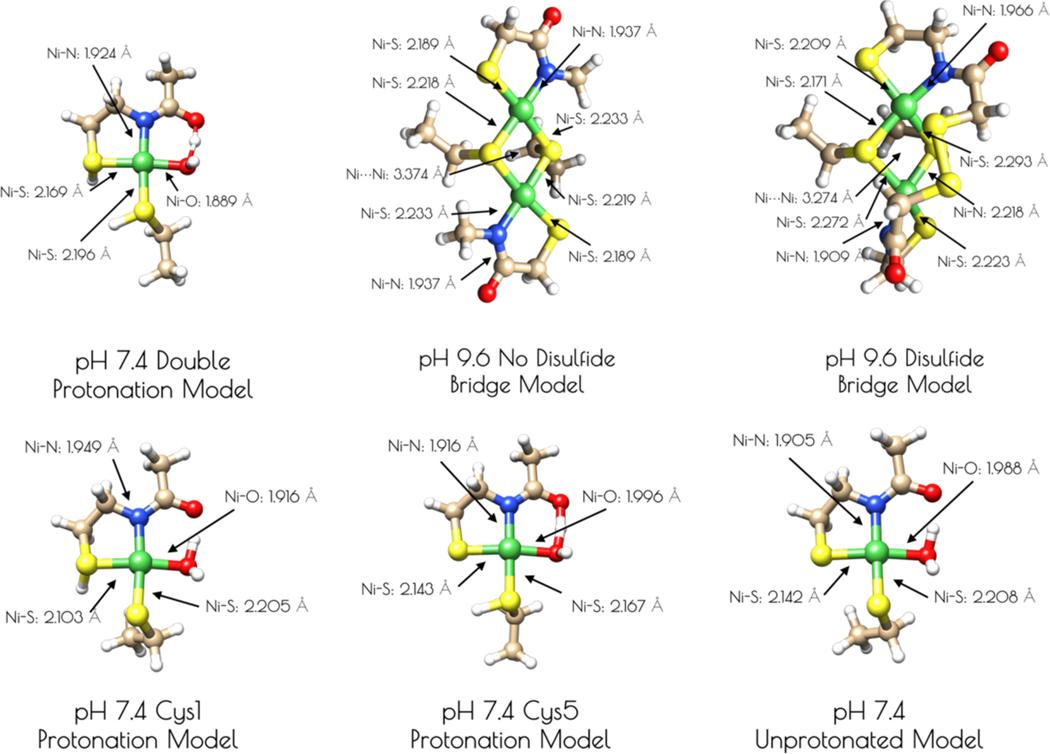
A disulfide-bridged peptide containing two Ni binding sites based on the nickel superoxide dismutase protein, {Ni(SOD)}, has been prepared. At physiological pH (7.4) it was found that the metal sites are mononuclear with a square planar NOS coordination environment with the two sulfur-based ligands derived from cysteinate residues, the nitrogen ligand derived from the amide backbone and a water ligand. Furthermore, S K-edge X-ray absorption spectroscopy indicated that the two cysteinate sulfur atoms ligated to nickel are each protonated. Elevation of the pH to 9.6 results in the deprotonation of the cysteinate sulfur atoms, and yields a binuclear, cysteinate bridged Ni center with each nickel contained in a distorted square planar geometry. At both pH = 7.4 and 9.6 the nickel sites are moderately air sensitive, yielding intractable oxidation products. However, at pH = 9.6 {Ni(SOD)} reacts with O at an ~3.5-fold faster rate than at pH = 7.4. Electronic structure calculations indicate the reduced reactivity at pH = 7.4 is a result of a reduction in S(3p) character and deactivation of the nucleophilic frontier molecular orbitals upon cysteinate sulfur protonation.
基于镍超氧化物歧化酶蛋白制备了一种含有两个镍结合位点的二硫键桥连肽,即{Ni(SOD)}。在生理pH值(7.4)下,发现金属位点为单核,具有平面正方形的NOS配位环境,两个硫基配体源自半胱氨酸残基,氮配体源自酰胺主链,还有一个水配体。此外,S K边X射线吸收光谱表明,与镍配位的两个半胱氨酸硫原子均被质子化。将pH值升高到9.6会导致半胱氨酸硫原子去质子化,并产生一个双核的、由半胱氨酸桥连的镍中心,每个镍处于扭曲的平面正方形几何结构中。在pH = 7.4和9.6时,镍位点对空气都有一定的敏感性,会产生难以处理的氧化产物。然而,在pH = 9.6时,{Ni(SOD)}与O反应的速率比在pH = 7.4时快约3.5倍。电子结构计算表明,在pH = 7.4时反应活性降低是由于半胱氨酸硫质子化后S(3p)特征减少以及亲核前沿分子轨道失活所致。




 Zotero 插件