
从模型肽研究中对镍过氧化物降解机制的新认识。
New insights into the mechanism of nickel superoxide degradation from studies of model peptides.
机构信息
Eduard-Zintl Institute for Physical and Inorganic Chemistry, Darmstadt University of Technology, Alarich-Weiss-Str. 8, 64287, Darmstadt, Germany.
Pharmaceutical Biochemistry and Bioanalytics, Pharmaceutical Institute, University of Bonn, An der Immenburg 4, D-53119, Bonn, Germany.
出版信息
Sci Rep. 2017 Dec 8;7(1):17194. doi: 10.1038/s41598-017-17446-3.
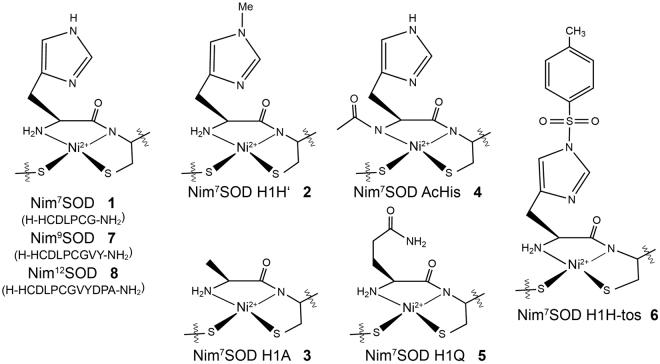
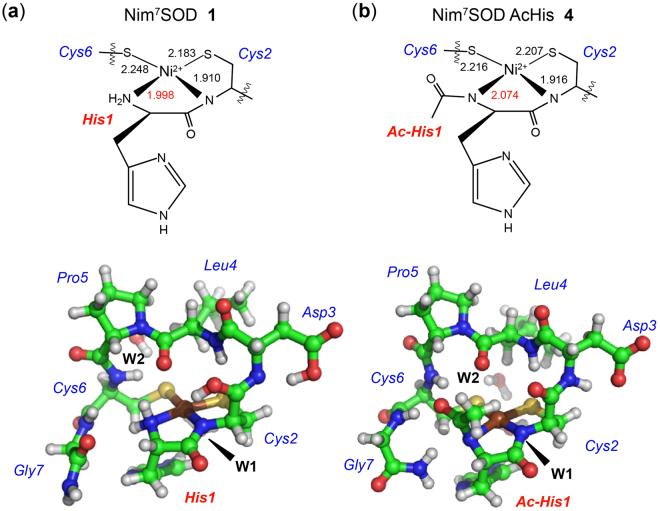
A series of small, catalytically active metallopeptides, which were derived from the nickel superoxide dismutase (NiSOD) active site were employed to study the mechanism of superoxide degradation especially focusing on the role of the axial imidazole ligand. In the literature, there are contradicting propositions about the catalytic importance of the N-terminal histidine. Therefore, we studied the stability and activity of a set of eight NiSOD model peptides, which represent the major model systems discussed in the literature to date, yet differing in their length and their Ni-coordination. UV-Vis-coupled stopped-flow kinetic measurements and mass spectrometry analysis unveiled their high oxidation sensitivity in the presence of oxygen and superoxide resulting into a much faster Ni(II)-peptide degradation for the amine/amide Ni(II) coordination than for the catalytically inactive bis-amidate Ni(II) coordination. With respect to these results we determined the catalytic activities for all NiSOD mimics studied herein, which turned out to be in almost the same range of about 2 × 10 M s. From these experiments, we concluded that the amine/amide Ni(II) coordination is clearly the key factor for catalytic activity. Finally, we were able to clarify the role of the N-terminal histidine and to resolve the contradictory literature propositions, reported in previous studies.
一系列的小的、催化活性的金属肽,来源于镍超氧化物歧化酶(NiSOD)活性位点,被用来研究超氧化物降解的机制,特别是关注轴向咪唑配体的作用。在文献中,关于 N 端组氨酸的催化重要性存在相互矛盾的观点。因此,我们研究了一组 8 个 NiSOD 模型肽的稳定性和活性,这些模型肽代表了迄今为止文献中讨论的主要模型体系,但在长度和 Ni 配位上有所不同。紫外-可见耦合的停流动力学测量和质谱分析揭示了它们在氧气和超氧存在下的高氧化敏感性,导致胺/酰胺 Ni(II)配位的 Ni(II)-肽降解速度比催化非活性的双酰胺 Ni(II)配位快得多。根据这些结果,我们确定了所有在此研究的 NiSOD 模拟物的催化活性,结果发现它们几乎处于相同的范围,约为 2×10^-5 M s。从这些实验中,我们得出结论,胺/酰胺 Ni(II)配位显然是催化活性的关键因素。最后,我们能够阐明 N 端组氨酸的作用,并解决之前研究中报道的相互矛盾的文献观点。



 Zotero 插件