
多维分析阐明乳腺癌骨转移的可能机制。
Multidimensional analysis to elucidate the possible mechanism of bone metastasis in breast cancer.
机构信息
Cancer Center, Department of Orthopedics, Affliated People`s Hospital, Zhejiang Provincial People`s Hospital, Hangzhou Medical College, Hangzhou, Zhejiang, China.
Department of Laboratory Medicine, Affliated People`s Hospital, Zhejiang Provincial People's Hospital, Hangzhou Medical College, Hangzhou, Zhejiang, China.
出版信息
BMC Cancer. 2023 Dec 8;23(1):1213. doi: 10.1186/s12885-023-11588-6.
BACKGROUND
Breast cancer (BC) patients tend to suffer from distant metastasis, especially bone metastasis.
METHODS
All the analysis based on open-accessed data was performed in R software, dependent on multiple algorithms and packages. The RNA levels of specific genes were detected using quantitative Real-time PCR as a method of detecting the RNA levels. To assess the ability of BC cells to proliferate, we utilized the CCK8 test, colony formation, and the 5-Ethynyl-20-deoxyuridine assay. BC cells were evaluated for invasion and migration by using Transwell assays and wound healing assays.
RESULTS
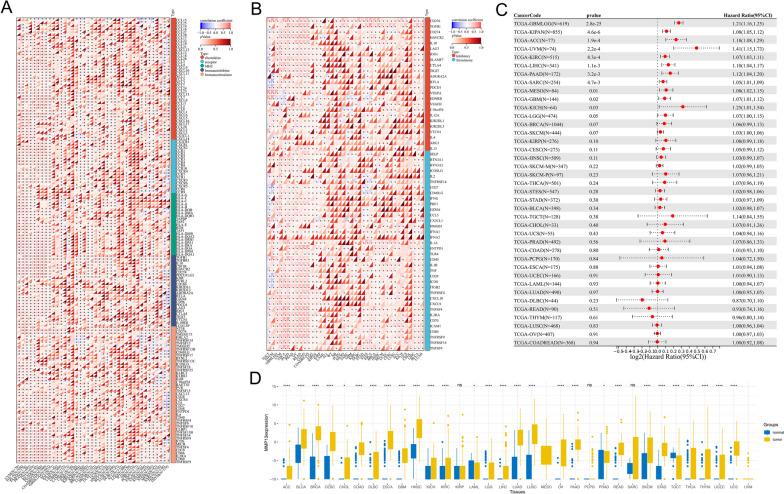
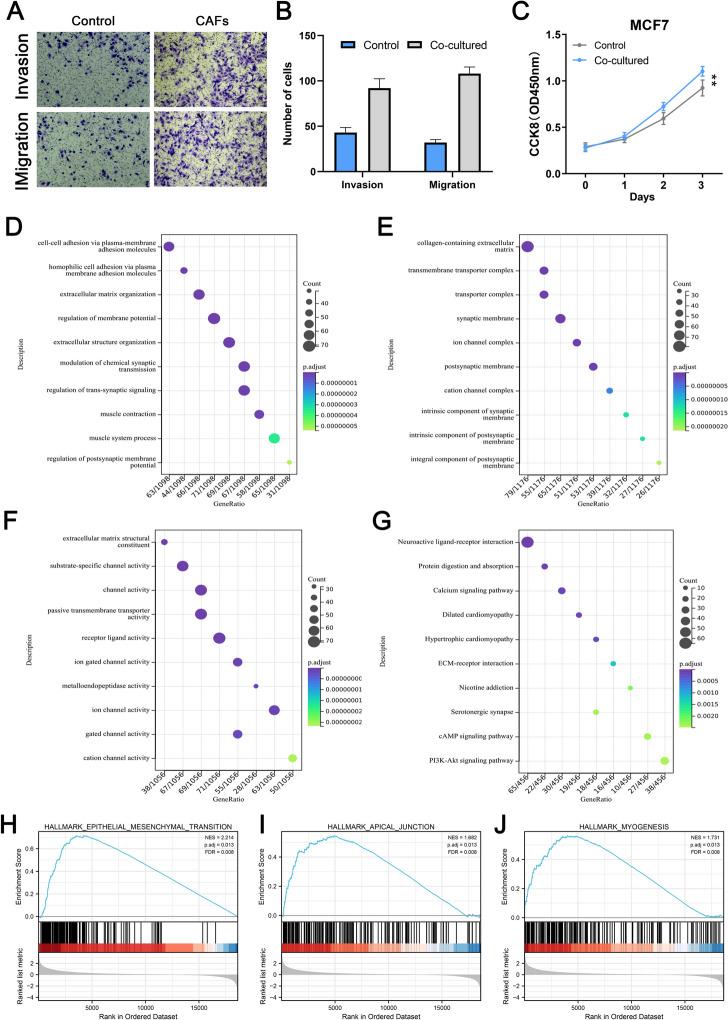
In our study, we identified the molecules involved in BC bone metastasis based on the data from multiple BC cohorts. Then, we comprehensively investigated the effect pattern and underlying biological role of these molecules. We found that in the identified molecules, the EMP1, ACKR3, ITGA10, MMP13, COL11A1, and THY1 were significantly correlated with patient prognosis and mainly expressed in CAFs. Therefore, we explored the CAFs in the BC microenvironment. Results showed that CAFs could activate multiple carcinogenic pathways and most of these pathways play an important role in cancer metastasis. Meanwhile, we noticed the interaction between CAFs and malignant, endothelial, and M2 macrophage cells. Moreover, we found that CAFs could induce the remodeling of the BC microenvironment and promote the malignant behavior of BC cells. Then, we identified MMP13 for further analysis. It was found that MMP13 can enhance the malignant phenotype of BC cells. Meanwhile, biological enrichment and immune infiltration analysis were conducted to present the effect pattern of MMP13 in BC.
CONCLUSIONS
Our result can improve the understanding of researchers on the underlying mechanisms of BC bone metastasis.
背景
乳腺癌(BC)患者往往容易发生远处转移,尤其是骨转移。
方法
所有基于公开访问数据的分析均在 R 软件中进行,依赖于多种算法和包。使用定量实时 PCR 检测特定基因的 RNA 水平作为检测 RNA 水平的方法。为了评估 BC 细胞的增殖能力,我们使用 CCK8 试验、集落形成和 5-乙炔基-20-脱氧尿苷检测。通过 Transwell 测定和划痕愈合测定评估 BC 细胞的侵袭和迁移能力。
结果
在我们的研究中,我们根据来自多个 BC 队列的数据确定了参与 BC 骨转移的分子,然后全面研究了这些分子的作用模式和潜在生物学作用。我们发现,在所确定的分子中,EMP1、ACKR3、ITGA10、MMP13、COL11A1 和 THY1 与患者预后显著相关,主要在 CAFs 中表达。因此,我们探索了 BC 微环境中的 CAFs。结果表明,CAFs 可以激活多种致癌途径,其中大多数途径在癌症转移中发挥重要作用。同时,我们注意到 CAFs 与恶性、内皮和 M2 巨噬细胞之间的相互作用。此外,我们发现 CAFs 可以诱导 BC 微环境的重塑并促进 BC 细胞的恶性行为。然后,我们确定了 MMP13 进行进一步分析。结果发现,MMP13 可以增强 BC 细胞的恶性表型。同时,进行了生物富集和免疫浸润分析,以呈现 MMP13 在 BC 中的作用模式。
结论
我们的结果可以提高研究人员对 BC 骨转移潜在机制的理解。




 Zotero 插件