
二苯甲胺-吡咯烷-2-酮腙衍生物的合成及体外评价作为潜在的抗癌和抗氧化剂。
Synthesis and In Vitro Evaluation as Potential Anticancer and Antioxidant Agents of Diphenylamine-Pyrrolidin-2-one-Hydrazone Derivatives.
机构信息
Department of Organic Chemistry, Kaunas University of Technology, Radvilėnų pl. 19, 50254 Kaunas, Lithuania.
Department of Physical and Inorganic Chemistry, Kaunas University of Technology, Radvilėnų pl. 19, 50254 Kaunas, Lithuania.
出版信息
Int J Mol Sci. 2023 Nov 27;24(23):16804. doi: 10.3390/ijms242316804.
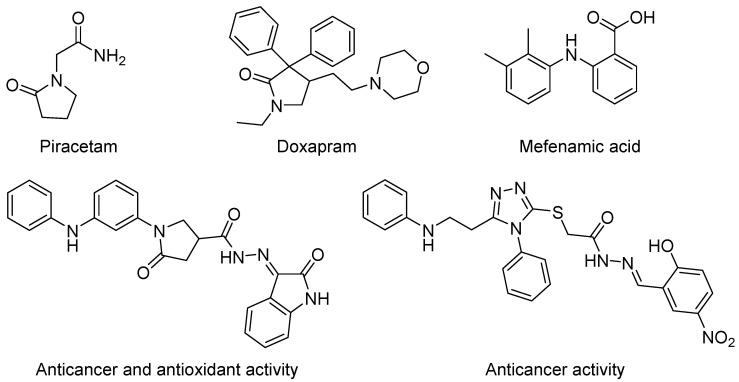
The title compounds were synthesized by the reaction of 5-oxo-1-(4-(phenylamino)phenyl)pyrrolidine-3-carbohydrazide with various aldehydes bearing aromatic and heterocyclic moieties and acetophenones, and their cytotoxicity was tested via MTT assay against human triple-negative breast cancer MDA-MB-231, human melanoma IGR39, human pancreatic carcinoma Panc-1, and prostate cancer cell line PPC-1. Furthermore, the selectivity of compounds towards cancer cells compared to fibroblasts was also investigated. Four compounds were identified as the most promising anticancer agents out of a series of pyrrolidinone-hydrazone derivatives bearing a diphenylamine moiety. These compounds were most selective against the prostate cancer cell line PPC-1 and the melanoma cell lines IGR39, with EC values in the range of 2.5-20.2 µM against these cell lines. In general, the compounds were less active against triple-negative breast cancer MDA-MB-231 cell line, and none of them showed an inhibitory effect on the migration of these cells. In the 'wound healing' assay, '-((5-nitrothiophen-2-yl)methylene)-5-oxo-1-(4-(phenylamino)phenyl)pyrrolidine-3-carbohydrazide was identified as the most promising derivative that could be further developed as an antimetastatic agent. '-(5-chloro- and '-(3,4-dichlorobenzylidene)-5-oxo-1-(4-(phenylamino)phenyl)pyrrolidine-3-carbohydrazides most efficiently reduced the cell viability in IGR39 cell spheroids, while there was no effect of the investigated pyrrolidinone-hydrazone derivatives on PPC-1 3D cell cultures. Antioxidant activity determined via FRAP assay of '-(1-(4-aminophenyl)ethylidene)-5-oxo-1-(4-(phenylamino)phenyl)pyrrolidine-3-carbohydrazide was 1.2 times higher than that of protocatechuic acid.
标题化合物是通过 5-氧代-1-(4-(苯氨基)苯基)吡咯烷-3-甲酰肼与各种带有芳基和杂环部分的醛和苯乙酮反应合成的,并通过 MTT 测定法对其进行了测试对人三阴性乳腺癌 MDA-MB-231、人黑色素瘤 IGR39、人胰腺癌细胞系 Panc-1 和前列腺癌细胞系 PPC-1 的细胞毒性。此外,还研究了化合物对癌细胞与成纤维细胞的选择性。在一系列带有二苯胺部分的吡咯烷酮腙衍生物中,有 4 种化合物被确定为最有前途的抗癌剂。这些化合物对前列腺癌细胞系 PPC-1 和黑色素瘤细胞系 IGR39 最为选择性,对这些细胞系的 EC 值在 2.5-20.2µM 范围内。总的来说,这些化合物对三阴性乳腺癌 MDA-MB-231 细胞系的活性较低,它们都没有对这些细胞的迁移产生抑制作用。在“伤口愈合”测定中,鉴定出'-(5-硝基噻吩-2-基)亚甲基)-5-氧代-1-(4-(苯氨基)苯基)吡咯烷-3-甲酰肼是最有前途的衍生物,可以进一步开发为抗转移剂。'-(5-氯-和'-(3,4-二氯苄叉基)-5-氧代-1-(4-(苯氨基)苯基)吡咯烷-3-甲酰肼最有效地降低了 IGR39 细胞球的细胞活力,而所研究的吡咯烷酮腙衍生物对 PPC-1 3D 细胞培养没有影响。通过 FRAP 测定法测定的'-(1-(4-氨基苯基)亚乙基)-5-氧代-1-(4-(苯氨基)苯基)吡咯烷-3-甲酰肼的抗氧化活性比原儿茶酸高 1.2 倍。



 Zotero 插件