
通过与肺腺癌化疗相关的五个基因构建肺腺癌的预后特征。
A prognostic signature for lung adenocarcinoma by five genes associated with chemotherapy in lung adenocarcinoma.
机构信息
Department of Thoracic Disease Diagnosis and Treatment Center, Zhejiang Rongjun Hospital, The Third Affiliated Hospital of Jiaxing University, Jiaxing, China.
Institute of Cancer and Basic Medicine (ICBM), Chinese Academy of Sciences, Hangzhou, China.
出版信息
Clin Respir J. 2023 Dec;17(12):1349-1360. doi: 10.1111/crj.13723. Epub 2023 Dec 10.
BACKGROUND
Lung adenocarcinoma (LUAD) is one of the most common subtypes of lung cancer. Finding prognostic biomarkers is helpful in stratifying LUAD patients with different prognosis.
METHODS
We explored the correlation of LUAD prognosis and genes associated with chemotherapy in LUAD and obtained data of LUAD patients from the Cancer Genome Atlas (TCGA) and Gene Expression Omnibus (GEO) databases. Drug sensitivity data were acquired from the Genomics of Drug Sensitivity in Cancer (GDSC) database. Differential and enrichment analyses were used to screen the target genes utilizing limma and "clusterProfiler" packages. Then univariate and LASSO Cox analyses were used to select the prognosis-related genes. Survival analysis was used to estimate the overall survival (OS) of different groups.
RESULTS
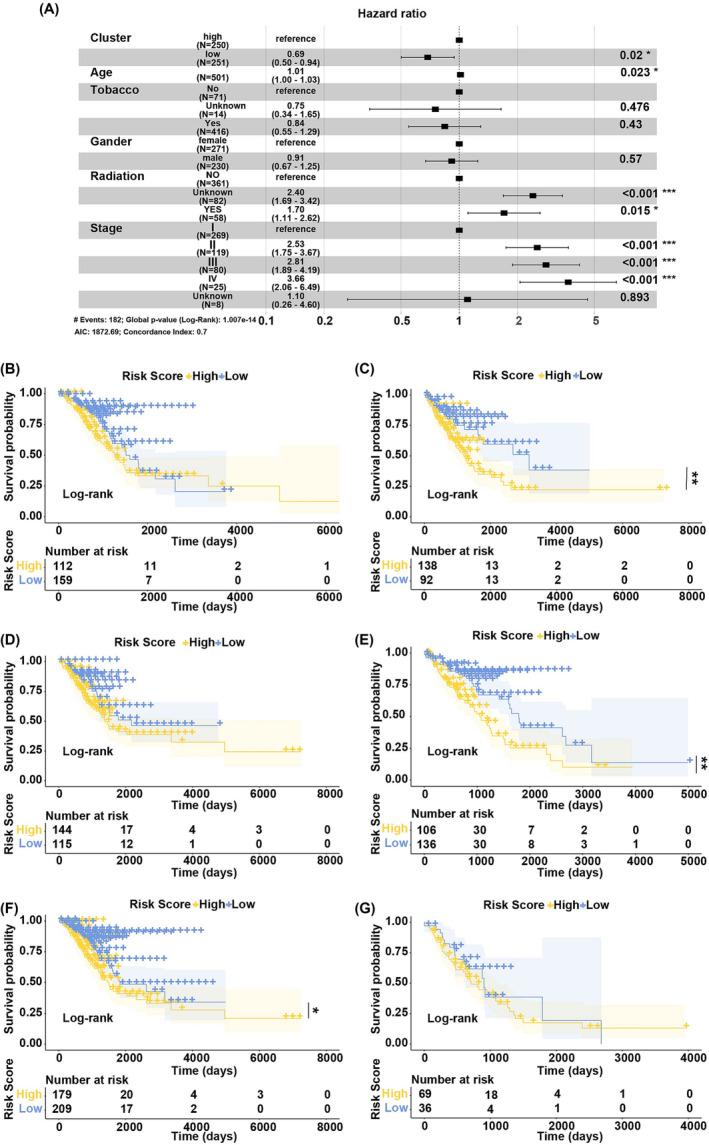
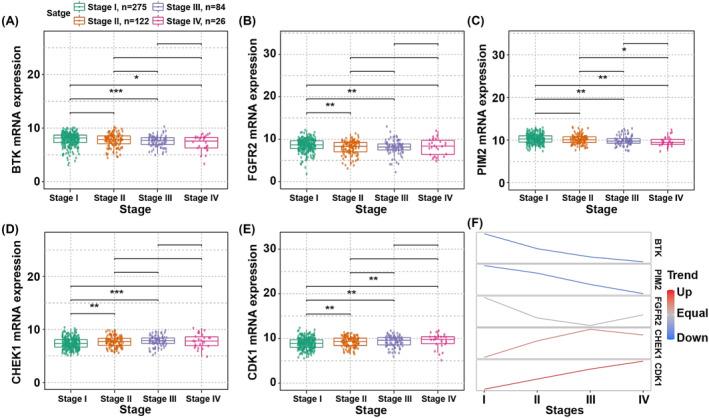
Twenty-three differentially expressed genes (DEGs) were screened between LUAD samples and healthy samples, and BTK, FGFR2, PIM2, CHEK1, and CDK1 were selected to construct a prognostic signature. The OS of patients in the high-risk group (risk score higher than 0.69) was worse than that in the low-risk group (risk score lower than 0.69).
CONCLUSION
The risk score model constructed by five genes is a potential prognostic biomarker for LUAD patients.
背景
肺腺癌 (LUAD) 是肺癌中最常见的亚型之一。寻找预后生物标志物有助于对具有不同预后的 LUAD 患者进行分层。
方法
我们探讨了 LUAD 预后与 LUAD 中与化疗相关的基因的相关性,并从癌症基因组图谱 (TCGA) 和基因表达综合 (GEO) 数据库中获取 LUAD 患者的数据。药物敏感性数据来自癌症基因组药物敏感性 (GDSC) 数据库。使用 limma 和“clusterProfiler”包进行差异和富集分析,以筛选目标基因。然后使用单变量和 LASSO Cox 分析选择与预后相关的基因。生存分析用于估计不同组的总生存期 (OS)。
结果
筛选出 LUAD 样本与健康样本之间的 23 个差异表达基因 (DEG),并选择 BTK、FGFR2、PIM2、CHEK1 和 CDK1 构建预后特征。风险评分高于 0.69 的高危组患者的 OS 比风险评分低于 0.69 的低危组患者差。
结论
由五个基因构建的风险评分模型是 LUAD 患者潜在的预后生物标志物。


 Zotero 插件