
肠道菌群研究揭示了当归芍药散及其拆方改善阿尔茨海默病大鼠认知功能障碍的作用机制。
Intestinal flora study reveals the mechanism of Danggui Shaoyao San and its decomposed recipes to improve cognitive dysfunction in the rat model of Alzheimer's disease.
机构信息
School of Integrated Chinese and Western Medicine, Hunan University of Chinese Medicine, Changsha, Hunan, China.
Key Laboratory of Hunan Province for Integrated Traditional Chinese and Western Medicine on Prevention and Treatment of Cardio-Cerebral Diseases, Hunan University of Chinese Medicine, Changsha, Hunan, China.
出版信息
Front Cell Infect Microbiol. 2023 Nov 21;13:1323674. doi: 10.3389/fcimb.2023.1323674. eCollection 2023.
BACKGROUND
Alzheimer's disease (AD), characterized by a severe decline in cognitive function, significantly impacts patients' quality of life. Traditional Chinese Medicine (TCM) presents notable advantages in AD treatment, closely linked to its regulation of intestinal flora. Nevertheless, a comprehensive exploration of the precise role of intestinal flora in AD remains lacking.
METHODS
We induced an AD model through bilateral intracerebroventricular injection of streptozotocin in rats. We divided 36 rats randomly into 6 groups: sham-operated, model, Danggui Shaoyao San (DSS), and 3 DSS decomposed recipes groups. Cognitive abilities were assessed using water maze and open field experiments. Nissl staining examined hippocampal neuron integrity. Western blot analysis determined synaptoprotein expression. Additionally, 16S rDNA high-throughput sequencing analyzed intestinal flora composition.
RESULTS
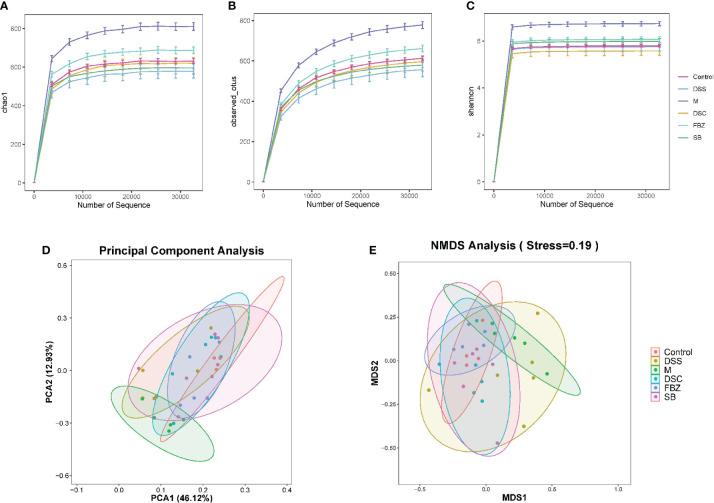
DSS and its decomposed recipe groups demonstrated improved learning and memory in rats (<0.01). The open field test indicated increased central zone residence time and locomotor activity distance in these groups (<0.05). Furthermore, the DSS and decomposed recipe groups exhibited reduced hippocampal neuronal damage and increased expression levels of synapsin I (<0.05) and PSD95 (<0.01) proteins. Alpha and Beta diversity analyses showed that the intestinal flora species richness and diversity in the DSS and decomposed recipe groups were similar to those in the sham-operated group, signifying a significant restorative effect (<0.05).
CONCLUSION
The combination of DSS and its decomposed recipes can reduce the abundance of harmful gut microbiota, leading to improvements in cognitive and learning abilities.
背景
阿尔茨海默病(AD)以认知功能严重下降为特征,极大地影响了患者的生活质量。中药(TCM)在 AD 治疗方面具有显著优势,与其对肠道菌群的调节密切相关。然而,肠道菌群在 AD 中的确切作用仍有待全面探索。
方法
我们通过向大鼠双侧侧脑室注射链脲佐菌素诱导 AD 模型。将 36 只大鼠随机分为 6 组:假手术组、模型组、当归芍药散(DSS)组和 3 个 DSS 拆方组。通过水迷宫和旷场实验评估认知能力。尼氏染色检查海马神经元完整性。Western blot 分析测定突触蛋白表达。此外,16S rDNA 高通量测序分析肠道菌群组成。
结果
DSS 及其拆方组大鼠学习和记忆能力提高(<0.01)。旷场试验表明,这些组的中央区停留时间和运动活动距离增加(<0.05)。此外,DSS 和拆方组大鼠海马神经元损伤减少,突触素 I(<0.05)和 PSD95(<0.01)蛋白表达水平增加。Alpha 和 Beta 多样性分析显示,DSS 和拆方组的肠道菌群丰富度和多样性与假手术组相似,表明具有显著的恢复作用(<0.05)。
结论
DSS 及其拆方的组合可以减少有害肠道微生物群的丰度,从而改善认知和学习能力。




 Zotero 插件