
一种Pvs25 mRNA疫苗可诱导对间日疟原虫产生完全且持久的传播阻断免疫力。
A Pvs25 mRNA vaccine induces complete and durable transmission-blocking immunity to Plasmodium vivax.
作者信息
Kunkeaw Nawapol, Nguitragool Wang, Takashima Eizo, Kangwanrangsan Niwat, Muramatsu Hiromi, Tachibana Mayumi, Ishino Tomoko, Lin Paulo J C, Tam Ying K, Pichyangkul Sathit, Tsuboi Takafumi, Pardi Norbert, Sattabongkot Jetsumon
机构信息
Mahidol Vivax Research Unit, Faculty of Tropical Medicine, Mahidol University, Bangkok, Thailand.
Department of Molecular Tropical Medicine and Genetics, Faculty of Tropical Medicine, Mahidol University, Bangkok, Thailand.
出版信息
NPJ Vaccines. 2023 Dec 14;8(1):187. doi: 10.1038/s41541-023-00786-9.
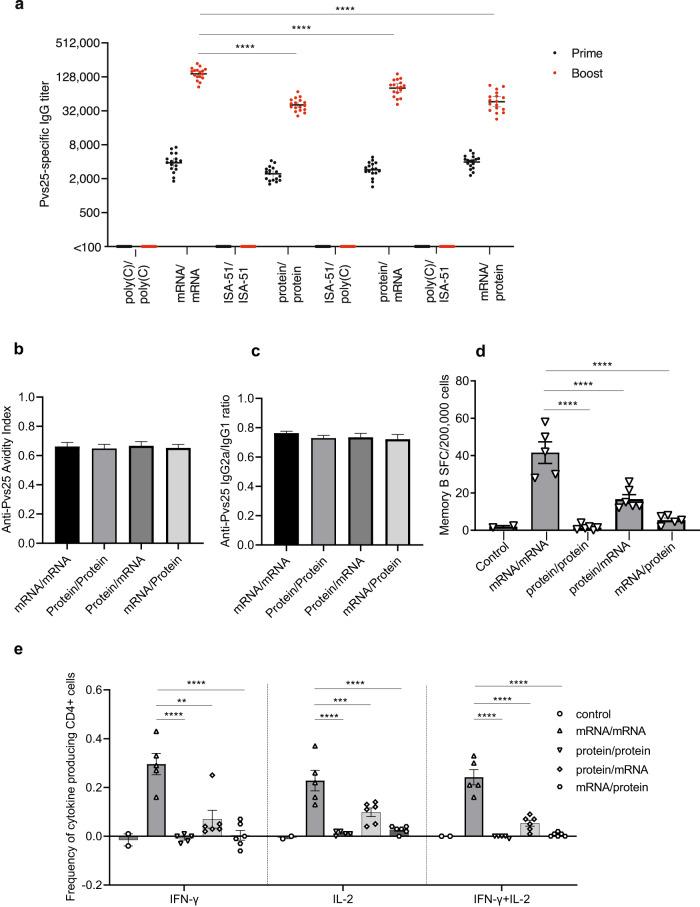
Plasmodium vivax (P. vivax) is the major malaria parasite outside of Africa and no vaccine is available against it. A vaccine that interrupts parasite transmission (transmission-blocking vaccine, TBV) is considered highly desirable to reduce the spread of P. vivax and to accelerate its elimination. However, the development of a TBV against this pathogen has been hampered by the inability to culture the parasite as well as the low immunogenicity of the vaccines developed to date. Pvs25 is the most advanced TBV antigen candidate for P. vivax. However, in previous phase I clinical trials, TBV vaccines based on Pvs25 yielded low antibody responses or had unacceptable safety profiles. As the nucleoside-modified mRNA-lipid nanoparticle (mRNA-LNP) vaccine platform proved to be safe and effective in humans, we generated and tested mRNA-LNP vaccines encoding several versions of Pvs25 in mice. We found that in a prime-boost vaccination schedule, all Pvs25 mRNA-LNP vaccines elicited robust antigen-specific antibody responses. Furthermore, when compared with a Pvs25 recombinant protein vaccine formulated with Montanide ISA-51 adjuvant, the full-length Pvs25 mRNA-LNP vaccine induced a stronger and longer-lasting functional immunity. Seven months after the second vaccination, vaccine-induced antibodies retained the ability to fully block P. vivax transmission in direct membrane feeding assays, whereas the blocking activity induced by the protein/ISA-51 vaccine dropped significantly. Taken together, we report on mRNA vaccines targeting P. vivax and demonstrate that Pvs25 mRNA-LNP outperformed an adjuvanted Pvs25 protein vaccine suggesting that it is a promising candidate for further testing in non-human primates.
间日疟原虫(P. vivax)是非洲以外地区主要的疟原虫,目前尚无针对它的疫苗。一种能够阻断寄生虫传播的疫苗(传播阻断疫苗,TBV)被认为对于减少间日疟原虫的传播以及加速其消除非常理想。然而,针对这种病原体的传播阻断疫苗的研发受到了无法培养该寄生虫以及迄今为止所开发疫苗免疫原性较低的阻碍。Pvs25是间日疟原虫最先进的传播阻断疫苗抗原候选物。然而,在之前的I期临床试验中,基于Pvs25的传播阻断疫苗产生的抗体反应较低,或者具有不可接受的安全性。由于核苷修饰的mRNA-脂质纳米颗粒(mRNA-LNP)疫苗平台在人体中被证明是安全有效的,我们在小鼠中制备并测试了编码几种版本Pvs25的mRNA-LNP疫苗。我们发现,在初免-加强免疫接种方案中,所有Pvs25 mRNA-LNP疫苗都能引发强烈的抗原特异性抗体反应。此外,与用Montanide ISA-51佐剂配制的Pvs25重组蛋白疫苗相比,全长Pvs25 mRNA-LNP疫苗诱导产生更强且更持久的功能性免疫。第二次接种七个月后,疫苗诱导的抗体在直接膜饲试验中仍保留完全阻断间日疟原虫传播的能力,而蛋白质/ISA-51疫苗诱导的阻断活性则显著下降。综上所述,我们报道了针对间日疟原虫的mRNA疫苗,并证明Pvs25 mRNA-LNP优于佐剂化的Pvs25蛋白疫苗,这表明它是在非人灵长类动物中进行进一步测试的有前景的候选物。


 Zotero 插件