
化学生物组学:靶向解析的广阔途径
Chemoproteomics, A Broad Avenue to Target Deconvolution.
机构信息
Beijing National Laboratory for Molecular Sciences, Key Laboratory of Bioorganic Chemistry and Molecular Engineering of Ministry of Education, College of Chemistry and Molecular Engineering, Peking University, Beijing, 100871, China.
Peking-Tsinghua Center for Life Sciences, Peking University, Beijing, 100871, China.
出版信息
Adv Sci (Weinh). 2024 Feb;11(8):e2305608. doi: 10.1002/advs.202305608. Epub 2023 Dec 14.
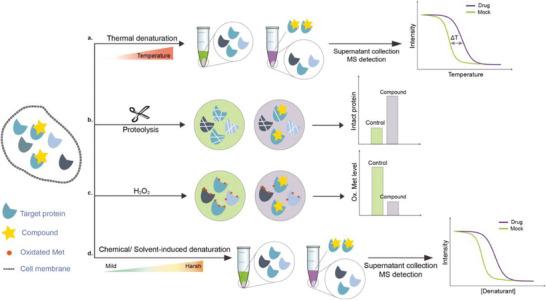
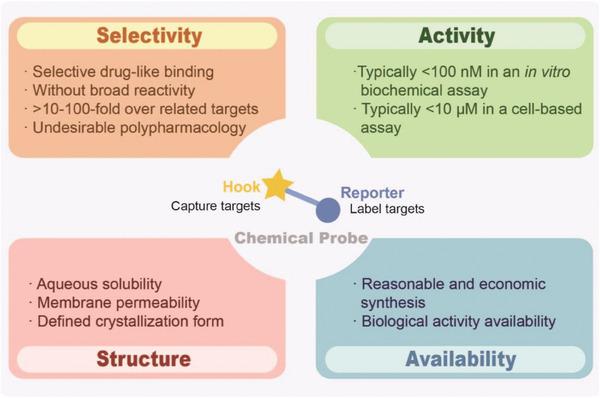
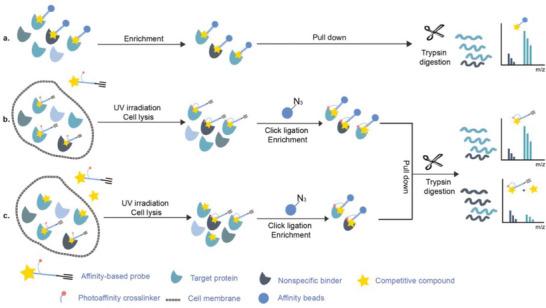
As a vital project of forward chemical genetic research, target deconvolution aims to identify the molecular targets of an active hit compound. Chemoproteomics, either with chemical probe-facilitated target enrichment or probe-free, provides a straightforward and effective approach to profile the target landscape and unravel the mechanisms of action. Canonical methods rely on chemical probes to enable target engagement, enrichment, and identification, whereas click chemistry and photoaffinity labeling techniques improve the efficiency, sensitivity, and spatial accuracy of target recognition. In comparison, recently developed probe-free methods detect protein-ligand interactions without the need to modify the ligand molecule. This review provides a comprehensive overview of different approaches and recent advancements for target identification and highlights the significance of chemoproteomics in investigating biological processes and advancing drug discovery processes.
作为化学生物学前沿研究的重要项目,靶标解析旨在确定活性命中化合物的分子靶标。化学生物组学,无论是采用化学探针辅助的靶标富集还是无探针方法,都为剖析靶标全景和揭示作用机制提供了一种直接有效的方法。经典方法依赖于化学探针来实现靶标结合、富集和鉴定,而点击化学和光亲和标记技术则提高了靶标识别的效率、灵敏度和空间准确性。相比之下,最近开发的无探针方法则无需修饰配体分子即可检测蛋白-配体相互作用。本文综述了不同方法和最新进展,以用于靶标鉴定,并强调了化学生物组学在研究生物过程和推进药物发现过程中的重要性。



 Zotero 插件