
GPDRP:基于图转换器的药物反应预测多模态框架。
GPDRP: a multimodal framework for drug response prediction with graph transformer.
机构信息
School of Mathematics and Statistics, Henan University of Science and Technology, Luoyang, 471000, China.
Longmen Laboratory, Luoyang, 471003, China.
出版信息
BMC Bioinformatics. 2023 Dec 17;24(1):484. doi: 10.1186/s12859-023-05618-0.
BACKGROUND
In the field of computational personalized medicine, drug response prediction (DRP) is a critical issue. However, existing studies often characterize drugs as strings, a representation that does not align with the natural description of molecules. Additionally, they ignore gene pathway-specific combinatorial implication.
RESULTS
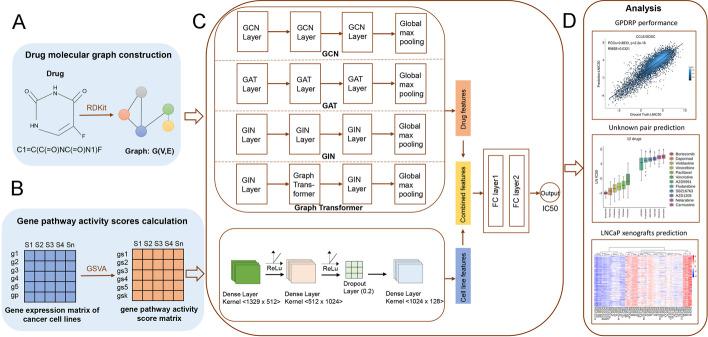
In this study, we propose drug Graph and gene Pathway based Drug response prediction method (GPDRP), a new multimodal deep learning model for predicting drug responses based on drug molecular graphs and gene pathway activity. In GPDRP, drugs are represented by molecular graphs, while cell lines are described by gene pathway activity scores. The model separately learns these two types of data using Graph Neural Networks (GNN) with Graph Transformers and deep neural networks. Predictions are subsequently made through fully connected layers.
CONCLUSIONS
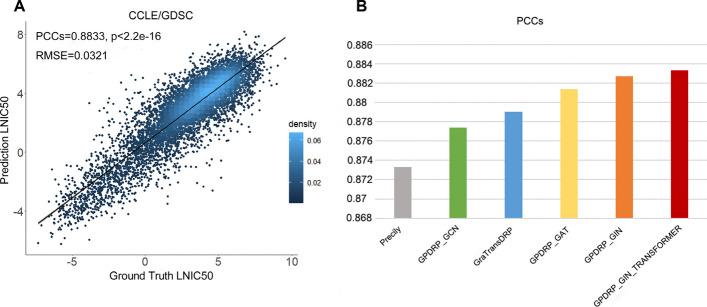
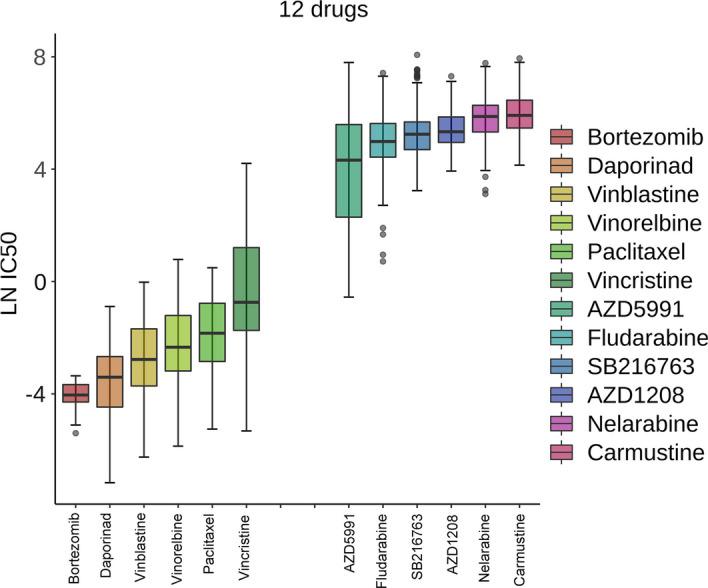
Our results indicate that Graph Transformer-based model delivers superior performance. We apply GPDRP on hundreds of cancer cell lines' bulk RNA-sequencing data, and it outperforms some recently published models. Furthermore, the generalizability and applicability of GPDRP are demonstrated through its predictions on unknown drug-cell line pairs and xenografts. This underscores the interpretability achieved by incorporating gene pathways.
背景
在计算个性化医学领域,药物反应预测(DRP)是一个关键问题。然而,现有研究通常将药物特征化为字符串,这种表示方式与分子的自然描述不一致。此外,它们忽略了基因途径特有的组合含义。
结果
在这项研究中,我们提出了基于药物图和基因途径的药物反应预测方法(GPDRP),这是一种新的基于药物分子图和基因途径活性的多模态深度学习模型,用于预测药物反应。在 GPDRP 中,药物由分子图表示,而细胞系由基因途径活性评分描述。该模型分别使用基于图转换器的图神经网络(GNN)和深度神经网络学习这两种类型的数据。然后通过全连接层进行预测。
结论
我们的结果表明,基于图转换器的模型具有优越的性能。我们将 GPDRP 应用于数百个癌细胞系的批量 RNA-seq 数据,其性能优于一些最近发表的模型。此外,通过对未知药物-细胞系对和异种移植物的预测,证明了 GPDRP 的泛化能力和适用性。这突出了通过纳入基因途径实现的可解释性。

 Zotero 插件