
DNA损伤反应蛋白的绝对定量
Absolute quantification of DNA damage response proteins.
作者信息
Matsuda Shun, Ikura Tsuyoshi, Matsuda Tomonari
机构信息
Research Center for Environmental Quality Management, Kyoto University, 1-2, Yumihama, Otsu, Shiga, 5200811, Japan.
Laboratory of Chromatin Regulatory Network, Department of Mutagenesis, Radiation Biology Center, Kyoto University, Yoshidakonoecho, Kyoto Sakyo-ku, Kyoto, 606-8501, Japan.
出版信息
Genes Environ. 2023 Dec 18;45(1):37. doi: 10.1186/s41021-023-00295-0.
BACKGROUND
DNA damage response (DDR) and repair are vital for safeguarding genetic information and ensuring the survival and accurate transmission of genetic material. DNA damage, such as DNA double-strand breaks (DSBs), triggers a response where sensor proteins recognize DSBs. Information is transmitted to kinases, initiating a sequence resulting in the activation of the DNA damage response and recruitment of other DDR and repair proteins to the DSB site in a highly orderly sequence. Research has traditionally focused on individual protein functions and their order, with limited quantitative analysis, prompting this study's attempt at absolute quantification of DNA damage response and repair proteins and capturing changes in protein chromatin affinity after DNA damage through biochemical fractionation methods.
RESULTS
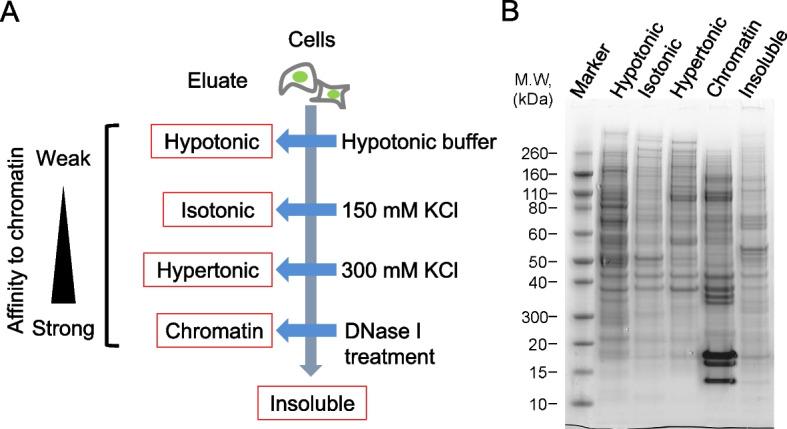
To assess the intracellular levels of proteins involved in DDR and repair, multiple proteins associated with different functions were quantified in EPC2-hTERT cells. H2AX had the highest intracellular abundance (1.93 × 10 molecules/cell). The components of the MRN complex were present at the comparable levels: 6.89 × 10 (MRE11), 2.17 × 10 (RAD50), and 2.35 × 10 (NBS1) molecules/cell. MDC1 was present at 1.27 × 10 molecules/cell. The intracellular levels of ATM and ATR kinases were relatively low: 555 and 4860 molecules/cell, respectively. The levels of cellular proteins involved in NHEJ (53BP1: 3.03 × 10; XRCC5: 2.62 × 10; XRCC6: 5.05 × 10 molecules/cell) were more than an order of magnitude higher than that involved in HR (RAD51: 2500 molecules/cell). Furthermore, we analyzed the dynamics of MDC1 and γH2AX proteins in response to DNA damage induced by the unstable agent neocarzinostatin (NCS). Using cell biochemical fractionation, cells were collected and analyzed at different time points after NCS exposure. Results showed that γH2AX in chromatin fraction peaked at 1 h post-exposure and gradually decreased, while MDC1 translocated from the isotonic to the hypertonic fraction, peaking at 1 hour as well. The study suggests increased MDC1 affinity for chromatin through binding to γH2AX induced by DNA damage. The γH2AX-bound MDC1 (in the hypertonic fraction) to γH2AX ratio at 1 h post-exposure was 1:56.4, with lower MDC1 levels which may attributed to competition with other proteins.
CONCLUSIONS
The approach provided quantitative insights into protein dynamics in DNA damage response.
背景
DNA损伤反应(DDR)和修复对于保护遗传信息以及确保遗传物质的存活和准确传递至关重要。DNA损伤,如DNA双链断裂(DSB),会触发一种反应,其中传感蛋白识别DSB。信息被传递给激酶,启动一系列反应,导致DNA损伤反应的激活,并以高度有序的顺序将其他DDR和修复蛋白招募到DSB位点。传统研究主要集中在单个蛋白质的功能及其顺序,定量分析有限,促使本研究尝试通过生化分级分离方法对DNA损伤反应和修复蛋白进行绝对定量,并捕捉DNA损伤后蛋白质染色质亲和力的变化。
结果
为了评估参与DDR和修复的蛋白质的细胞内水平,在EPC2-hTERT细胞中对多种具有不同功能的蛋白质进行了定量。H2AX具有最高的细胞内丰度(1.93×10个分子/细胞)。MRN复合物的成分以相当的水平存在:6.89×10(MRE11)、2.17×10(RAD50)和2.35×10(NBS1)个分子/细胞。MDC1以1.27×10个分子/细胞的水平存在。ATM和ATR激酶的细胞内水平相对较低:分别为555和4860个分子/细胞。参与非同源末端连接(NHEJ)的细胞蛋白水平(53BP1:3.03×10;XRCC5:2.62×10;XRCC6:5.05×10个分子/细胞)比参与同源重组(HR)的水平(RAD51:2500个分子/细胞)高出一个数量级以上。此外,我们分析了MDC1和γH2AX蛋白对不稳定剂新制癌菌素(NCS)诱导的DNA损伤的反应动力学。使用细胞生化分级分离,在NCS暴露后的不同时间点收集并分析细胞。结果表明,染色质组分中的γH2AX在暴露后1小时达到峰值并逐渐下降,而MDC1从等渗组分转移到高渗组分,也在1小时达到峰值。该研究表明,DNA损伤诱导MDC1通过与γH2AX结合而增加对染色质的亲和力。暴露后1小时,高渗组分中与γH2AX结合的MDC1与γH2AX的比率为1:56.4,MDC1水平较低可能归因于与其他蛋白质的竞争。
结论
该方法为DNA损伤反应中的蛋白质动力学提供了定量见解。


 Zotero 插件