
绿色空间与慢性呼吸道健康问题:系统评价与荟萃分析。
Greenness and chronic respiratory health issues: a systematic review and meta-analysis.
机构信息
School of Landscape Architecture and Forestry, Qingdao Agricultural University, Qingdao, China.
School of Art, Qufu Normal University, Rizhao, Shandong, China.
出版信息
Front Public Health. 2023 Dec 6;11:1279322. doi: 10.3389/fpubh.2023.1279322. eCollection 2023.
INTRODUCTION
The number of chronic respiratory disease (CRD) individuals worldwide has been continuously increasing. Numerous studies have shown that greenness can improve chronic respiratory health issues through different mechanisms, with inconsistent evidence. By quantitatively summarizing existing studies, our purpose is to determine the connection between greenness exposure and various chronic respiratory health.
METHODS
We conducted a comprehensive search on PubMed, EMBASE, and Web of Science core databases to identify relevant studies on the correlation between greenness exposure and chronic respiratory health issues. Studies published up to January 2023 were included in the search. The study used the most frequent indicator (normalized difference vegetation index [NDVI]) as the definition of greenness exposure.
RESULTS
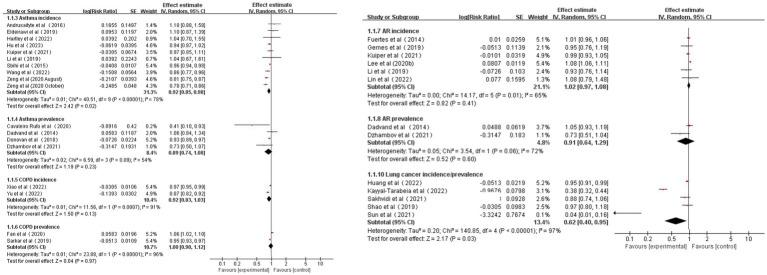
We finally identified 35 studies for meta-analysis. We calculated pooled effects across studies using a random-effects model and conducted a subgroup analysis by age and buffer zones to discuss the effects on chronic respiratory health issues. This study showed that 0.1 increments in NDVI were significantly related to lower rates of asthma incidence, lung cancer incidence, and chronic obstructive pulmonary disease (COPD) mortality risk; the pooled RRs were 0.92 (95% CI: 0.85-0.98), 0.62 (95% CI: 0.40-0.95), and 0.95 (95% CI: 0.92- 0.99), respectively. For the age subgroup, the higher greenness exposure level was related to the incidence rate of asthma among teenagers aged 13-18years (RR: 0.91; 95% CI: 0.83-0.99). For the buffer subgroup, a positive relationship with greenness exposure and asthma incidence/prevalence at 200-300m and 800- 1000m buffers, as well as the COPD mortality at 800-1000m buffer, the pooled RRs were 0.92 (95% CI: 0.86-0.98), 0.87 (95% CI: 0.81-0.93), and 0.93 (95% CI: 0.88- 0.98), respectively. Evidence of publication bias was not detected in this study.
DISCUSSION
Our study is the first global meta-analysis between greenness and various CRDs to report an inverse association. Further research is needed in order to determine the effect of greenness exposure on different CRDs. Therefore, when planning for green development, more consideration must be given to public health and green management as intervention measures.
UNLABELLED
https://www.crd.york.ac.uk/PROSPEROFILES/384029_STRATEGY_20230116.pdf.
简介
全球慢性呼吸道疾病(CRD)患者人数持续增加。许多研究表明,绿色环境可以通过不同的机制改善慢性呼吸道健康问题,但证据并不一致。通过对现有研究进行定量总结,我们的目的是确定绿色环境暴露与各种慢性呼吸道健康问题之间的联系。
方法
我们在 PubMed、EMBASE 和 Web of Science 核心数据库中进行了全面检索,以确定与绿色环境暴露与慢性呼吸道健康问题相关的研究。检索范围包括截至 2023 年 1 月发表的研究。本研究使用最常见的指标(归一化差异植被指数 [NDVI])作为绿色环境暴露的定义。
结果
我们最终确定了 35 项进行荟萃分析的研究。我们使用随机效应模型计算了研究间的汇总效应,并按年龄和缓冲区进行了亚组分析,以讨论对慢性呼吸道健康问题的影响。本研究表明,NDVI 增加 0.1 与哮喘发病率、肺癌发病率和慢性阻塞性肺疾病(COPD)死亡率风险降低显著相关;汇总相对风险(RR)分别为 0.92(95%置信区间:0.85-0.98)、0.62(95%置信区间:0.40-0.95)和 0.95(95%置信区间:0.92-0.99)。按年龄亚组分析,较高的绿色环境暴露水平与 13-18 岁青少年的哮喘发病率相关(RR:0.91;95%置信区间:0.83-0.99)。按缓冲区亚组分析,在 200-300m 和 800-1000m 缓冲区中,绿色环境暴露与哮喘发病率/患病率呈正相关,在 800-1000m 缓冲区中 COPD 死亡率也呈正相关,汇总 RR 分别为 0.92(95%置信区间:0.86-0.98)、0.87(95%置信区间:0.81-0.93)和 0.93(95%置信区间:0.88-0.98)。本研究未发现发表偏倚的证据。
讨论
本研究是第一项全球范围内关于绿色环境与各种 CRD 之间关系的荟萃分析,报告了一种反比关系。需要进一步的研究来确定绿色环境暴露对不同 CRD 的影响。因此,在规划绿色发展时,必须更多地考虑公共卫生和绿色管理作为干预措施。
未加标签
https://www.crd.york.ac.uk/PROSPEROFILES/384029_STRATEGY_20230116.pdf。



 Zotero 插件