
免疫检查点抑制剂作为逆转 T 细胞耗竭和逆转 HIV 潜伏的潜在治疗方法,用于 HIV 感染者。
Immune checkpoint inhibitors as potential therapy for reverting T-cell exhaustion and reverting HIV latency in people living with HIV.
机构信息
HIV and Viral Hepatitis Research Laboratory, Instituto de Investigación Sanitaria Fundación Jiménez Díaz, Universidad Autónoma de Madrid (IIS-FJD, UAM), Madrid, Spain.
Hospital Universitario Rey Juan Carlos, Móstoles, Spain.
出版信息
Front Immunol. 2023 Dec 7;14:1270881. doi: 10.3389/fimmu.2023.1270881. eCollection 2023.
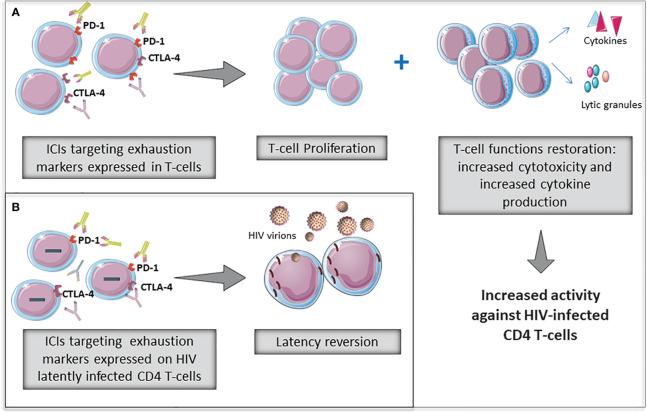
The immune system of people living with HIV (PLWH) is persistently exposed to antigens leading to systemic inflammation despite combination antiretroviral treatment (cART). This inflammatory milieu promotes T-cell activation and exhaustion. Furthermore, it produces diminished effector functions including loss of cytokine production, cytotoxicity, and proliferation, leading to disease progression. Exhausted T cells show overexpression of immune checkpoint molecules (ICs) on the cell surface, including programmed cell death protein 1 (PD-1), cytotoxic T-lymphocyte-associated antigen-4 (CTLA-4), T-cell immunoglobulin and mucin-domain containing-3 (TIM-3), T-cell immunoglobulin and immunoreceptor tyrosine-based inhibitory motif domain (TIGIT), and lymphocyte activation gene-3 (LAG-3). The ICs also play a crucial role in T-cell exhaustion by reducing the immune response to cancer antigens. Immunotherapy based on immune checkpoint inhibitors (ICIs) has changed the management of a diversity of cancers. Additionally, the interest in exploring this approach in the setting of HIV infection has increased, including AIDS-defining cancers and non-AIDS-defining cancers in PLWH. To date, research on this topic suggests that ICI-based therapies in PLWH could be a safe and effective approach. In this review, we provide an overview of the current literature on the potential role of ICI-based immunotherapy not only in cancer remission in PLWH but also as a therapeutic intervention to restore immune response against HIV, revert HIV latency, and attain a functional cure for HIV infection.
尽管接受了联合抗逆转录病毒治疗 (cART),但 HIV 感染者 (PLWH) 的免疫系统仍持续暴露于抗原,导致全身炎症。这种炎症环境促进了 T 细胞的激活和耗竭。此外,它还产生了减弱的效应功能,包括细胞因子产生、细胞毒性和增殖的丧失,导致疾病进展。耗竭的 T 细胞在细胞表面过度表达免疫检查点分子 (ICs),包括程序性细胞死亡蛋白 1 (PD-1)、细胞毒性 T 淋巴细胞相关抗原 4 (CTLA-4)、T 细胞免疫球蛋白和粘蛋白结构域 3 (TIM-3)、T 细胞免疫球蛋白和免疫受体酪氨酸基抑制基序域 (TIGIT),以及淋巴细胞激活基因-3 (LAG-3)。这些 ICs 还通过降低对癌症抗原的免疫反应,在 T 细胞耗竭中发挥关键作用。基于免疫检查点抑制剂 (ICIs) 的免疫疗法改变了多种癌症的治疗方法。此外,人们对在 HIV 感染背景下探索这种方法的兴趣也有所增加,包括 PLWH 中的艾滋病定义性癌症和非艾滋病定义性癌症。迄今为止,关于这一主题的研究表明,基于 ICI 的疗法在 PLWH 中可能是一种安全有效的方法。在这篇综述中,我们概述了目前关于基于 ICI 的免疫疗法的潜在作用的文献,不仅包括 PLWH 中癌症缓解,还包括作为一种治疗干预措施,恢复针对 HIV 的免疫反应,逆转 HIV 潜伏,以及实现 HIV 感染的功能性治愈。
 Zotero 插件