
在阿拉伯联合酋长国的耐甲氧西林金黄色葡萄球菌:12 年回顾性分析不断变化的趋势。
Methicillin resistant in the United Arab Emirates: a 12-year retrospective analysis of evolving trends.
机构信息
Department of Environmental and Occupational Health and Safety, Abu Dhabi Public Health Center, Abu Dhabi, United Arab Emirates.
Department of Pathology and Infectious Diseases, College of Medicine and Health Sciences, Khalifa University, Abu Dhabi, United Arab Emirates.
出版信息
Front Public Health. 2023 Dec 7;11:1244351. doi: 10.3389/fpubh.2023.1244351. eCollection 2023.
INTRODUCTION
Methicillin resistant (MRSA) is a major contributor to the global burden of antimicrobial resistance (AMR). As MRSA continues to evolve, the need for continued surveillance to evaluate trends remains crucial. This study was carried out to assess MRSA trends in the United Arab Emirates (UAE) based on analysis of data from the national AMR surveillance program.
METHODS
We carried out a 12-year (2010-2021) retrospective analysis of MRSA demographic and microbiological data collected as part of the UAE national AMR surveillance program. Participating centers from across the country routinely submit AMR surveillance data collected by trained personnel to the National AMR Surveillance Committee, where data is analyzed using a unified WHONET platform. Data on non-duplicate isolates associated with clinical infections were obtained and included in the analysis.
RESULTS
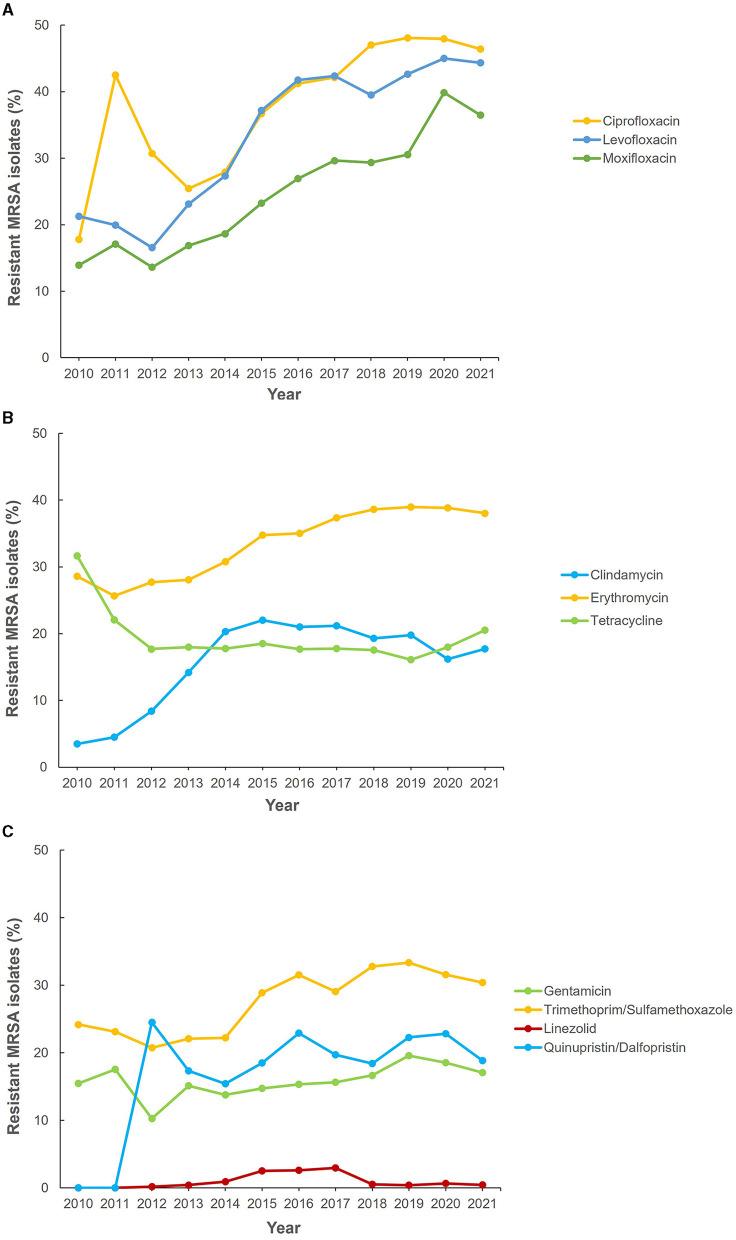
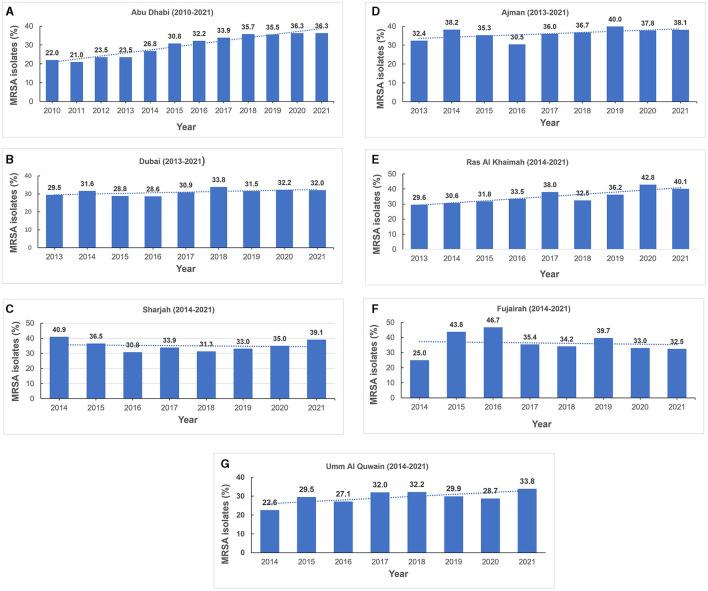
A total of 29,414 non-duplicate MRSA isolates associated with clinical infections were reported between 2010 and 2021 (2010: = 259; 2021: = 4,996). MRSA represented 26.4% of all ( = 111,623) isolates identified during the study period. In 2010, among the isolates with reported oxacillin testing, 21.9% (/ = 259/1,181) were identified as MRSA and this showed an increase to 33.5% (/ = 4,996/14,925) in 2021. Although there was variation in the distribution of MRSA across the seven emirates of the country, most had an upward trend. Patient demographics reflected a male preponderance, with most being adults and from the outpatient setting. Isolates were mostly from skin and soft tissue infection specimens (72.5%; / = 21,335/29,414). Among the inpatients ( = 8,282), a total of 3,313 MRSA isolates were from specimens obtained ≤ 48 h after admission indicative of community acquired infection. Increasing resistance trends were observed for most antibiotics including ciprofloxacin, levofloxacin, moxifloxacin, erythromycin, gentamicin, trimethoprim-sulfamethoxazole, and quinupristin/dalfopristin. Low levels of resistance (0.0-0.8%) were sustained for linezolid except for 2015, 2016, and 2017 with 2.5, 2.6, and 2.9%, respectively. No confirmed vancomycin resistance was reported.
CONCLUSION
The increasing trend of MRSA isolates associated with clinical infections in the hospital and community settings is a concern. Continued monitoring including incorporation of genomic surveillance and infection control measures are recommended to stem the dissemination.
简介
耐甲氧西林金黄色葡萄球菌(MRSA)是导致全球抗菌药物耐药性(AMR)负担的主要因素之一。随着 MRSA 的不断演变,持续监测以评估趋势的需求仍然至关重要。本研究旨在根据国家 AMR 监测计划的数据评估阿联酋的 MRSA 趋势。
方法
我们对 2010 年至 2021 年期间作为阿联酋国家 AMR 监测计划一部分收集的 MRSA 人口统计学和微生物学数据进行了为期 12 年的回顾性分析。来自全国各地的参与中心定期向国家 AMR 监测委员会提交由经过培训的人员收集的 AMR 监测数据,在那里使用统一的 WHONET 平台对数据进行分析。获得了与临床感染相关的非重复分离株的数据,并将其纳入分析。
结果
2010 年至 2021 年期间共报告了 29414 例与临床感染相关的非重复 MRSA 分离株(2010 年: = 259;2021 年: = 4996)。MRSA 占研究期间鉴定的所有 ( = 111623)分离株的 26.4%。在 2010 年,报告了青霉素检测的 中,有 21.9%(/ = 259/1181)被鉴定为 MRSA,这一比例在 2021 年增加到 33.5%(/ = 4996/14925)。尽管该国七个酋长国的 MRSA 分布存在差异,但大多数都呈上升趋势。患者人口统计学特征显示男性居多,大多数是成年人,来自门诊。分离株主要来自皮肤和软组织感染标本(72.5%;/ = 21335/29414)。在住院患者中( = 8282),共有 3313 株 MRSA 分离株来自入院后 48 小时内获得的标本,表明这是社区获得性感染。大多数抗生素的耐药性呈上升趋势,包括环丙沙星、左氧氟沙星、莫西沙星、红霉素、庆大霉素、复方磺胺甲噁唑和奎奴普丁/达福普汀。除 2015 年、2016 年和 2017 年分别为 2.5%、2.6%和 2.9%外,利奈唑胺的耐药率一直保持在较低水平(0.0-0.8%)。未报告确认的万古霉素耐药性。
结论
与医院和社区环境中临床感染相关的 MRSA 分离株的上升趋势令人担忧。建议继续监测,包括纳入基因组监测和感染控制措施,以阻止传播。


 Zotero 插件