
2018 - 2021年韩国收集的革兰氏阴性菌分离株对亚胺培南/瑞来巴坦及对照药物的敏感性——全球抗菌药物监测研究(SMART)
Susceptibility of Gram-negative isolates collected in South Korea to imipenem/relebactam and comparator agents-SMART 2018-21.
作者信息
Karlowsky James A, Wise Mark G, Chen Wei-Ting, Siddiqui Fakhar, Young Katherine, Motyl Mary R, Sahm Daniel F
机构信息
IHMA, Schaumburg, IL, USA.
Department of Medical Microbiology and Infectious Diseases, Max Rady College of Medicine, University of Manitoba, Winnipeg, Manitoba, Canada.
出版信息
JAC Antimicrob Resist. 2023 Dec 28;6(1):dlad149. doi: 10.1093/jacamr/dlad149. eCollection 2024 Feb.
OBJECTIVES
To evaluate the susceptibility of recent Gram-negative pathogens collected in South Korean medical centres to imipenem/relebactam and comparator agents.
METHODS
From 2018 to 2021, six hospitals in South Korea each collected up to 250 consecutive, aerobic or facultative Gram-negative pathogens per year from patients with bloodstream, intra-abdominal, lower respiratory tract and urinary tract infections. MICs were determined using CLSI broth microdilution and interpreted by 2023 CLSI breakpoints. Most isolates that were imipenem/relebactam, imipenem or ceftolozane/tazobactam non-susceptible were screened for β-lactamase genes by PCR or WGS.
RESULTS
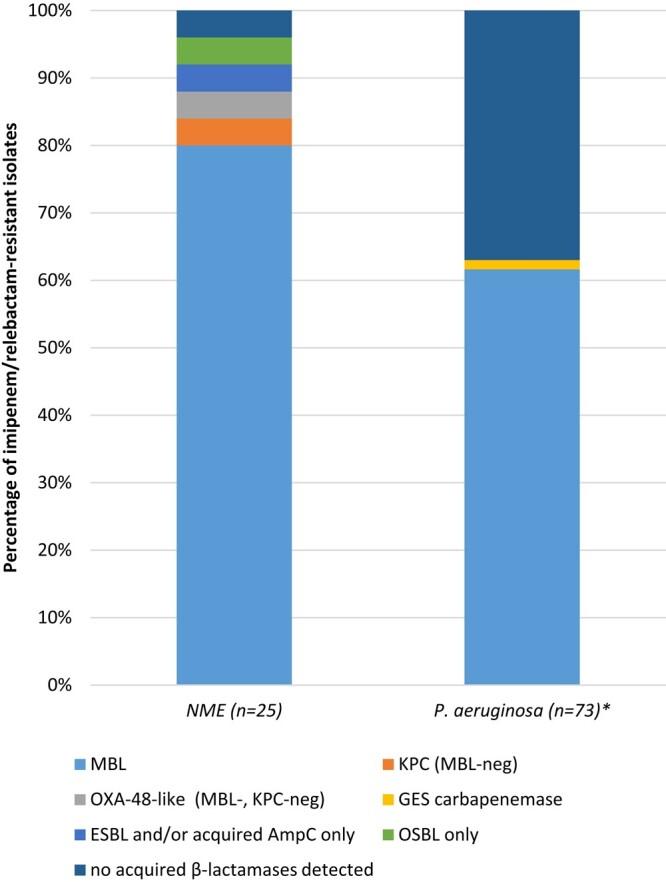
Of all non-Morganellaceae Enterobacterales (NME) isolates (= 4100), 98.8% were imipenem/relebactam susceptible. Most NME were also susceptible to imipenem alone (94.7%) and meropenem (97.3%); percent susceptible values for non-carbapenem β-lactam comparators were lower (68%-80%). Imipenem/relebactam retained activity against 96.4%, 70.8% and 70.6% of MDR, difficult-to-treat resistant (DTR) and meropenem-non-susceptible NME, respectively, and inhibited 93.1% of KPC-carrying and 95.5% of ESBL-carrying NME. Of imipenem/relebactam-resistant NME, 21/25 (84.0%) carried an MBL or an OXA-48-like carbapenemase. Of all isolates (= 738), 82.8% were imipenem/relebactam susceptible; percent susceptible values for all β-lactam comparators, including carbapenems (imipenem, meropenem) were 61.5%-74.7%. Less than 20% of MDR and DTR isolates, and 41% of meropenem-non-susceptible isolates were imipenem/relebactam susceptible. Of imipenem/relebactam-resistant isolates, 61.6% carried an MBL and 37.0% did not possess any acquired β-lactamase genes.
CONCLUSIONS
Based on data, imipenem/relebactam, if licensed in South Korea, may be a viable treatment option for many hospitalized patients infected with common Gram-negative pathogens including NME exhibiting MDR, DTR and carbapenem resistance and many β-lactam-resistant phenotypes of .
目的
评估韩国医疗中心收集的近期革兰氏阴性病原体对亚胺培南/瑞来巴坦及对照药物的敏感性。
方法
2018年至2021年,韩国六家医院每年从患有血流感染、腹腔感染、下呼吸道感染和泌尿系统感染的患者中收集多达250株连续的需氧或兼性革兰氏阴性病原体。采用CLSI肉汤微量稀释法测定最低抑菌浓度(MIC),并根据2023年CLSI标准进行解读。对大多数亚胺培南/瑞来巴坦、亚胺培南或头孢洛扎/他唑巴坦不敏感的分离株,通过聚合酶链反应(PCR)或全基因组测序(WGS)筛查β-内酰胺酶基因。
结果
在所有非摩根菌属肠杆菌科(NME)分离株(=4100株)中,98.8%对亚胺培南/瑞来巴坦敏感。大多数NME对单独使用的亚胺培南(94.7%)和美罗培南(97.3%)也敏感;非碳青霉烯类β-内酰胺对照药物的敏感率较低(68%-80%)。亚胺培南/瑞来巴坦对多重耐药(MDR)、难治性耐药(DTR)和美罗培南不敏感的NME分别有96.4%、70.8%和70.6%的活性,并抑制了93.1%携带KPC和95.5%携带超广谱β-内酰胺酶(ESBL)的NME。在亚胺培南/瑞来巴坦耐药的NME中,21/25(84.0%)携带金属β-内酰胺酶(MBL)或OXA-48样碳青霉烯酶。在所有分离株(=738株)中,82.8%对亚胺培南/瑞来巴坦敏感;所有β-内酰胺对照药物(包括碳青霉烯类药物(亚胺培南、美罗培南))的敏感率为61.5%-74.7%。MDR和DTR分离株中,对亚胺培南/瑞来巴坦敏感的不到20%,美罗培南不敏感的分离株中这一比例为41%。在亚胺培南/瑞来巴坦耐药的分离株中,61.6%携带MBL,37.0%未携带任何获得性β-内酰胺酶基因。
结论
基于这些数据,如果在韩国获得许可,亚胺培南/瑞来巴坦可能是许多感染常见革兰氏阴性病原体(包括表现出MDR、DTR和碳青霉烯耐药的NME以及许多β-内酰胺耐药表型)的住院患者的可行治疗选择。
 Zotero 插件