
2018 - 2022年以色列收集的革兰氏阴性病原体对头孢洛扎/他唑巴坦、亚胺培南/瑞来巴坦及对照药物的敏感性:SMART研究
Susceptibility of Gram-negative pathogens collected in Israel to ceftolozane/tazobactam, imipenem/relebactam and comparators: SMART 2018-22.
作者信息
Wise Mark G, DeRyke C Andrew, Alekseeva Irina, Siddiqui Fakhar, Young Katherine, Motyl Mary R, Sahm Daniel F
机构信息
IHMA, Schaumburg, IL, USA.
MSD, Dubai, United Arab Emirates.
出版信息
JAC Antimicrob Resist. 2024 Sep 17;6(5):dlae150. doi: 10.1093/jacamr/dlae150. eCollection 2024 Oct.
OBJECTIVES
To assess the antimicrobial activity of ceftolozane/tazobactam, imipenem/relebactam and comparator agents against clinical isolates of Gram-negative bacilli collected in Israel from 2018 to 2022.
METHODS
Six clinical laboratories each collected up to 250 consecutive Gram-negative isolates per year from patients with bloodstream, intra-abdominal, lower respiratory tract and urinary tract infections. MICs were determined by CLSI broth microdilution and interpreted with 2024 EUCAST breakpoints. Acquired β-lactamase gene carriage was investigated for most ceftolozane/tazobactam- and imipenem/relebactam-resistant isolates.
RESULTS
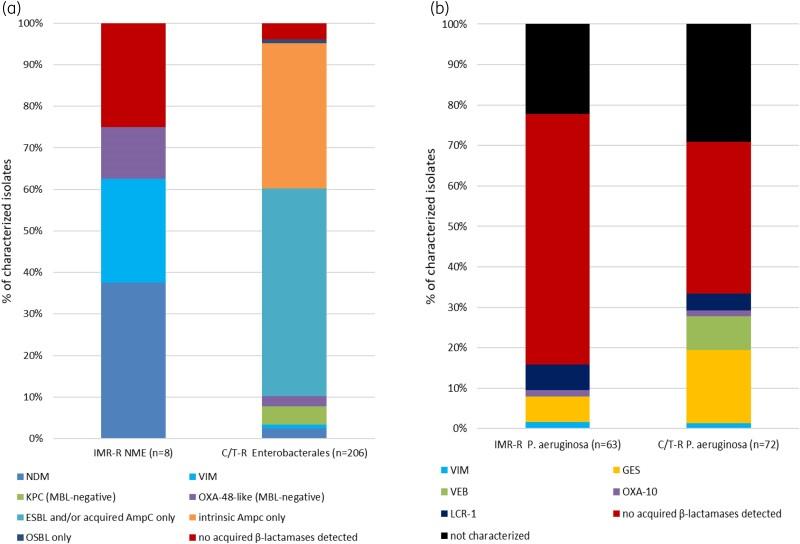
Among the full collection of Enterobacterales (= 4420), 95.1% were susceptible to ceftolozane/tazobactam, including 95.3% of putative AmpC/ESBL-positive, non-carbapenem-resistant Enterobacterales (CRE) phenotype and 86.6% of AmpC/ESBL-positive, non-CRE phenotype . Overall, 99.8% of non- Enterobacterales ( = 3723) were imipenem/relebactam susceptible including 98% of the MDR isolates. Most isolates (= 1182) were inhibited by ceftolozane/tazobactam (93.9% susceptible) and imipenem/relebactam (94.7%). Imipenem/relebactam retained activity against ≥78% of cefepime-resistant, ceftazidime-resistant, and piperacillin/tazobactam-resistant , while ceftolozane/tazobactam inhibited the greatest percentage of meropenem-resistant (67.4%) among comparator β-lactam antimicrobials. Molecular characterization showed the majority of imipenem/relebactam-resistant Enterobacterales harboured a metallo-β-lactamase, while half of the ceftolozane/tazobactam-resistant Enterobacterales carried an acquired ESBL or AmpC. Most of the imipenem/relebactam- and ceftolozane/tazobactam-resistant characterized did not possess acquired β-lactamases.
CONCLUSIONS
Recent clinical isolates of Enterobacterales and collected in Israel were highly susceptible to ceftolozane/tazobactam and imipenem/relebactam.
目的
评估头孢洛扎/他唑巴坦、亚胺培南/瑞来巴坦及对照药物对2018年至2022年在以色列收集的革兰氏阴性杆菌临床分离株的抗菌活性。
方法
六个临床实验室每年从患有血流感染、腹腔感染、下呼吸道感染和尿路感染的患者中各收集多达250株连续的革兰氏阴性分离株。采用CLSI肉汤微量稀释法测定最低抑菌浓度(MIC),并根据2024年欧洲药敏试验委员会(EUCAST)的断点进行判读。对大多数对头孢洛扎/他唑巴坦和亚胺培南/瑞来巴坦耐药的分离株进行获得性β-内酰胺酶基因携带情况调查。
结果
在全部肠杆菌目细菌(=4420株)中,95.1%对头孢洛扎/他唑巴坦敏感,其中包括95.3%假定的产AmpC酶/超广谱β-内酰胺酶(ESBL)阳性、非碳青霉烯类耐药肠杆菌目细菌(CRE)表型以及86.6%的产AmpC酶/ESBL阳性、非CRE表型。总体而言,99.8%的非肠杆菌目细菌(=3723株)对亚胺培南/瑞来巴坦敏感,其中包括98%的多重耐药(MDR)分离株。大多数分离株(=1182株)对头孢洛扎/他唑巴坦(93.9%敏感)和亚胺培南/瑞来巴坦(94.7%)敏感。亚胺培南/瑞来巴坦对≥78%的对头孢吡肟耐药、对头孢他啶耐药和对哌拉西林/他唑巴坦耐药的菌株仍有活性,而在对照β-内酰胺类抗菌药物中,头孢洛扎/他唑巴坦对美罗培南耐药菌株的抑制率最高(67.4%)。分子特征分析表明,大多数对亚胺培南/瑞来巴坦耐药的肠杆菌目细菌携带金属β-内酰胺酶,而对头孢洛扎/他唑巴坦耐药的肠杆菌目细菌中有一半携带获得性ESBL或AmpC。大多数已鉴定的对亚胺培南/瑞来巴坦和头孢洛扎/他唑巴坦耐药的菌株不具有获得性β-内酰胺酶。
结论
近期在以色列收集的肠杆菌目细菌和其他细菌临床分离株对头孢洛扎/他唑巴坦和亚胺培南/瑞来巴坦高度敏感。
 Zotero 插件