
抗体作为结核病的临床工具。
Antibodies as clinical tools for tuberculosis.
机构信息
Biomedical Sciences and Molecular Biology, College of Public Health, Medical and Veterinary Sciences, James Cook University, Douglas, QLD, Australia.
Australian Institute of Tropical Health and Medicine, James Cook University, Douglas, QLD, Australia.
出版信息
Front Immunol. 2023 Dec 14;14:1278947. doi: 10.3389/fimmu.2023.1278947. eCollection 2023.
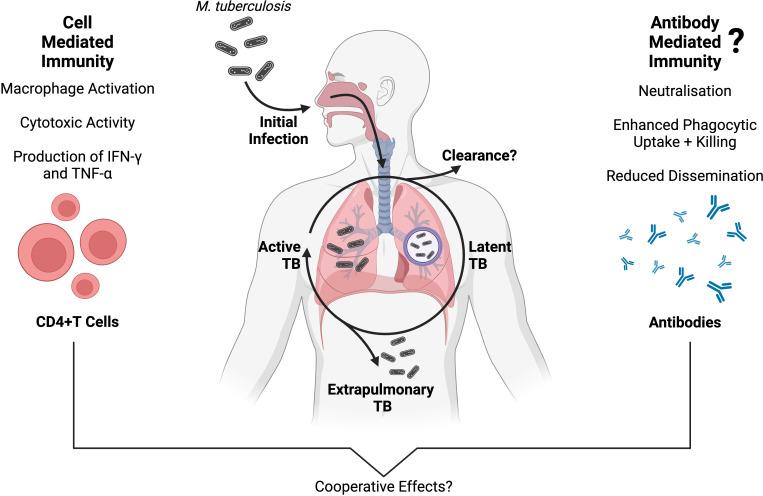
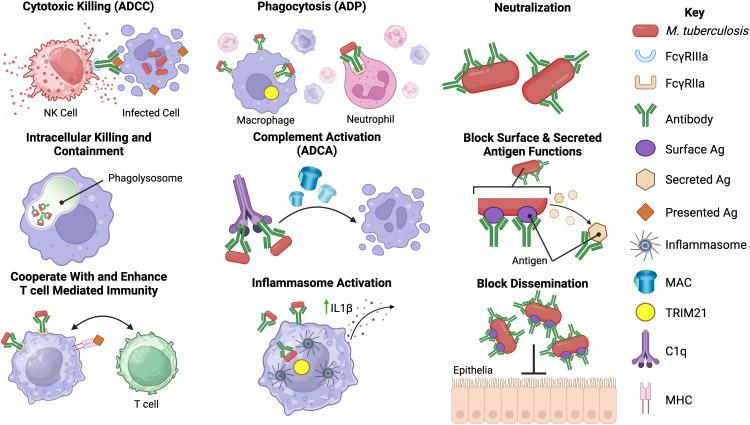
Tuberculosis (TB) is a leading cause of morbidity and mortality worldwide. Global research efforts to improve TB control are hindered by insufficient understanding of the role that antibodies play in protective immunity and pathogenesis. This impacts knowledge of rational and optimal vaccine design, appropriate diagnostic biomarkers, and development of therapeutics. Traditional approaches for the prevention and diagnosis of TB may be less efficacious in high prevalence, remote, and resource-poor settings. An improved understanding of the immune response to the causative agent of TB, (), will be crucial for developing better vaccines, therapeutics, and diagnostics. While memory CD4+ T cells and cells and cytokine interferon gamma (IFN-g) have been the main identified correlates of protection in TB, mounting evidence suggests that other types of immunity may also have important roles. TB serology has identified antibodies and functional characteristics that may help diagnose infection and distinguish between different TB disease states. To date, no serological tests meet the World Health Organization (WHO) requirements for TB diagnosis, but multiplex assays show promise for improving the sensitivity and specificity of TB serodiagnosis. Monoclonal antibody (mAb) therapies and serum passive infusion studies in murine models of TB have also demonstrated some protective outcomes. However, animal models that better reflect the human immune response to are necessary to fully assess the clinical utility of antibody-based TB prophylactics and therapeutics. Candidate TB vaccines are not designed to elicit an -specific antibody response, but evidence suggests BCG and novel TB vaccines may induce protective antibodies. The potential of the humoral immune response in TB monitoring and control is being investigated and these studies provide important insight into the functional role of antibody-mediated immunity against TB. In this review, we describe the current state of development of antibody-based clinical tools for TB, with a focus on diagnostic, therapeutic, and vaccine-based applications.
结核病(TB)是全球发病率和死亡率的主要原因。由于对抗体在保护性免疫和发病机制中的作用认识不足,全球改善结核病控制的研究工作受到阻碍。这影响了对合理和最佳疫苗设计、适当的诊断生物标志物以及治疗方法的开发的了解。在高患病率、偏远和资源匮乏的环境中,传统的预防和诊断结核病的方法可能效果不佳。因此,对导致结核病的病原体的免疫反应的深入了解对于开发更好的疫苗、治疗方法和诊断方法至关重要。虽然记忆 CD4+T 细胞和细胞和细胞因子干扰素γ(IFN-g)已被确定为结核病保护的主要相关因素,但越来越多的证据表明,其他类型的免疫也可能具有重要作用。结核病血清学已经确定了抗体和功能特征,这些可能有助于诊断结核感染并区分不同的结核病疾病状态。迄今为止,没有一种血清学检测符合世界卫生组织(WHO)对结核病诊断的要求,但多重检测方法显示出提高结核病血清学诊断的敏感性和特异性的潜力。在结核病的小鼠模型中,单克隆抗体(mAb)治疗和血清被动输注研究也证明了一些保护作用。然而,需要更好地反映人类对的免疫反应的动物模型来充分评估基于抗体的结核病预防和治疗的临床实用性。候选结核病疫苗的设计不是为了引起针对的抗体反应,但有证据表明 BCG 和新型结核病疫苗可能会诱导保护性的抗体。正在研究体液免疫反应在结核病监测和控制中的潜力,这些研究为针对结核病的抗体介导免疫的功能作用提供了重要的见解。在这篇综述中,我们描述了用于结核病的基于抗体的临床工具的当前开发状态,重点介绍了诊断、治疗和疫苗应用。

 Zotero 插件