
厄瓜多尔的微塑料:环境与健康风险评估挑战综述
Microplastics in Ecuador: A review of environmental and health-risk assessment challenges.
作者信息
Vélez-Terreros Pamela Y, Romero-Estévez David, Yánez-Jácome Gabriela S
机构信息
Centro de Estudios Aplicados en Química, Pontificia Universidad Católica del Ecuador, Av. 12 de Octubre 1076 y Roca, Quito, Pichincha, 170525, Ecuador.
出版信息
Heliyon. 2023 Dec 3;10(1):e23232. doi: 10.1016/j.heliyon.2023.e23232. eCollection 2024 Jan 15.
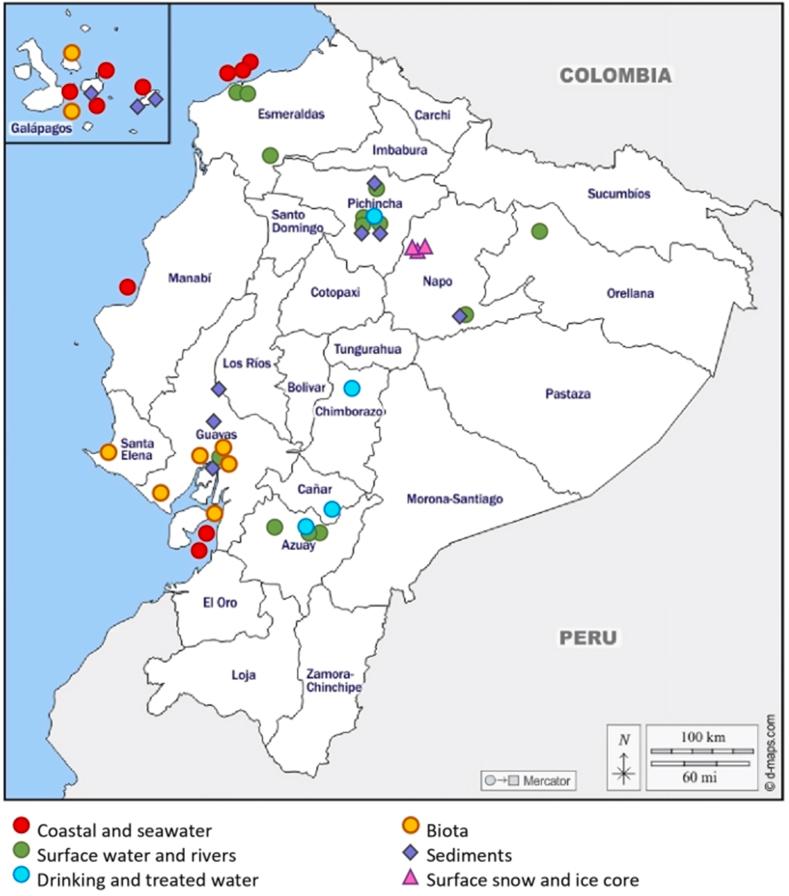
Pollution from plastic debris and microplastics (MPs) is a worldwide issue. Classified as emerging contaminants, MPs have become widespread and have been found not only in terrestrial and aquatic ecosystems but also within the food chain, which affects both the environment and human health. Since the outbreak of COVID-19, the consumption of single-use plastics has drastically increased, intensifying mismanaged plastic waste in countries such as Ecuador. Therefore, the aim of this review is to 1) summarize the state of MP-related knowledge, focusing on studies conducted with environmental matrices, biota, and food, and 2) analyze the efforts by different national authorities and entities in Ecuador to control MP contamination. Results showed a limited number of studies have been done in Ecuador, which have mainly focused on the surface water of coastal areas, followed by studies on sediment and food. MPs were identified in all samples, indicating the lack of wastewater management policies, deficient management of solid wastes, and the contribution of anthropogenic activities such as artisanal fishing and aquaculture to water ecosystem pollution, which affects food webs. Moreover, studies have shown that food contamination can occur through atmospheric deposition of MPs; however, ingredients and inputs from food production, processing, and packaging, as well as food containers, contribute to MP occurrence in food. Further research is needed to develop more sensitive, precise, and reliable detection methods and assess MPs' impact on terrestrial and aquatic ecosystems, biota, and human health. In Ecuador specifically, implementing wastewater treatment plants in major cities, continuously monitoring MP coastal contamination, and establishing environmental and food safety regulations are crucial. Additionally, national authorities need to develop programs to raise public awareness of plastic use and its environmental effects, as well as MP exposure's effects on human health.
塑料碎片和微塑料造成的污染是一个全球性问题。微塑料被归类为新兴污染物,已广泛存在,不仅在陆地和水生生态系统中被发现,还存在于食物链中,这对环境和人类健康都有影响。自新冠疫情爆发以来,一次性塑料的消费量急剧增加,加剧了厄瓜多尔等国管理不善的塑料垃圾问题。因此,本综述的目的是:1)总结与微塑料相关的知识状况,重点关注针对环境基质、生物群和食物开展的研究;2)分析厄瓜多尔不同国家当局和实体为控制微塑料污染所做的努力。结果显示,厄瓜多尔开展的研究数量有限,主要集中在沿海地区的地表水,其次是沉积物和食物方面的研究。在所有样本中均检测到了微塑料,这表明缺乏废水管理政策、固体废物管理不善,以及个体渔业和水产养殖等人为活动对水生态系统污染的影响,进而影响了食物网。此外,研究表明,微塑料可通过大气沉降造成食物污染;然而,食品生产、加工和包装的成分及投入,以及食品容器,也导致了微塑料在食物中的出现。需要进一步开展研究,以开发更灵敏、精确和可靠的检测方法,并评估微塑料对陆地和水生生态系统、生物群以及人类健康的影响。具体到厄瓜多尔而言,在主要城市建设污水处理厂、持续监测沿海地区的微塑料污染,以及制定环境和食品安全法规至关重要。此外,国家当局需要制定相关计划,提高公众对塑料使用及其环境影响的认识,以及微塑料暴露对人类健康的影响。


 Zotero 插件