
多种慢性疾病、健康生活方式与中国老年人认知障碍风险的关系:一项纵向队列研究。
Multimorbidity, healthy lifestyle, and the risk of cognitive impairment in Chinese older adults: a longitudinal cohort study.
机构信息
Tianjin Key Laboratory of Food Science and Health, School of Medicine, Nankai University, No. 94 Weijin Road, 300071, Tianjin, China.
Department of Occupational and Environmental Health, School of Public Health, Tianjin Medical University, 300070, Tianjin, China.
出版信息
BMC Public Health. 2024 Jan 2;24(1):46. doi: 10.1186/s12889-023-17551-1.
BACKGROUND
Evidence on the association between multimorbidity and cognitive impairment in Chinese older population is limited. In addition, whether a healthy lifestyle can protect cognitive function in multimorbid older population remains unknown.
METHODS
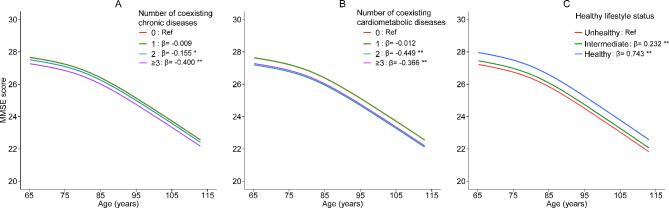
A total of 6116 participants aged ≥ 65 years from the Chinese Longitudinal Healthy Longevity Survey were followed up repeatedly. The number of coexisting chronic diseases was used for assessing multimorbidity and cardiometabolic multimorbidity. Three lifestyle statuses (unhealthy, intermediate, and healthy) were defined based on a lifestyle score covering smoking, alcohol drinking, body mass index, outdoor activities, and dietary pattern. Cognitive impairment was defined as the Mini-Mental State Examination score < 24. A modified Poisson regression model with robust error variance was used to assess the associations between multimorbidity, healthy lifestyle, and cognitive impairment.
RESULTS
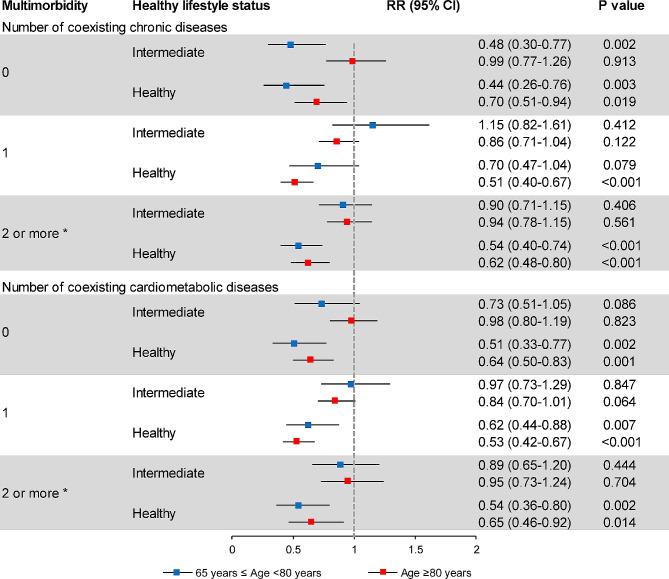
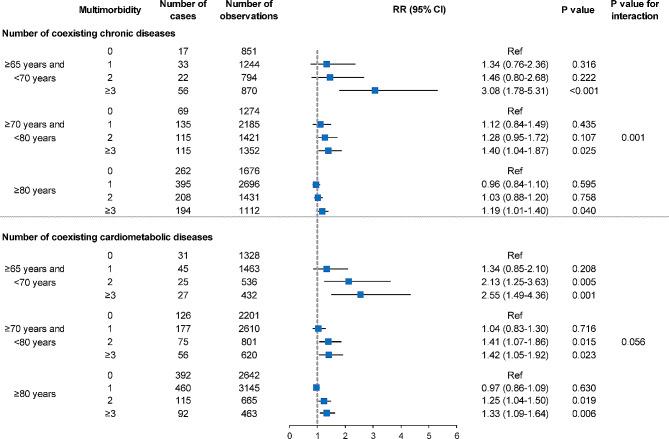
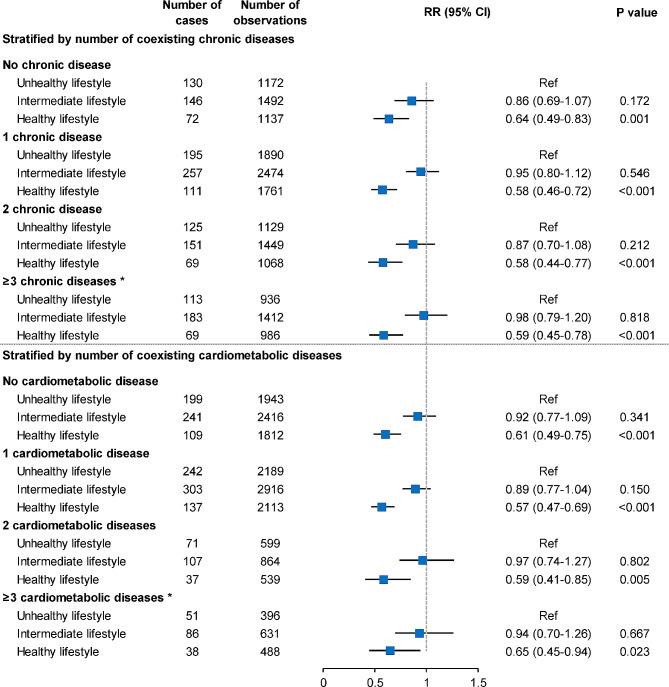
During a median follow-up period of 5.8 years, 1621 incident cases of cognitive impairment were identified. The relative risk (RR) of cognitive impairment associated with heavy multimorbidity burden (≥ 3 conditions) was 1.39 (95% confidence interval: 1.22-1.59). This association declined with age, with RRs being 3.08 (1.78-5.31), 1.40 (1.04-1.87), and 1.19 (1.01-1.40) in subjects aged < 70 years, ≥ 70 and < 80 years, and ≥ 80 years, respectively (P for interaction = 0.001). Compared to unhealthy lifestyle, a healthy lifestyle was related to an approximately 40% reduced risk of cognitive impairment regardless of multimorbidity burden. Among the 5 lifestyle factors assessed, daily outdoor activities and a healthy dietary pattern showed convincing protective effects on cognitive function.
CONCLUSIONS
The relationship between multimorbidity and cognitive impairment is age-dependent but remains significant in the population aged 80 years or older. A healthy lifestyle may protect cognitive function regardless of the multimorbidity burden. These findings highlight the importance of targeting individuals with heavy multimorbidity burden and promoting a heathy lifestyle to prevent cognitive impairment in Chinese older population.
背景
关于中国老年人群中多种疾病与认知障碍之间关联的证据有限。此外,健康的生活方式是否能保护患有多种疾病的老年人群的认知功能仍不清楚。
方法
共有 6116 名年龄≥65 岁的中国长寿纵向研究参与者接受了多次随访。采用共存慢性疾病数量来评估多种疾病和心血管代谢多种疾病。根据涵盖吸烟、饮酒、体重指数、户外活动和饮食模式的生活方式评分,将生活方式状态定义为不健康、中间和健康三种。认知障碍定义为简易精神状态检查评分<24 分。采用具有稳健误差方差的校正泊松回归模型来评估多种疾病、健康生活方式与认知障碍之间的关联。
结果
在中位随访时间为 5.8 年期间,共发现 1621 例认知障碍新发病例。与重度多种疾病负担(≥3 种疾病)相关的认知障碍相对风险(RR)为 1.39(95%置信区间:1.22-1.59)。这种关联随年龄而变化,在年龄<70 岁、≥70 岁且<80 岁以及≥80 岁的人群中,RR 分别为 3.08(1.78-5.31)、1.40(1.04-1.87)和 1.19(1.01-1.40)(交互检验 P=0.001)。与不健康的生活方式相比,无论多种疾病负担如何,健康的生活方式与认知障碍风险降低约 40%相关。在所评估的 5 种生活方式因素中,每天户外活动和健康的饮食模式对认知功能有明显的保护作用。
结论
多种疾病与认知障碍之间的关系随年龄而异,但在 80 岁及以上的人群中仍然显著。健康的生活方式可能保护认知功能,无论多种疾病负担如何。这些发现强调了针对患有重度多种疾病负担的个体和促进健康生活方式以预防中国老年人群认知障碍的重要性。
 Zotero 插件