
2001年至2021年墨西哥老年人认知功能的队列变化
Cohort Changes in Cognitive Function Among Mexican Older Adults from 2001 to 2021.
作者信息
Ponce Julián, Beltrán-Sánchez Hiram
机构信息
Department of Community Health Sciences, Fielding School of Public Health, University of California Los Angeles (UCLA), Los Angeles, California, USA.
UCLA California Center for Population Research, University of California Los Angeles (UCLA), Los Angeles, California, USA.
出版信息
Gerontologist. 2025 Jun 12;65(7). doi: 10.1093/geront/gnaf143.
BACKGROUND AND OBJECTIVES
Multimorbidity (2+ chronic conditions) associated with faster cognitive decline among older adults, yet longitudinal evidence from low- and middle-income countries, including Mexico, remains limited. This study examines cohort differences in the annual rate of cognitive decline, measured by global cognitive function scores (GCFS), and tests whether the association between multimorbidity and cognitive decline differs between two cohorts aged 50-60 in 2001 and 2012.
RESEARCH DESIGN AND METHODS
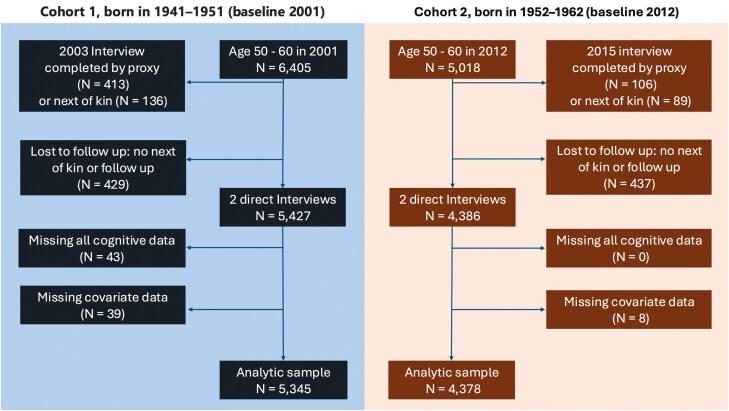
We assess two 10-year birth cohorts (Cohort 1: born 1941-1951, n = 5,345 Cohort 2: born 1952-1962, n = 4,378), at 3 time points (Cohort 1: 2001, 2003, and 2012; Cohort 2: 2012, 2015, 2021), at ages 50-60 at baseline. We examine cohort differences in average annual GCFS changes by fitting growth curve models incorporating random intercepts and slopes.
RESULTS
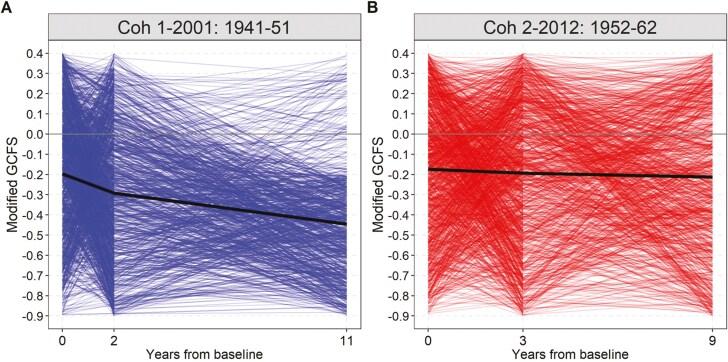
Two key findings emerged. First, the earlier cohort (Cohort 1, 2001), experienced a faster average annual rate of decline in GCFS than the recent cohort (Cohort 2, 2012). Second, the link between multimorbidity and cognitive decline did not significantly differ between cohorts net of possible confounders.
DISCUSSION AND IMPLICATIONS
Our findings advance our understanding of cohort differences in cognitive decline and how the influence of multimorbidity on cognitive decline has evolved in Mexico. The slower rate of decline among the recent cohort suggests potential improvements in cognitive reserve due to educational improvements. Improvements in healthcare access over the past decades may have mitigated the negative consequences of multimorbidity on cognitive decline, potentially explaining the absence of cohort differences.
背景与目的
多种慢性病(两种及以上慢性疾病)与老年人认知功能衰退加速有关,但来自包括墨西哥在内的低收入和中等收入国家的纵向证据仍然有限。本研究通过全球认知功能评分(GCFS)来考察认知衰退年率的队列差异,并检验2001年和2012年两个年龄在50至60岁的队列中,多种慢性病与认知衰退之间的关联是否存在差异。
研究设计与方法
我们评估了两个10年出生队列(队列1:出生于1941年至1951年,n = 5345;队列2:出生于1952年至1962年,n = 4378),在3个时间点进行评估(队列1:2001年、2003年和2012年;队列2:2012年、2015年、2021年),基线时年龄在50至60岁。我们通过拟合包含随机截距和斜率的生长曲线模型,来考察平均每年GCFS变化的队列差异。
结果
出现了两个关键发现。第一,较早的队列(队列1,2001年)的GCFS平均年衰退率比近期队列(队列2,2012年)更快。第二,在排除可能的混杂因素后,两个队列中多种慢性病与认知衰退之间的联系没有显著差异。
讨论与启示
我们的研究结果增进了我们对认知衰退队列差异的理解,以及在墨西哥多种慢性病对认知衰退的影响是如何演变的。近期队列中较慢的衰退率表明,由于教育水平的提高,认知储备可能有所改善。过去几十年医疗保健可及性的改善可能减轻了多种慢性病对认知衰退的负面影响,这可能解释了队列差异的不存在。

 Zotero 插件