
共病模式对糖尿病患者身体和认知功能的影响:中国中老年成年人的纵向队列研究
The effect of multimorbidity patterns on physical and cognitive function in diabetes patients: a longitudinal cohort of middle-aged and older adults in China.
作者信息
Zhou Xieting, Qin Juan-Juan, Li Hang, Chen Jiyu, Zhang Qing, Ye Xujun
机构信息
School of Nursing, Department of Geriatric, Zhongnan Hospital of Wuhan University, Wuhan, China.
出版信息
Front Aging Neurosci. 2024 May 14;16:1388656. doi: 10.3389/fnagi.2024.1388656. eCollection 2024.
BACKGROUND
The prevalence of diabetes has increased rapidly, and comorbid chronic conditions are common among diabetes patients. However, little is known about the pattern of multimorbidity in diabetes patients and the effect on physical and cognitive function. This study aimed to assess the disease clusters and patterns of multimorbidity in diabetes patients using a novel latent class analysis (LCA) approach in middle-aged and older adults and explore the association between different clusters of multimorbidity in diabetes and the effect on physical and cognitive function.
METHODS
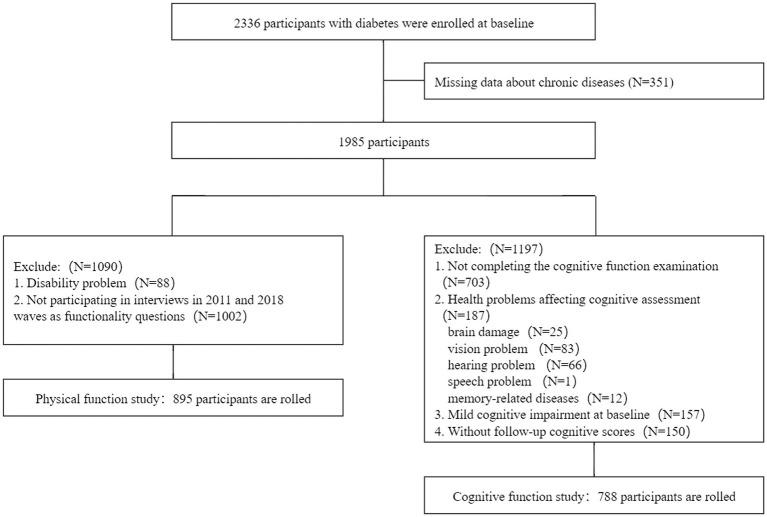
This national observational study included 1,985 diabetes patients from the four waves of the China Health and Retirement Longitudinal Study (CHARLS) in 2011 to 2018. Thirteen chronic diseases were used in latent class analysis to identify the patterns of multimorbidity in diabetes, which span the cardiovascular, physical, psychological, and metabolic systems. Cognitive function is assessed via a structured questionnaire in three domains: memory, executive function, and orientation. We combined activities of daily living (ADL) with instrumental activities of daily living (IADL) to measure physical function. Linear mixed models and negative binomial regression models were used to analyze the association between patterns of multimorbidity in diabetes and the effect on cognitive function and disability, respectively.
RESULTS
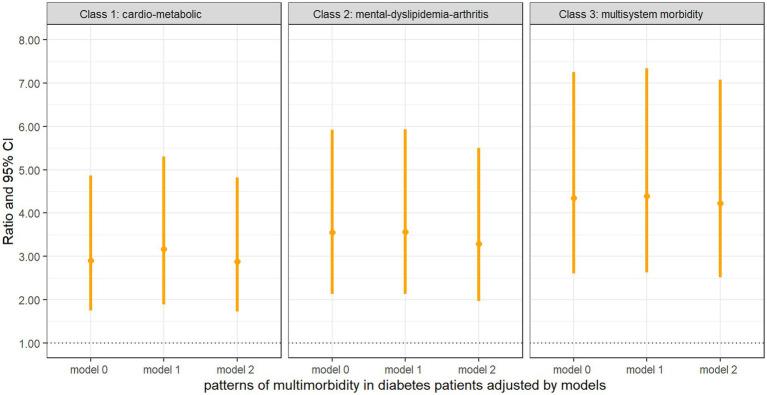
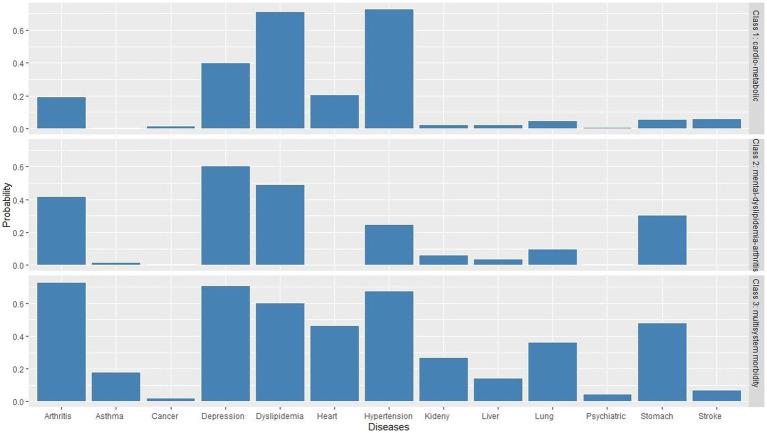
A sample of 1,985 diabetic patients was identified, of which 1,889 (95.2%) had multimorbidity; their average age was 60.6 years (standard deviation (SD) = 9.5), and 53.1% were women. Three clusters were identified: "cardio-metabolic" ( = 972, 51.5%), "mental-dyslipidemia-arthritis" ( = 584, 30.9%), and "multisystem morbidity" ( = 333, 17.6%). Compared with diabetes alone, the "multisystem morbidity" class had an increased association with global cognitive decline. All patterns of multimorbidity were associated with an increased risk of memory decline and disability; however, the "multisystem morbidity" group also had the strongest association and presented a higher ADL-IADL disability (ratio = 4.22, 95% CI = 2.52, 7.08) and decline in memory Z scores ( = -0.322, 95% CI = -0.550, -0.095, = 0.0058).
CONCLUSION
Significant longitudinal associations between different patterns of multimorbidity in diabetes patients and memory decline and disability were observed in this study. Future studies are needed to understand the underlying mechanisms and common risk factors for multimorbidity in diabetes patients and to propose treatments that are more effective.
背景
糖尿病患病率迅速上升,糖尿病患者中合并慢性疾病很常见。然而,对于糖尿病患者的共病模式及其对身体和认知功能的影响知之甚少。本研究旨在采用一种新颖的潜在类别分析(LCA)方法,评估中老年糖尿病患者的疾病聚类和共病模式,并探讨糖尿病中共病的不同聚类之间的关联及其对身体和认知功能的影响。
方法
这项全国性观察性研究纳入了2011年至2018年中国健康与养老追踪调查(CHARLS)四个波次中的1985名糖尿病患者。在潜在类别分析中使用了13种慢性疾病来确定糖尿病患者的共病模式,这些疾病涵盖心血管、身体、心理和代谢系统。认知功能通过结构化问卷在三个领域进行评估:记忆、执行功能和定向。我们将日常生活活动(ADL)与工具性日常生活活动(IADL)相结合来衡量身体功能。分别使用线性混合模型和负二项回归模型分析糖尿病中共病模式与对认知功能和残疾影响之间的关联。
结果
确定了1985名糖尿病患者的样本,其中1889名(95.2%)患有共病;他们的平均年龄为60.6岁(标准差(SD)=9.5),女性占53.1%。确定了三个聚类:“心血管-代谢”(n=972,51.5%)、“精神-血脂异常-关节炎”(n=584,30.9%)和“多系统发病”(n=333,17.6%)。与单纯糖尿病相比,“多系统发病”类别与整体认知下降的关联增加。所有共病模式都与记忆衰退和残疾风险增加相关;然而,“多系统发病”组的关联最强,且日常生活活动-工具性日常生活活动残疾率更高(比值=4.22,95%CI=2.52,7.08),记忆Z评分下降幅度更大(β=-0.322,95%CI=-0.550,-0.095,P=0.0058)。
结论
本研究观察到糖尿病患者不同共病模式与记忆衰退和残疾之间存在显著的纵向关联。未来需要开展研究以了解糖尿病患者共病的潜在机制和共同危险因素,并提出更有效的治疗方法。

 Zotero 插件